


 100 / 112

ning is required during the fourth year, while harvest takes
place after eight years from planting, so that another 50% of
plants is left to grow. These plants left to grow are in fact al-
ready in their fourth year, because they have grown from the
stumps left after the thinning. This solution increases pro-
ductivity, but presents various difficulties in management (du-
ring cultivation but especially during harvest) if compared to
more spacious layouts, such as the 4x4 m, 5x4 m, and also
the 5x5 m, in which case harvest occurs between the eighth
and tenth year after planting.
For biomass production (mainly production of wood chips) it
is necessary to reduce spacing drastically, because harvest
is generally carried out every two or three years. The most
advantageous layout has an inter-row space of 2 m, with
plants every 50 cm. Before transplant, and especially with
virgin soil, it is recommended to carry out a preliminary wee-
ding with non-selective herbicides, to prevent the growth of
any plant which may compete with the young trees.
Basal fertilization
As with all poliennial woody crops, physical preparation of the
soil must be followed by thorough basal fertilization, better if
organic. This will be very useful in the first stages of growth
of the plant, because when the tree has reached maturity the
abundant foliage of the Paulownia does not impoverish the
soil of organic substances, on the contrary, it enriches it.
In any case, the plant’s intake of nitrogen, phosphorous and
potassium can be compensated by implementing specific fer-
tilizing programmes, which can be applied using machinery
such as the single disk or twin disk broadcaster for synthe-
tic fertilizers, or manure spreader and slurry spreader for or-
ganic fertilizers.
Transplant
If the propagation materials are potted seedlings, transplan-
ting is generally carried out manually. The seedlings are car-
ried in their bins to the field by a small tower and put direc-
tly in the holes that have been prepared beforehand (on the
bottom of which there may be some organic fertilizer). The si-
des of the holes are then filled with earth, after which about
2 l of water can be applied. To prevent the eventual growth
of weeds it is best to cover the soil around the plant with mul-
ch.
relazione agli ingombri delle attrezzature necessarie per la
coltivazione (trattori, falciatrici, atomizzatori, ecc.), ma an-
che e soprattutto della destinazione della piantagione.
Per la produzione di legname da opera sono indicati sesti
da 3x3 m o 4x3 m, per i quali si deve effettuare un dirada-
mento al 50% al 4° anno, per poi raccogliere all’8° anno il
prodotto piantumato all’inizio, in modo da lasciare un ulte-
riore 50% di piante già al 4° anno di vita, ovvero quelle ri-
cresciute dalle ceppaie su cui è stato effettuato il dirada-
mento. Con tale soluzione la produttività ne guadagna, ma
si creano diverse difficoltà gestionali (nella coltivazione, ma
soprattutto in fase di abbattimento) rispetto a schemi di im-
pianto più ampi, come 4x4 m, 5x4 m o anche 5x5 m, nei
quali la raccolta viene eseguita in un’unica soluzione tra
l’8° e il 10° anno dalla messa a dimora.
Per la produzione di biomassa (sostanzialmente sotto for-
ma di cippato) è giocoforza obbligatorio considerare sche-
mi di impianto molto più fitti, dato che la raccolta prevede
tipicamente turni di 2-3 anni; i sesti più vantaggiosi preve-
dono allora un’interfila di 2 m, con piante ogni 50 cm.
Prima del trapianto, e specie sui terreni vergini, è opportu-
no effettuare un diserbo con un erbicida totale, in modo da
scongiurare qualsiasi fenomeno di competizione radicale a
danno delle giovani piantine.
Concimazione di fondo
Come per tutte le colture legnose a ciclo poliennale, dopo
la preparazione fisica del terreno si deve effettuare un’at-
tenta concimazione di fondo, molto meglio se di tipo orga-
nico. Ciò risulta oltremodo utile nelle prime fasi di crescita
della pianta, poiché a maturità l’abbondante produzione di
foglie della Paulownia non impoverisce di sostanza organi-
ca il terreno, ma semmai provvede ad un suo arricchimen-
to, grazie all’abbondante produzione di humus. In ogni ca-
so, le asportazioni in termini di azoto, fosforo e potassio
possono essere compensate con programmi specifici di fer-
tilizzazione, attuabili a livello di macchinario con i classici
spandiconcime a disco (o a doppio disco) per i concimi di
sintesi, o con spandiletame e spandiliquame se si opta per
la fertilizzazione organica.
Trapianto
Se il materiale di propagazione è rappresentato da pianti-
98
n. 12/2016
TECNICA
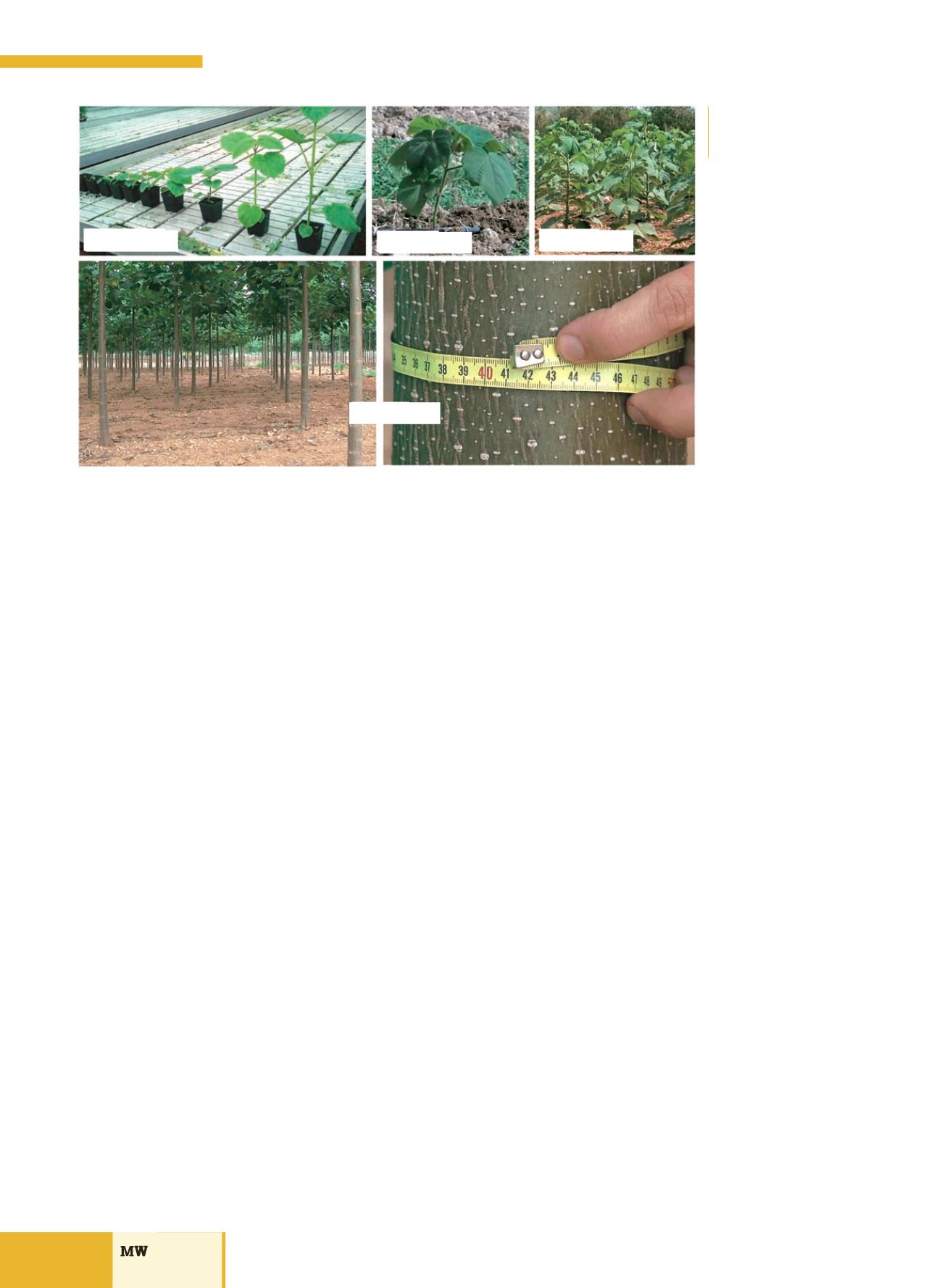
La Paulownia è caratterizzata da
una crescita estremamente rapida
Paulownia is characterized by
extremely rapid growth
in vivaio /
nursery
2 mesi /
2 months
6 mesi /
6 months
2 anni /
2 years