


 95 / 112

di un’azienda come questa innovativi e in grado di com-
petere anche con i giganti del settore. Il solo K105, fiore
all’occhiello e protagonista delle novità di quest’anno, può
vantare ben sei
brevetti. Un anti-
doto alla contraf-
fazione e anche
un “grimaldello”
per conquistare i
segmenti di mer-
cato più pregiati,
ovvero la cliente-
la interessata a
macchine con
prestazioni supe-
riori perché in
grado di recupera-
re l’investimento
utilizzandole in
modo più intenso
e per attività più
redditizie.
Giampiero Moncada
In both cases, economic development has been slowed down
by political unrest. Political uncertainty, although of a completely
different nature, also weighs on the indicators for the next year
with regard to the European market. On the other hand, indi-
cators remain positive for the US, where BCS expects revenues
to increase next year, also thanks to a favourable rate exchange.
Overall, forecasts for the period September 1
st
, 2016/August
31, 2017, indicate an increase of revenues of about 2% for the
agro-greenery sector, and of 5% for the energy sector.
The increase in sales and the good performance registered this
year are due to the feature that has always characterized this
firm and that today more than ever has proven to be the rea-
son behind its success: technological research, and the great
number of patents that make the products of a company such
as this one innovative and able to compete with the giants of
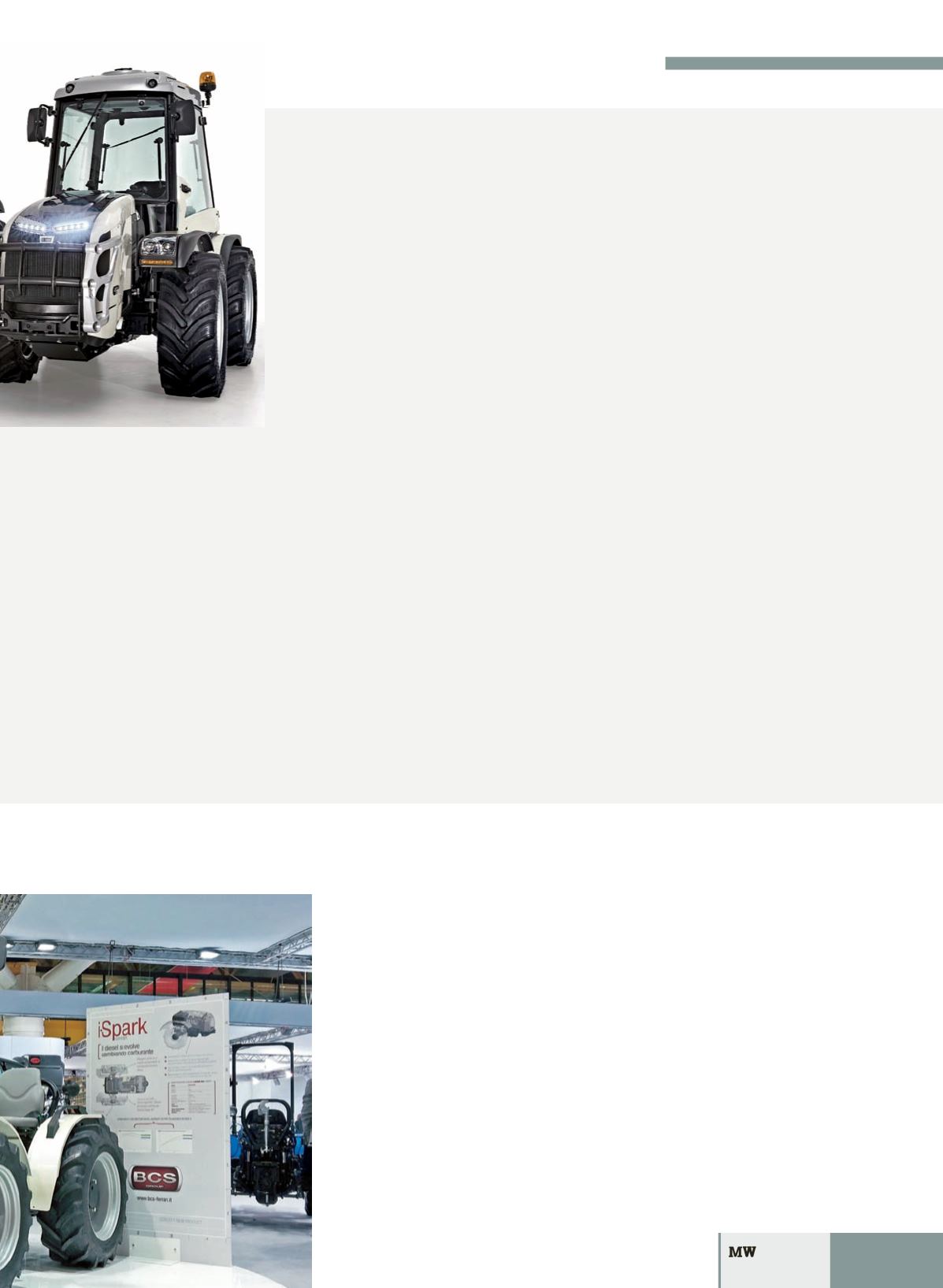
the sector. The K105 alone, feather in the cap and protagonist
among the new products presented this year, has earned six
patents. An effective way to combat counterfeiting and a means
to conquer the most precious segments of the market, clients
interested in machinery with superior performance that allow
to recoup the initial investments using the machinery in a more
intense way and for more profitable activities.
Giampiero Moncada
93
n. 12/2016
Mondo Macchina/MachineryWorld
has interviewed the marketing and
distribution director of BCS Group
Carlo Cislaghi to take a better look
at the short-term programs and to
better understand the strategies
the company intends to implement
You said that there was a very lar-
ge crowd at EIMA but that com-
pared to previous editions there
were few requests for brochures.
Do you think this is unusual? To-
day in fact everybody uses the in-
ternet to look up information...
Yes we did consider this, but it’s not the
only reason. I think there is interest in buying but that decisions are put off in order to wait
and see how economic contexts will develop.
You are not referring only to Italy, am I correct?
No, of course. 80% of our activity is carried out on the European market.Apart from small
variations the situation in Italy is very similar to that of France, Germany and of other coun-
tries. The anticipated growth of the GDP in the Euro area of 1.7% in 2017 is quite optimi-
stic in my
view.Wecontinue to be strong in the national market because we are a historic
brand.Wehave more difficulties in other important foreign markets,such as France and Ger-
many, because we do not sell some products that are in demand, products that we are
however working on.
What is in demand in these countries?
It is not a uniform demand. Countries in Central Europe continuously request hydrostatic
tractors, we do not yet produce them although we have already started to design them.
There is then a small demand for haying machines, and at present there are no plans for
the production of these.With regard to electricity generating units the demand is for mo-
re powerful machines with more sophisticated ecological features, coming from some spe-
cific markets such as Switzerland, Germany and Austria.
Speaking of ecological standards, the regulations have become increa-
singly restrictive and seem to pose some obstacles, in that they cause an
increase of costs and limit performance. Despite this a company such as
yours might actually benefit from these commercial regulations because
not all firms are able to produce such sophisticated machinery.
Indeed, if we are speaking of European markets, of developed markets.The disadvantage
is that a company like ours must produce a double line of products, because in less deve-
loped countries common rail engines and engines equipped with electronics cannot be
marketed. So this represents a cost, the fact that we must keep two parallel lines of pro-
duction.
Speaking of your presence in foreign countries, apart from exportation, do
you continue also to produce abroad?
We are investing a lot in India, where we have a branch that is not only commercial but
also productive. The core part of the machinery is sent from Italy and the assembly takes
place in India, where we have about thirty people working for us, and this branch covers
only part of the
country.Wecould in fact expand in other parts of the country where our
company is little known.Also, this branch in particular is working very well with Pakistan,
despite the difficult relations between the two countries.
Much of your strength is guaranteed by the patent system, because it is thanks
to innovation that you are able to maintain and increase large shares of the
market. However, the patent system is not respected everywhere and imita-
tions are very frequent in this sector. Does your company suffer from this?
Yes the company suffers in places where it is difficult to defend patents and make them
understood. It is however true that when clients buy a BCS machine they do it because
they trust our company.
In other words, would you say that defending a patent is not only about le-
gal measures, but more about reputation, about loyalty of the client?
Undoubtedly reputation, Service and customers’ loyalty are fundamental for IP protection.
Nevertheless, we have some ongoing legal actions, even if in certain geographical areas
we can’t rely too much on them.
You are investing to reorganize a plant.What does this reorganization consi-
st in?What will change in the production methods?
It is necessary to update new technologies and modify methods of production.The intro-
duction of innovative concepts such as lean manufacturing allows a company to operate
on the market at the right moment, with good timing and with the right price.
Does this mean that you are reducing the “time to market”, that is the time
it takes to produce a machine ready to sell starting from a project?
Yes, and this of course is a decisive element for a company in terms of revenue. The
K105 tractor has lead us to consider these aspects in particular.
AZIENDA
|
COMPANY
Cislaghi
: “we focus on flexibility and plannig”