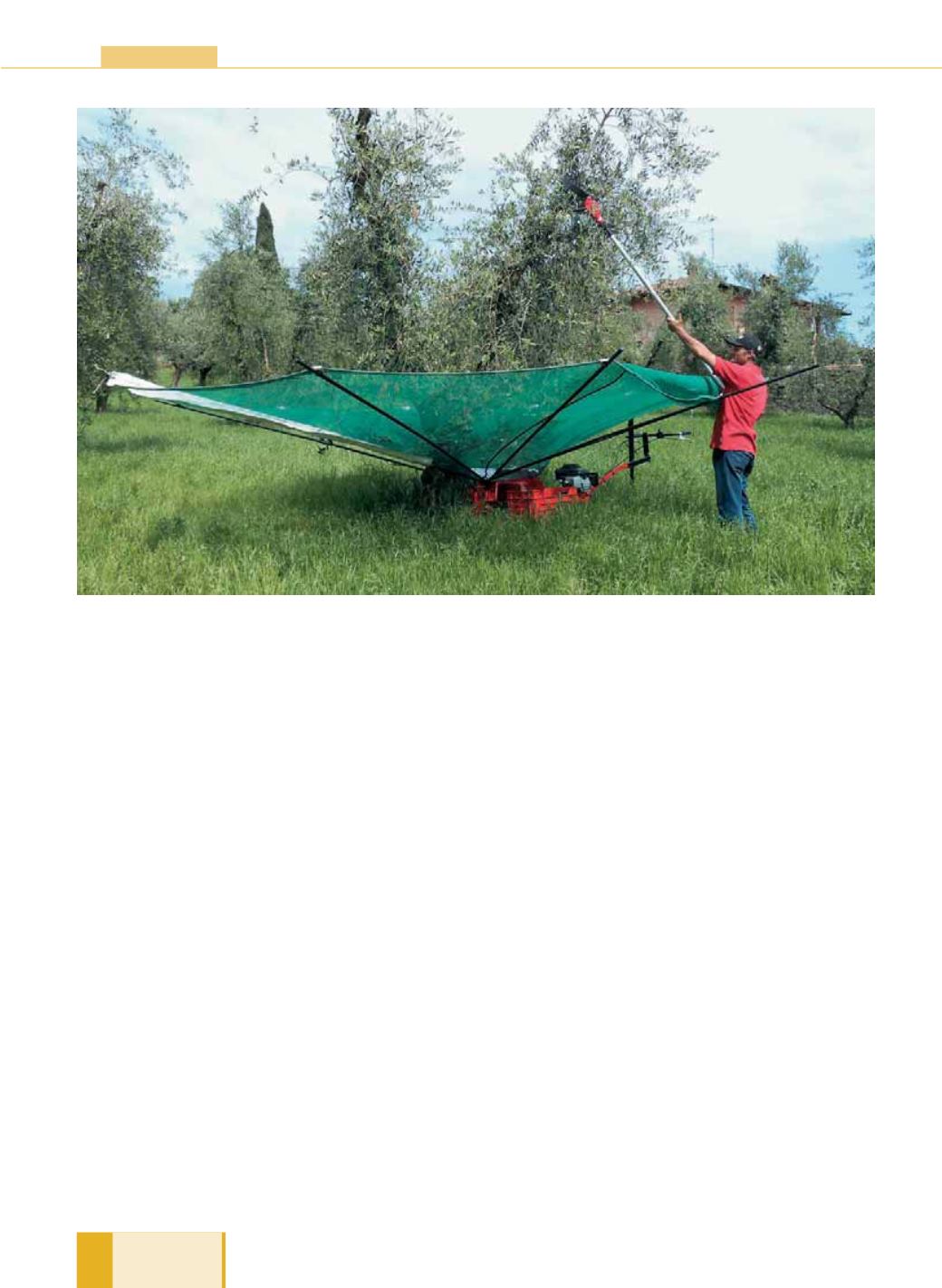
una resa scarsa in termini di quantità di prodotto raccolto
nell’unità di tempo. L’abbacchiatura consiste nel percuote-
re i rami con rastrelli azionatimeccanicamente, inmodo ta-
le da far cadere anche in questo caso le olive sulle reti di
raccolta. È il metodo oggi preferito, per la sua produttività
elevata. I più recenti abbacchiatori hanno testine realizza-
te conmateriali evoluti (fibra di carbonio o resine ad eleva-
ta elasticità) e riescono ad essere particolarmente “deli-
cati” con lapianta,senzadanneggiare i rami, inconveniente
praticamente inevitabile con le testine di raccolta metalli-
che, che sono notevolmente rigide. I danni alle piante si
acuisconoulteriormente con gli scrollatori, ovvero scuotito-
ri dotati di un gancio terminale che veniva agganciato alle
branche principali, per far cadere le olive per scuotimento.
Lemodalità di azionamento
Il classicomotoreendotermico (di potenza limitata) è lasor-
gente di potenza installata sugli scuotiolivi (o scrollatori);
ciò inevitabilmente comportaunappesantimentodi queste
attrezzature, tali da produrre un precoce e intenso affatica-
mento dell’operatore, tanto che solo i soggetti più robusti
sono in grado di mantenere un’elevata produttività per l’in-
tera giornata lavorativa. In ogni caso, con uno scuotiolivi in
5-10minuti possonoessere raccoltepiùdell’80%delleoli-
ve di un albero adulto. Critico permane l’aspetto vibrazio-
nale, tale che secondo la vigente normativa inmateria i li-
velli tipici non consentirebbero un impiego continuativo su-
periore alle di 2-4 ore/giorno. Anche la rumorosità è note-
vole, attestandosi quasi sempre oltre85 dB(A), tale quindi
da imporre l’adozione di otoprotettori.
In alternativa a questa soluzione sono comparsi sul mer-
cato gli abbacchiatori elettrici, più leggeri, silenziosi, ecolo-
gici e pressoché esenti damanutenzione. Vengono di nor-
ma alimentati via cavo con un accumulatore a 12 V, collo-
cato a terra omontato su un piccolo carrello. Le nuove ti-
ershaveheadsmadeusing state-of-the-artmaterials (carbon
fibre or high elasticity resins) that are particularly “delicate”
on the plant, avoiding damage to the branches, something
that was almost inevitable with themetal heads, which are
extremely rigid. Damage to the plant is further reduced us-
ing shakers, that is to say shaking devices fittedwithahook
at the end that is hooked onto the main branches, so that
the olives aremade to fall by shaking.
Operatingmethods
The traditional internal combustionengine (of limitedpower)
is thepower source installedonolive shakers; this inevitably
makes the equipment heavy, resulting in early and intense
fatigue for the operator, somuch so that only the strongest
are able tomaintain high production levels for the whole of
the working day. In any case, it is possible to harvest more
than 80% of the olives from amature tree in just 5-10min-
utes using an olive shaker.
The vibrations remaina critical aspect, to theextent that un-
der current regulations on the subject the typical levels do
not allow continuous use formore than2-4hours aday.The
noise levelsarealsoconsiderable,beingalmost alwaysabove
85 dB(A), so that it is necessary to use ear protectors.
As an alternative to this option, electric beaters have ap-
peared on themarket. These are lighter, quieter, more eco-
logical andalmostmaintenance-free.They arenormally pow-
ered viaacable froma12Vbattery,positionedon theground
ormountedona small trolley.Thenew typesof Li-ionbattery
have seen considerable success, thanks to the fact that they
reduce the size andweight of the power supply unit, so that
the operator can carry the battery pack fastened to his belt,
or in a special backpack.
Pneumatic olive shakers normally use the same harvesting
head as the electrical beaters, but are activated using com-
pressed air from a compressor unit, either electrical or with
118
n. 10_11/2014
T
ECNICA


