consigliato.
Infine, ma non meno importante, è la necessità di valu-
tare attentamente la tipologia di organo chiudisolco e la
sua corretta regolazione. Questi organi, infatti, vengono
spesso erroneamente “trascurati” dagli operatori, ma ri-
vestono un ruolo fondamentale per garantire un’adegua-
ta e costante copertura specialmente su terreni partico-
larmente argillosi o limosi.
Un importante aiuto dall’agricoltura di precisione
La corretta adozione a livello aziendale dello strip-tillage
non dipende solo ed esclusivamente dalle peculiarità tec-
niche delle operatrici impiegatema anche dall’attenta pro-
grammazione ed esecuzione dei singoli interventi.
Nello specifico, tale lavorazione, avviene generalmente a
velocità sostenute attestandosi a valori prossimi ai 7-12
km/h. Velocità sostenute e l’esigenza di ripercorrere a di-
stanza di tempo la striscia lavorata al momento della se-
mina fanno si che la tecnica dello strip-tillage ben si pre-
sti all’adozione di un sistema di guida assistita.
L’esigenza di operare una corretta deposizione della se-
mente al centro della “striscia lavorata” è un aspettomol-
to importante che, se non adeguatamente garantito, può
negativamente incidere sull’omogeneità dell’emergenza
e sullo sviluppo radicale della pianta.
Andrea Pezzuolo
stant adaptation to the profile of the
ground, necessary to ensure a perfect
horizontality of the machine so that
each element is able to operate in op-
timal conditions.
The preliminary cleaning operation of
the land strip is provided by “prepar-
ing” elements, already widely used on
sod seeders, such as residue cutters
and tools able to move the crop
residue present on the future seeding
line to the inter-row surface (eg. pair
of starred disks).
The next tillage phase occurs by
means of anchors capable of operat-
ing at a depth of 15-30 cm, supported
by a pair of deflector discs and by a fi-
nal roller that settles and refines the
tilled area. Conceptually, themain ob-
jective of the anchor is to perform a
subsurface tillage, but without dis-
turbing toomuch of the surface,which
will instead be worked by the comple-
mentary toolsmentioned above.
The requirements
for quality seeding
The decompaction produced by the
strip-tiller facilitates the subsequent
work of theplanter’s ploughandhelps
avoid most of the problems that may
occur upon closing the seed furrow,
often amajor cause of reduced emer-
gence. The better working conditions
allow theplanter to followwith greater
precision of the seeding depth and
create an optimal edaphic environ-
ment around the seed.
However, to be able to also adapt to non-optimal operating
conditions it is important that the planter be able to tack-
le successfully even the possible presence of crop residue.
For this reason, the fitting of residue-parting elements and
the presence of a corrugated profile disc to break up pos-
sible compacted surfaces is strongly recommended.
Last but not least, the need to carefully consider the type
of furrow closing tool and its proper adjustment.These tools
are oftenmistakenly “neglected”by the operators, but play
a vital role to ensure adequate and consistent coverage es-
pecially on particularly clayey or loamy soils.
An important aid in precision agriculture
The proper adoption of strip-tillage at the enterprise level
does not depend solely and exclusively on the technical
features of themachines used, but also on the careful plan-
ning and execution of individual interventions.
Specifically, this tillage generally takes place at high speed,
reaching values close to 7-12 km/h. High speeds and the
need to retrace later in time the strip that was tilled while
sowingmeans the strip-tillage technique lends itself well to
the adoption of an assisted guidance system.
The need to perform proper seed placement at the centre
of the “tilled strip” is a very important aspect that, if not
properly ensured, cannegatively affect the homogeneity of
the emergence and the root development of the plant.
Andrea Pezzuolo
114
n. 10_11/2014
T
ECNICA
| LAVORAZIONE |
|
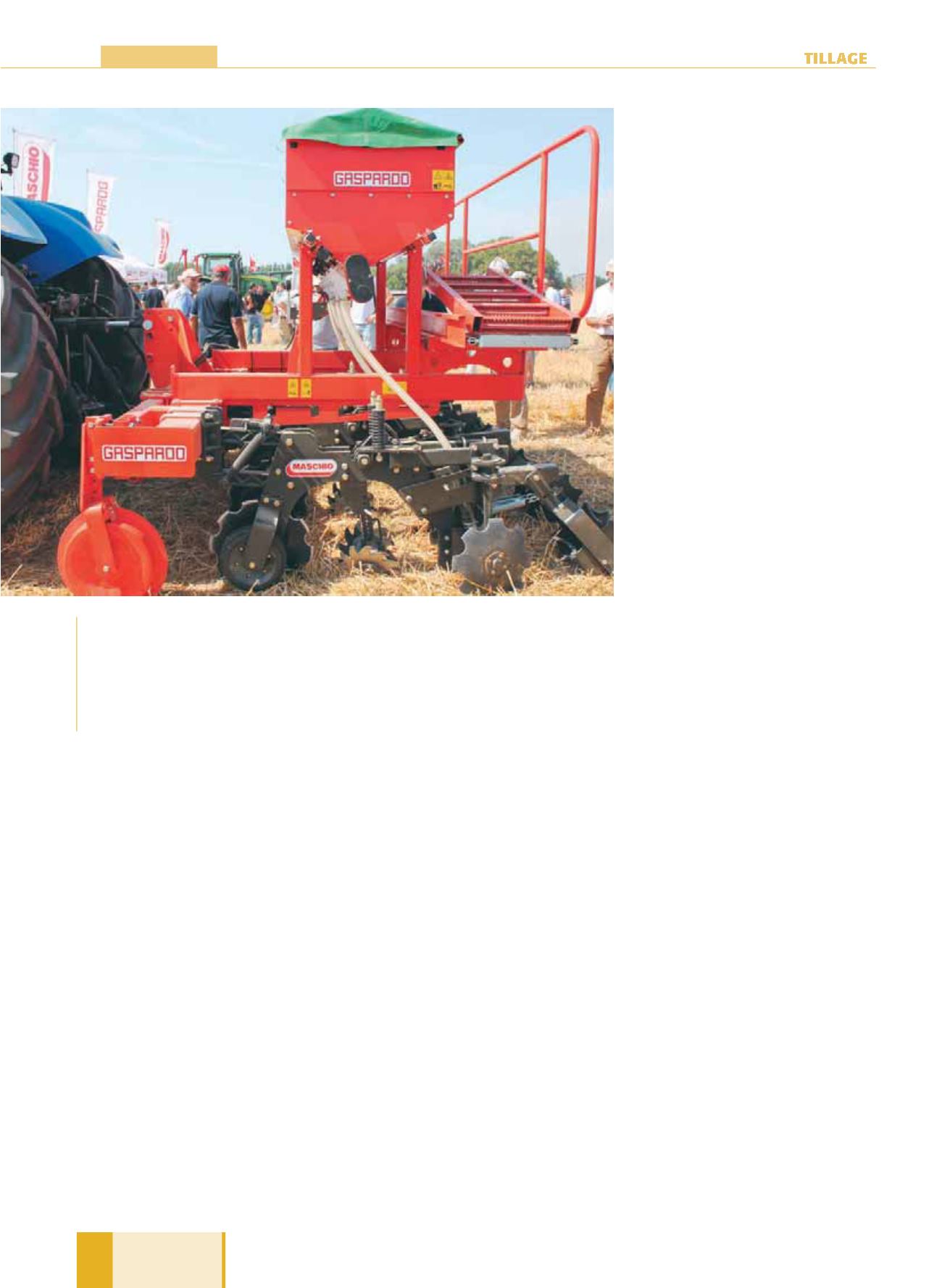
L’applicazionedello strip-tillagepuòpermetteredi eseguire, contemporaneamente alla lavorazione, un
interventodi fertilizzazionemediante tubi adduttori collegati alle singoleunità lavoranti. Oltre allapossibilitàdi
distribuire inmodo localizzato fertilizzanti chimici, lo strip-tiller puòessere collegato, tramite attacco a trepunti,
amacchineoperatrici spandiliquame (trainateo semoventi), allo scopodi operareunadistribuzione
sottosuperficialedi liquami ebiodigestati.
Theapplicationof strip-tillage canenable, simultaneouslywith the tillage, anoperationof fertilization through
adductor pipes connected to the individual tillageunits. Besides thepossibility of distributing chemical fertilizers
ina localizedmanner, the strip-tiller canbe connected via three-point linkage to spreadermachines (towedor
self-propelled), inorder toperforma subsurfacedistributionof slurryanddigestedbioslurry.


