tecnologie che faranno fare allameccanizzazione agricola un
nuovopasso verso il futuro.
Si è parlato quindi di ISOBUS Automation (o TIM - Tractor Im-
plement Management) e del protocollo di cifratura della co-
municazione. Se la TIM abilita l’attrezzo all’utilizzo automatiz-
zatodi diverse funzionalitàdel trattore, il protocollodi sicurez-
zaavrà il compitodi impedirechemacchinenonautorizzatee
fidate–ovverononcertificateAEF–possanoutilizzare tali fun-
zioni; questo allo scopo di prevenire incidenti agli operatori e
problemi legali ai costruttori.Si èparlatodiHighVoltageedel-
la necessità di ridurre costi e dimensioni di cavi e connettori
per la fornituradipotenzaelettricadal trattoreall’attrezzo.Fon-
damentale tale tecnologiaal finedi ottenereuna lavorazionesemprepiùprecisa, conminori
sprechi e conun ridottissimo impattoambientale, conbuonapacedei regolamenti nazionali
sulleemissioni e l’inquinamento.Si èparlatodi CameraSystems,ovverodi comeconsentire
unostreaming videostandardizzato (per oradi tipoanalogico) traattrezzi e trattrici.Molteplici
leapplicazioni: daquelle relativealla sicurezzaaquelledi diagnosticae verificadelle lavora-
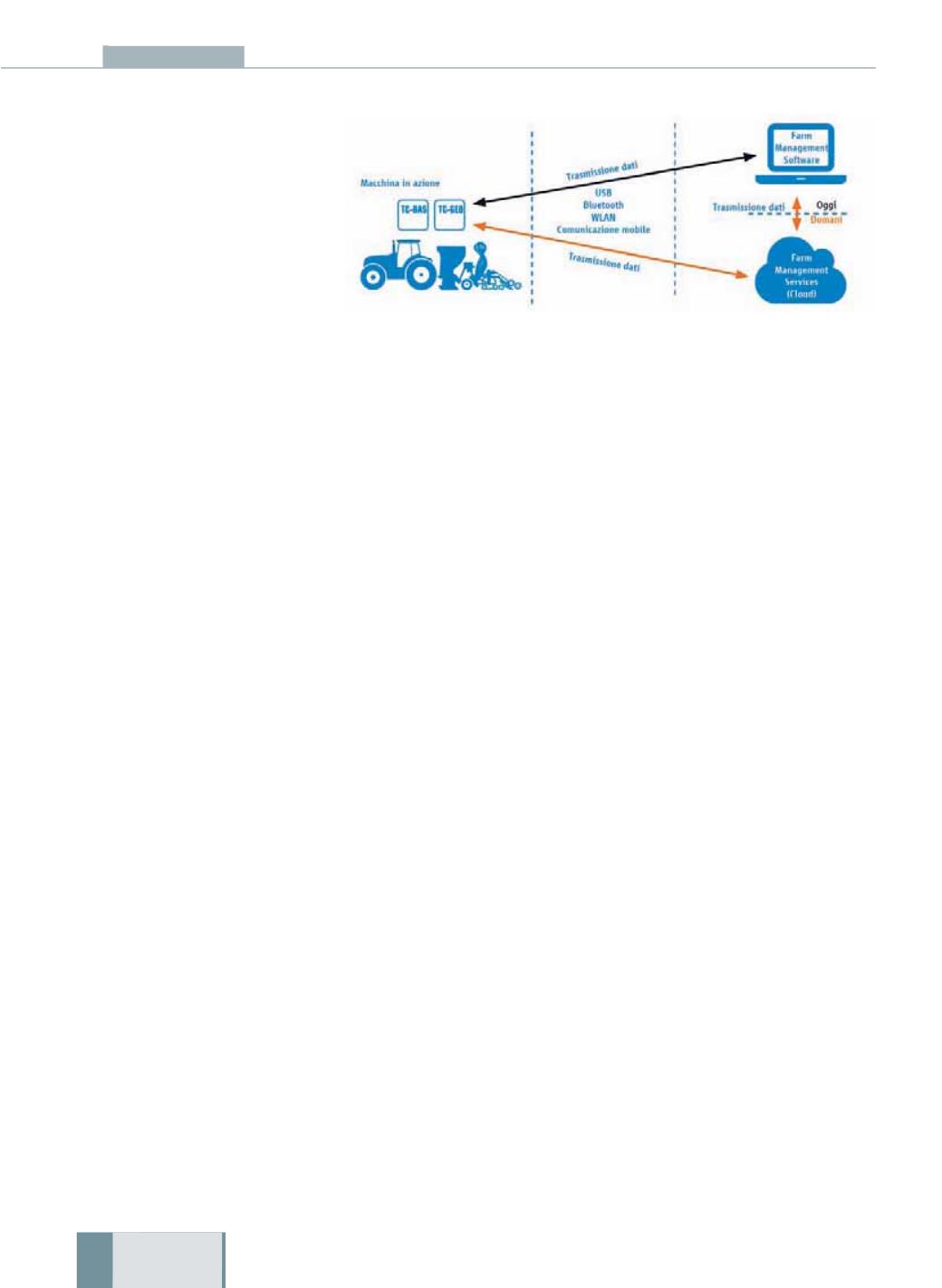
zioni in corso. Si è parlato di FMI (FarmManagement InformationSystems) e delle informa-
zioni necessarieper lamiglioregestionepossibiledell’aziendaagricolaedelle lavorazioni. Si
sono introdotti inoltreduenuovi gruppi di lavoro:HighSpeedeWirelessCommunication. Il pri-
mosi occuperàdi definire il nuovomedia fisicoper la trasmissionedati abanda larga tra trat-
trici edattrezzi, al finedi superare i limiti, oggi quasi raggiunti, dell’ISOBUS.Manon solo, su
talemediasaràpossibile trasmettere flussi videodigitali,effettuarediagnostica,calibrazione
eprogrammazionedellecentralineemoltoaltro…unico limite la fantasiadeiprogettisti! Il grup-
poal lavorosullaWirelessCommunication, invece,avràcomeobiettivoprimario (manonuni-
co) quello di definire uno standard per la sincronizzazione delle lavorazioni tramacchine di-
verseeper lacomunicazionedati daunaall’altraeconsistemi FMIS.
È inutiledire che i campi applicativi di tali tecnologie –presesingolarmenteo in combinazio-
ne tra loro – sono davvero infiniti, non è questa l’occasione per parlarne,ma saranno ap-
profonditi conarticoli ed incontri. Preme invecespenderedueparolesudi unanuovaattività
dellaqualeFederUnacomaèstata ideatriceepromotrice.
Si parlavaad inizioarticolodi come il Giapponesi stiamuovendoper l’adozionedell’ISOBUS
e delle altre tecnologie promosse daAEF, il ché ha portato a porsi una domanda: è così dif-
ferente il Giapponedell’Italia?La rispostaèun “No”.
Lamaggioranzadelle lavorazioni agricole inGiapponeèmoltospecifica,così come losono le
macchinepercompierle.Trattrici edattrezzi di piccoledimensioni ebassocostoper i quali im-
plementare “fisicamente” l’ISOBUSera fuori discussione: sistemaelettrico complesso, trop-
po costoso, troppo voluminoso,parti difficilmente reperibili inquelmercato,ecc. Eccoquindi
l’idea di “fare gruppo” e di proporre unmedia fisico per la comunicazione ISOBUS più sem-
pliceemeno costoso, conovvieeampie limitazioni,masufficientementestabileper essere
usatosumacchinesemplici edi piccoledimensioni. L’obiettivo, chiaro,èquellodi spingere i
costruttori di talimacchineadadottare lenuove tecnologieelaboratedaAEF; ISOBUS inpri-
mis. Il nuovo livello fisiconon intendesostituirequellostandardenonneavrebbe lacapacità
per ovvi limiti tecnici.Ma può consentire allePMI nostrane di approcciare le tecnologie elet-
tronicheconmaggioreserenità, integrandolesullepropriemacchineperottenereprodottie la-
vorazioni sempremigliori. In ISO,dove il TC23/SC19/WG1 (riunitosi sempreaSenlis il giorno
20ottobre) è il gruppodi lavorochesi occupadellanormativa ISO11783,èstataavviataad
aprile2014una task forceguidatadaFederUnacomaper analizzare lepossibili soluzioni tec-
niche per questomedia fisico semplificato. La prima soluzione è stata presentata dalla Fe-
derazione per conto della task force all’ISO ed all’AEF e forte è stato l’interesse e la sensa-
zionecheAEF intendapromuovere taleattività,pureseancora instadioembrionale,siadaun
puntodi vista tecnicochedimarketing,apartiredalladefinizionedi unnome.Molti, infatti,so-
no i costruttori internazionali chesi sonouniti al gruppodi lavoroestannodando il loro con-
tributo,mostrando forte interesseper questaopportunità. Insomma,per usare luoghi comu-
ni, di acqua sotto i ponti ne è passatamolta e grande è la quantità di carne al fuoco per il
prossimo futuro. EFederUnacomaha la volontàdi partecipareaquestoprocessodi sviluppo
insieme a tutte le associate. Per questo, già in EIMA la Federazione organizza tre eventi da
nonperdereperentrare incontattocon la realtàdiAEFoperapprofondirne laconoscenza:13
Novembredalle10.00alle12.30 ilseminario“Agricultural IndustryElectronicsFundation (AEF):
Situazioneepanoramicasulleattività »;13Novembredalle16.00alle17.00e14Novembre
dalle11.00 alle12.00 i seminari tecnici: “AEF ‘Forma il Formatore’: Introduzionemarketing
orientedall’AEF,ai servizi edagli strumenti per lapromozionedella tecnologia ISOBUS”. Tutti
gli interessati possonoconoscere i dettagli sul sitoufficialeEIMA,ed iscriversi per partecipa-
reagli incontri.
AlessioBolognesi
tics and the verification work under way. There is talk of FMI (FarmManagement Infor-
mation Systems) and the information necessary for the best possible management of
farms and operations.
Twonewwork groups have been introduced: HighSpeedandWireless Communications.
The first focuses on the definition of the new physical media for broad band transmis-
sions between tractors and implements for the purpose of overcoming the ISOBUS lim-
itation now reached. But not this alone in that these media will be capable of trans-
missmitting digital video flows, carry out diagnostics, calibrations and programming for
CPUs and much more. The only limitation is that of the fantasy of the designers! The
work group onWireless Communications, on the other hand, is aiming mainly but not
exclusively, at the synchronizationof operations betweendifferentmachines for the com-
munication of data from one to the other via FMIS systems. Its useless to say that in
field of the application of these technologies – taken singularly or in a combination of
them – us truly infinate. This is not the occasion for discussing the issue but it will be
examinated in future articles andmeeting.What is pressing instead is to say twowords
on the FederUnacoma activities for their ideas andpromotions.Referencewasmade at
the beginning of the article to the way Japan is moving towards the adoption of the
ISOBUS protocol and other AEF backed technologies has led to the question: is Japan
so different from Italy? The answer is a resounding No.
Most agricultural work in Japan is highly specialized as are the machines for perform-
ing these operations. Tractors and low price small scale implements physically deploy-
ing ISOBUS are beyonddiscussionbecause the electronic systems are complicated, too
costly, too big, parts are difficult to find on themarket and so forth. This is what is be-
hind the idea of forming a group and offering a physical media for ISOBUS communi-
cations which aremore simple and less costly, with obvious and ample limitations but
are sufficiently stable to be used on simple and small machinery. The objective, be it
clear, is to drive the manufacturers of these machines to adopt new technologies de-
veloped by AEF, led by I-SOBUS.
The new physical level is not intended to replace the standard and could not be capa-
ble of doing so because of obvious technical limitations. But it could allow Italy’s SMIs
to approach electro-niche technologies with greater confidence, integrating then into
their ownmachines for building increasingly better products for rational operations.
In ISO, with TC23/SC19/WG1 (meeting in Senlis on October 21th), is the work group in-
volvedwith the ISO11783normactivated inApril 2014witha task forced ledby FederUna-
coma for analyzingpossible technical solutions for this simplifiedphysicalmedia.The first
solution presented by FederUnacoma for the task force to ISO andAEFwas a strong one
and led to the thinking that AEF intended to promote this activity from the technical as
well as themarketing standpoints beginning with a name, though the initiative is still at
the embroynic stage.
Therearemanymanufacturers grouped in theworkgroupproviding their imput and show-
ing strong interest in the opportunity offered. In substance, according to the Italian say-
ing, a lot of water has passedunder thebridgeand there’s a lot ofmeat in the fire for the
future.
FederUmacoma has volunteered to take part in this development process along with
themember companies. For this reason, EIMA International has organized three events
for getting into contact with the real AEF and benefit from this knowledge. On Novem-
ber 13th from 10:00 to 12:3o am there is a seminar, Agricultural Industry Electronics
Foundation (AEF): Situation and Panorama of Activities and technical seminars on No-
vember 13th from 4:00 to 5:00 pm and November 14th from 11:00 to 12:00 am on
Formula the Formulator: Introducing AEF Market Orientations to Services and Instru-
ments for Promotion of ISOBUS Technology. All those interested can learn details from
the official EIMA International webside and register for participation in the events.
AlessioBolognesi
34
n. 10_11/2014
S
PECIALE
| EIMA INTERNATIONAL 2014 |


