operations on roadsides, ditches, brush and on lawns and for
gardening. The 10 is the small brother of the machines in the
TB series 100, the TBE and the TB series 10 with work widths
of 160 and 180 cm and features many of the characteristics
and solutions found in the BE line in production, including the
advanced front hammer. Like the BE, the TB series 10 requires
power at between 35 and 65 hp. The newest Nobili arrival in
the shredder category is the BC model, an ideal high-yield ma-
chine for mulching a great variety of vegetable materials, from
cornstalks and beet leaves to potatoes, sunflowers, cotton and
open field crop residues. Among the machine’s strong points
are the completely closed frame to avoid tampering or opening
the machine in full field operation, the front-mounted hammer
or vigorous blades and counter-blades installed on an oversize
rotor to ensure not only excellent mulching in all conditions of
work but reduced fuel consumption as well thanks to lower pow-
er needed. The BCs have a power requirement of between 70
and 150 hp and a Hardox slide which, according to work con-
ditions, can run on a roller or wheels. Another first arriving at
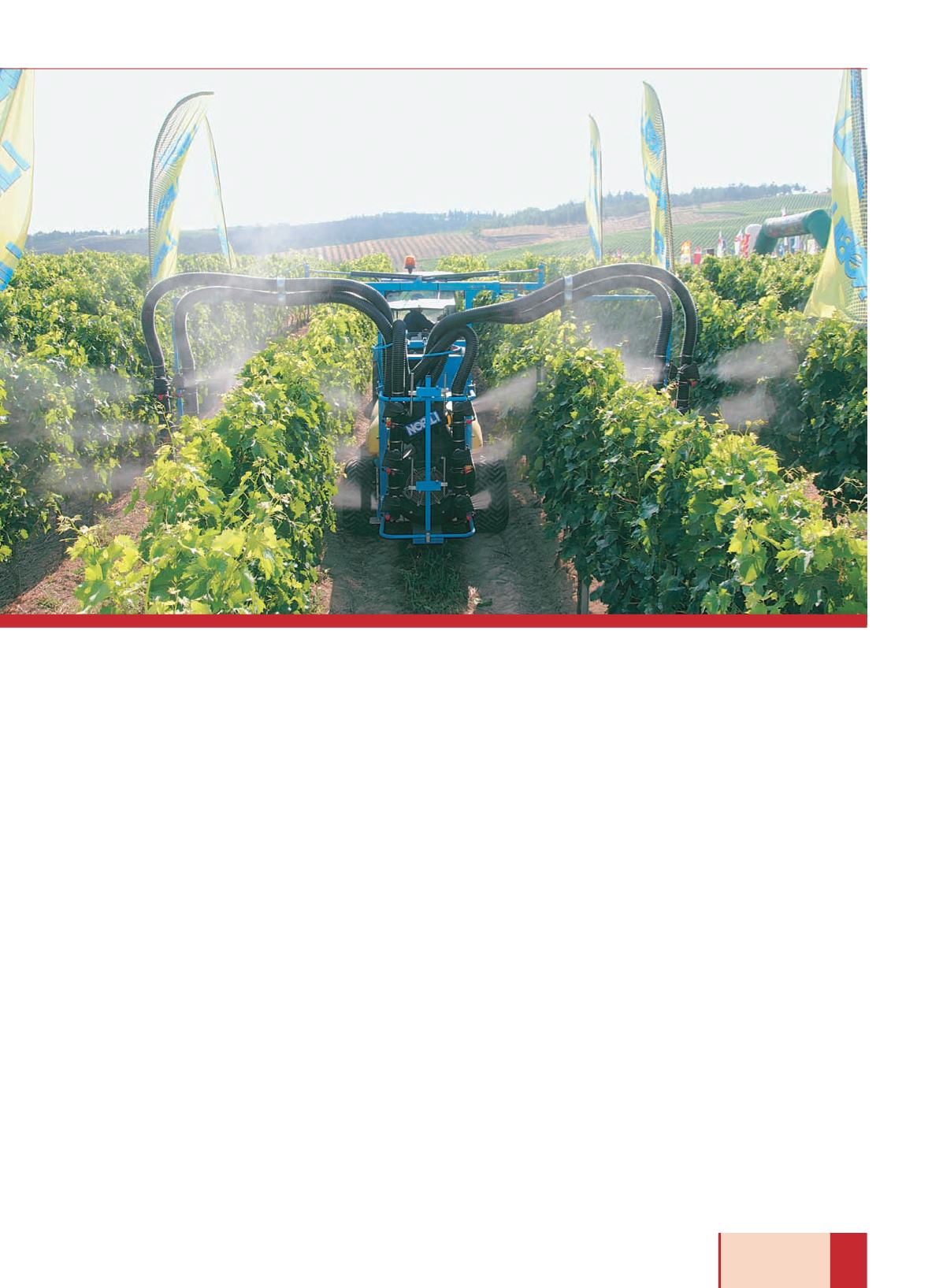
Eima International is the trailed pneumatic Ventis sprayer with
a capacity from 1000 to 1500 liters and an OTF and OTF-F in-
ter-row head designed for plant treatment operations in vine-
yards and, specifically, for the simultaneous treatment of three
rows with one passage.
At the heart of the sprayer is a double turbine in aluminum
which ensures air speed of 120 m/s allowing the distributors
to form of fine droplets for the uniform distribution of the prod-
uct on the plants and low at volumes of water. Thanks to the
electro-hydraulic controls located in the tractor cab, the Ventis
with the inter-row head can be adapted in width and height to
the layout of the vineyard and the ramp can be folded for steer-
ing or road transport.
The Ventis is built for tractors at 70 to 110 hp and can be
equipped with a steered towbar with a single kinetic joint for
facilitating headland maneuvers.
boccole. Come la BE, la TB serie 10 ha una richiesta di po-
tenza da 35 a 65 CV. L’ultima novità della Nobili per il seg-
mento delle trince è il modello BC, un’applicazione ideale
per la trinciatura di una grande varietà di materiali vegetali
(tra gli altri: stocchi di mais, foglie di bietole, patate, gira-
sole, cotone, residui colturali a campo aperto) e ad alto ren-
dimento. Un merito, questo, ascrivibile sia al telaio - è com-
pletamente chiuso per impedire possibili manomissioni o
aperture della macchina a pieno campo – sia ai vigorosi col-
telli e contro coltelli (o mazze su boccole) che, montati su
un rotore di grandi dimensioni, assicurano non soltanto una
qualità di trinciatura ottimale in tutte le condizioni di lavoro,
ma anche un ridotto consumo di carburante (l’assorbimen-
to di potenza è molto contenuto). Con una richiesta di po-
tenza medio-alta (da 70 a 150 CV) e con tre differenti lar-
ghezze di lavoro (240, 270, 300 cm), le BC hanno slitte in
Hardox; a seconda delle condizioni di lavoro possono ap-
poggiare su un rullo o sulle ruote.
A Eima International 2012, inoltre, fa la sua prima uscita l’a-
tomizzatore pneumatico trainato Ventis (capacità da 1000
e 1500 litri) con testate scavallanti OTF e OTF-F, progettato
per trattamenti nei vigneti e, nello specifico, per il tratta-
mento simultaneo di tre filari con un solo passaggio. Il “cuo-
re operativo” dell’atomizzatore è costituito da una doppia
turbina di alluminio che garantisce una velocità dell’aria di
120 m/s ai diffusori, permettendo così una micronizzazione
fine e una distribuzione regolare del prodotto sulla vegeta-
zione con bassi volumi di acqua. Grazie ai comandi elettroi-
draulici posizionati nella cabina del trattore, il Ventis con te-
stata scavallante riesce ad adattarsi - in larghezza e in al-
tezza - al sesto di impianto dei vigneti, compattando la ram-
pa in fase di sterzata o di trasporto su strada.
Adatto a trattori con potenza da 70 a 110 CV, Ventis può es-
sere equipaggiato con timone sterzante e giunto omocineti-
co per ottimizzare le svolte in capezzagna.
117
MW
n. 10_11/12
| EIMA INTERNATIONAL 2012 |


