The development of bioenergy production chains
makes it possible for many agricultural lands and
marginal territories become productive to counter
the phenomena of pouring cement which has taken
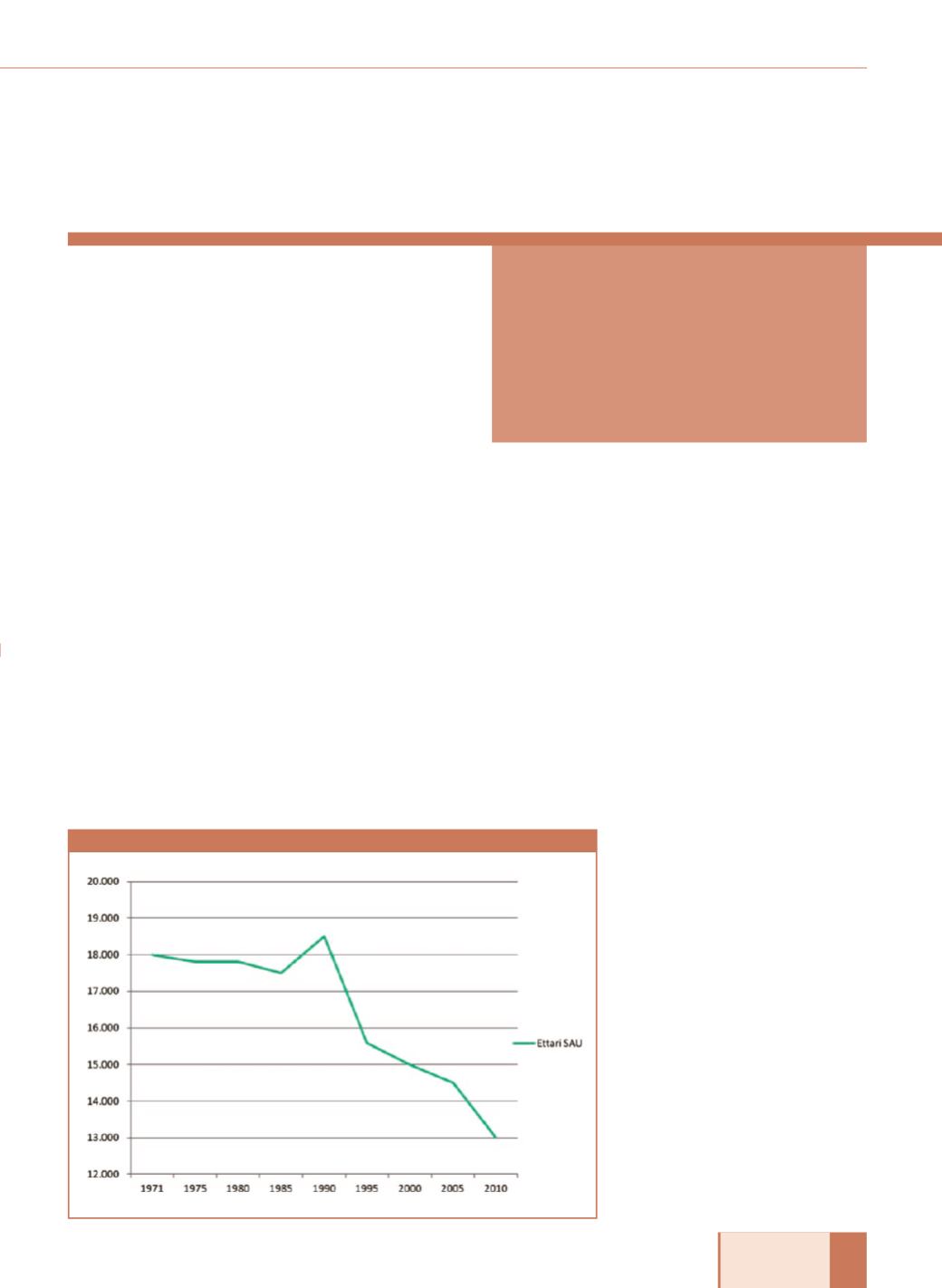
on a drastic scale. According to a recent survey
sponsored by the Ministry for Agricultural and
Forestry Policy, five million hectares of farmland
have been lost in Italy since 1971. Every day, one
hundred hectares of land are rendered
impermeable by building construction.
icals. Vito Pignatelli, the president of ITABIA, the Italian Bio-
mass Association, was tapped as coordinator of the group with
the job of naming those responsible for each of the produc-
tion chains.
Group 2 will work on the front of research, development and
statistical analyses under the coordination of Luigi Pari, the di-
rector of CNR-IVALSA, the National Research Council and Trees
and Timber Institute.
Group 3, of no less importance, is to focus on legislation and
simplification, regulatory questions and characteristics, and is
coordinated by Sofia Mannelli from the MiPAAF.
Obviously to be expected out of necessity is ongoing con-
structive dialogue among the groups aimed at organizing a
system for the results of the activities carried out separately.
From this point of view, ITABIA’s interest in taking part in the
table is even more highly motivated in light of the systematic
approach to be ensured.
The work of the Table appears to provide an excellent oppor-
tunity for coming up with concrete answers for the many peo-
ple involved in the agri-energy production chains who for years
have been seeking a dialogue with in-
stitutions. This is happening at in historic
time for our country, in need of adequate
governance for the formulation of a sus-
tainable energy strategy.
Beyond the question of incentives, which
has attracted a lot of talk, of great im-
portance for raising the value of biomass
for energy generation is a framework for
the issues in light of the tangible impli-
cations for the land. A central feature,
for example, is finding a correct defini-
tion of the available resources which can
be relied on. These resources must fea-
ture quality and by continuously available
without impacting negatively on agricul-
tural food production and traditional
forestry operations.
The experience of ITABIA points to ab-
solutely certainty that not only can this
come about but must be encouraged for
the precise purpose of strengthening
farming enterprises and reviving and
modernizing forestry businesses. The re-
| TERRITORIO AGRICOLO/AGRICULTURAL LAND
43
MW
n. 10_11/12
lorizzando le esperienze dei soggetti coinvolti nel definire delle
strategie sostenibili, perfezionando il quadro normativo e asse-
gnando in modo funzionale le poche risorse economiche dispo-
nibili.
La riunione d’avvio, ha visto la partecipazione di numerosi rap-
presentanti di enti ed associazioni del settore, compresi alcuni re-
ferenti delle amministrazioni (Ministeri, Regioni), e ha portato al-
la costituzione di tre gruppi di lavoro per la trattazione di diversi
temi specifici.
Il gruppo 1, articolato in quattro sezioni, si occuperà di biomasse,
biocarburanti e bioliquidi, biogas e biometano e chimica verde. Per
il suo coordinamento è stato nominato Vito Pignatelli (Presidente
di Itabia) e dovrà individuare un responsabile per ciascuna delle
filiere.
Il gruppo 2, opererà sul fronte “ricerca, sviluppo e indagini stati-
stiche” e avrà per coordinatore Luigi Pari (Direttore del Craing). In-
fine, ma non meno importante, il gruppo 3, dedicato alle questioni
di carattere normativo “legislazione e semplificazione”, che sarà
coordinato da Sofia Mannelli (MiPAAF).
Ovviamente è previsto, in quanto necessario, un dialogo costan-
te e costruttivo tra i diversi gruppi volto a mettere a sistema gli
esiti delle attività condotte separatamente. In questa ottica l’in-
teresse di Itabia a partecipare al “Tavolo” è ancora più motivato
visto l’approccio sistemico che si è voluto assicurare.
L’attivazione del “Tavolo” sembra essere un’ottima occasione per
dare una risposta concreta ai tanti soggetti coinvolti nelle filiere
agroenergetiche che da anni chiedono un dialogo con le istituzio-
ni. Questo avviene in una fase storica del nostro Paese, che ne-
cessita di una governance adeguata alla formulazione di una stra-
tegia energetica sostenibile.
Al di là delle questioni riguardanti gli incentivi, di cui si sente tan-
to parlare, per la valorizzazione delle biomasse ad uso energeti-
A
biomass economy
for saving
farmland
Ettari SAU /
UAA Hectares


