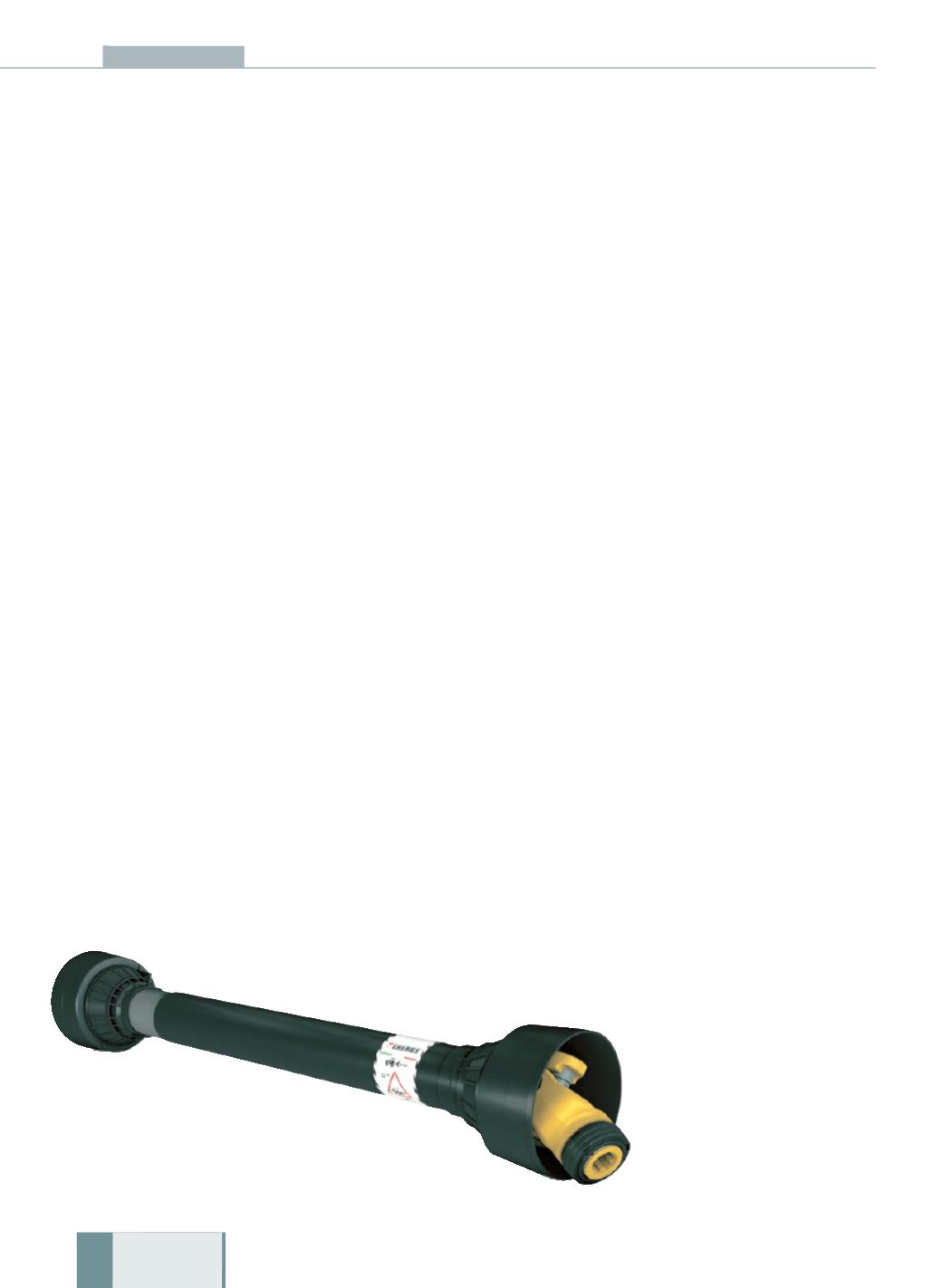
della quale si ricorre di fatto alle norme armonizzate: tra
queste, la norma di riferimento per gli alberi cardanici è la
EN 12965:2009. Sappiamo che la Direttiva Macchine è
basata sull’autocertificazione, dunque il costruttore di una
macchina solitamente dichiara di aver preso tutti i provve-
dimenti necessari per garantire la sicurezza del proprio pro-
dotto e ciò è ritenuto valido sino ad eventuale prova con-
traria; in alcuni casi però, quando gli aspetti di sicurezza
sono particolarmente rilevanti, la Direttiva Macchine pre-
vede diverse procedure per dimostrare che i requisiti es-
senziali di sicurezza sono soddisfatti. Gli alberi cardanici
rientrano tra queste eccezioni, e ciò implica di fatto che
ogni modello (non ogni esemplare) immesso sul mercato
sia controllato da un ente notificato che verifica l’operato
del costruttore per quanto riguarda gli aspetti di sicurezza.
La dichiarazione di conformità CE dell’albero cardanico con-
tiene le informazioni sull’ente notificato che ha esamina-
to quel tipo di albero.
Evoluzione normativa
È evidente dunque che il legislatore non ha trascurato gli
aspetti relativi alla sicurezza degli alberi cardanici, ma no-
nostante questo, l’INAIL registra annualmente un numero
di infortuni mortali variabile tra 10 e 15. La quasi totalità
degli infortuni avviene quando le protezioni non sono pre-
senti o non sono integre ed efficienti; in alcuni casi, mol-
to più rari, gli infortuni possono essere dovuti ad altre cau-
se. A livello nazionale si è quindi costituito un gruppo di la-
voro composto da INAIL e dai costruttori aderenti a Fede-
rUnacoma, con l’obiettivo di aumentare il livello di sicu-
rezza fissato dalla norma armonizzata di riferimento EN
12965, aggiornandone i contenuti. La norma dovrà esse-
re strutturata in modo da evitare, come invece accade og-
gi, che le protezioni degli alberi cardanici siano eliminate
o non sostituite in caso di necessità. Il gruppo di lavoro na-
zionale ha impostato la discussione su due binari: da un
lato occorre facilitare l’utilizzo degli alberi cardanici in pre-
senza delle protezioni, dall’altro occorre migliorare la resi-
stenza delle protezioni stesse. Attualmente, la revisione
della EN 12965 è concentrata sul primo dei due aspetti.
Gli alberi cardanici, infatti, devono essere collegati alla trat-
trice ad ogni accoppiamento della macchina operatrice al-
la trattrice stessa. Per realizzare il collegamento del car-
dano alla presa di potenza esistono diversi dispositivi (di
tipo a pulsante, a collare, a bullone), ma nella quasi tota-
lità dei casi per ciascuno di essi l’operatore deve accede-
re con le mani in spazi angusti dovuti proprio alla presen-
za delle protezioni, e contemporaneamente sostenere il pe-
so del cardano stesso, che può superare i 30 kg. E’ evi-
dente che un sistema di collegamento del car-
dano alla presa di potenza che non debba es-
sere azionato negli spazi tra le pro-
tezioni ma dall’ester-
no ri-
spetto
ad esse porta un migliora-
mento delle condizioni operative, e
questo dovrebbe scongiurare la possibilità di ri-
mozione o mancata sostituzione delle protezioni. La revi-
sione della norma di riferimento ha l’obiettivo di richiede-
re proprio tali nuovi sistemi di collegamento. Ci sono altri
aspetti che la nuova norma dovrebbe prendere in consi-
derazione, tra cui i requisiti relativi allo sfilo dei cardani ed
alla loro lubrificazione. Relativamente al primo aspetto, oc-
with respect to the transmission shaft, and contact with the
protective sheathing poses no risk. But it must pass clear-
ly defined resistance tests, as specified in European and
international norms.
In the EU, the reference point is the Machine Directive, for
which harmonised norms are applied, including a reference
norm for universal joints, EN 12965:2009. The Machine Di-
rective is based on self-certification, so the manufacturer
generally makes a declaration that all the measures to guar-
antee the safety of the part have been taken, and this is
assumed to be the case in the absence of proof to the con-
trary. In some cases, however, where safety is especially
crucial, the Machine Directive lays down different proce-
dures for showing that essential safety requirements have
been taken care of. Universal joints are among these ex-
ceptions, which implies that every model (not every single
product) sold on the market should be checked by a body
which verifies what the manufacturer claims to have done
as regards safety issues. The EC declaration of conformity
for the joint contains information identifying the body that
did the testing.
How the Norms Evolved
The framers of the rules have clearly not ignored safety
considerations for universal joints, yet INAIL, Italy’s acci-
dents at work insurance fund, reports 10-15 deaths a year
from universal joint failures. Almost all of them occur in cas-
es where protection is missing or damaged and ineffective.
In some very rare cases, there may be other causes.
The result was the creation of a working group by INAIL and
manufacturer associates of FederUnacoma to increase the
safety levels incorporated in the reference norm EN 12965
by updating its content. The norm must be restructured to
avoid the elimination of the protection from universal joints
and the failure to replace it when needed, as happens now.
The debate followed two broad lines. Universal joint must
be attached to the tractor each time a tool is hooked. There
are various ways of ensuring the link, by button, collar or
bolt, for example. But in almost all cases, the operator has
to get his hands into very limited spaces to carry out the
connection. The space may even be reduced by the joint
protection. At the same time as he or she is making the
connection, the weight of the joint, in some cases over 30
kg, must also be supported.
Clearly, completing the connection should not require get-
ting inside the protection but should rather take place out-
side it, which would in itself improve operating conditions.
This should also discourage removal of the protection or
failure to replace it. The revision of the norm is designed to
demand these new connection systems.
The debate also covered cases where the universal joint
slips out and how it should be lubricated. One point that
arose is that in some conditions - for example, if the joint
is too short in a machine whose position
with respect to the tractor changes while
working – the overlap of the joint’s mid-
dle section ay be insufficient, which
could allow the two elements to slip out
of contact, in which case serious safe-
ty risks would arise. This is true espe-
cially when the operator reduces the
shaft’s length for his or her own rea-
sons, cutting both the mechanical parts
and the protection. The operator has to be
correctly informed and to respect the manufacturer’s in-
16
MW
n. 10_11/2013
S
PECIALE


