tilizzo delle tecnologie basate sui dati di posizionamento GPS e sui siste-
mi per l’agricoltura di precisione (
Precision Farming
). L’analisi è stata fat-
ta su tre tipologie di coltivazioni ampiamente diffuse in tali paesi: grano,
soia e cotone prendendo in considerazione un campione di aziende agri-
cole che utilizzavano tali sistemi. E’ risultato che il risparmio annuale va-
ria dai 30
€
ai 60
€
per ettaro a seconda dalle attività previste dal ciclo di
lavoro per una specifica coltivazione. L’iter ideale del ciclo di lavorazione
parte dalla pianificazione delle operazioni (task) sul campo in base di ca-
ratteristiche quali: composizione del terreno, illuminazione, vicinanza ai
canali di irrigazione, etc. E’ oggi possibile inoltre pianificare i percorsi che
le proprie macchine devono seguire sul campo, oppure tra un appezza-
mento e l’altro (si pensi ai carri per trasportare il materiale raccolto, ad
esempio), al fine di ottimizzare i tempi di percorrenza ed il carburante ne-
cessario. Le operazioni programmate possono poi essere eseguite sul
campo utilizzando il posizionamento GPS congiuntamente ai sistemi per
l’agricoltura di precisione installati o integrati in trattori, attrezzi ed altre
tipologie di macchine: si è così in grado di eseguire lavorazioni a rateo va-
riabile per ottimizzare il trattamento, utilizzare il controllo sezioni, per con-
trollare l’applicazione della semina o dell’irrorazione ed evitare sovrappo-
sizioni, od utilizzare l’autoguida o l’autosterzatura per seguire i percorsi
programmati.
L’applicazione dei trattamenti in maniera ottimizzata dà origine ad un mi-
glioramento generale della qualità della produzione oltre che ad un au-
mento della stessa che è stato valutato tra il 3% ed il 7% circa. Come con-
seguenza di quanto citato sopra, anche i tempi di lavorazione, sulla base
di una ricerca condotta in Germania nell’ambito di un progetto del 7° Pro-
gramma Quadro, si riducono fino al 5%.
Per focalizzare meglio quanto appena detto, si possono riportare alcuni
esempi generali relativi ad alcune delle fasi principali di una lavorazione.
Durante la semina, ogni singolo kg di seme superfluo si traduce in uno
spreco e quindi in un inutile costo. L’obiettivo è sempre quello di ottene-
re uniformità nella deposizione del seme, così da garantire lo sviluppo cor-
retto di ogni singola pianta. L’utilizzo delle tecnologie per l’agricoltura di
precisione basate su GPS permettono di raggiungere tale obiettivo, anche
nei campi la cui forma o composizione del suolo rendono difficoltoso un
trattamento omogeneo. La coltura andrà poi concimata, oppure andranno
applicati fitofarmaci di diverse tipologie. In tale caso l’utilizzo dell’elettro-
nica è estremamente importante poiché la quantità di concime distribui-
ta è strettamente legata al tempo di erogazione, così come per una mac-
china irroratrice la quantità di sostanza dipende dal tipo di ugello, dal tem-
po di erogazione, dalla velocità del veicolo e da altri parametri. Il know-how
dei costruttori di macchine sta nelle modalità con cui le sostanze vengo-
no distribuite. In ultima battuta, però la quantità di materiale utilizzato è
sotto il controllo dell’operatore. Da una recente stima della Comunità Eu-
of their own machines in the field or between one field and another for,
for example, the transport of the product harvested and for the purpose
of optimizing the route and the fuel required.The programmed operations
can be performed in the field through the use of GPS combined with the
precision farming systems installed on the tractors or integrated with
equipment and other types of machinery.This way work can be performed
at variable rates for optimizing plant treatment and using sector control
for controlling seeding or spraying to avoid overlapping or using self-dri-
ve or self-steering to follow the programmed courses.
The correct application of plant treatment products results in the gener-
al improvement of the quality of production which leads, in turn, to in-
creased yields evaluated at some 3% to 7%. Also work time, on the basis
of research conducted in Germany in connection with the European Union
Framework Program 7 project, was reduced by 5% as a consequence of
what is cited above.
Some general examples on some of the main work phases can be re-
ported to draw a better focus on what has been stated. In seeding, every
single kg of excess seed is transformed into waste and thus into useless
cost.The objective is always to achieve uniformity in the deposit of seeds
to guarantee the correct development of each individual plant. This ob-
jective can be reached through precision farming technologies based on
GPS also in fields difficult to treat uniformly because of their shape or soil
composition. Crops are then fertilized or various types of plant treatment
products are applied. In these cases, the use of electronics is extremely
important in that the quantities of fertilizer distributed is closely related
to the time taken for spreading as is for time needed for spraying relat-
ed to the speed of the machine and other parameters. The know-how of
manufacturers is found in the way the substances are distributed. Ulti-
mately, however, the quantity of product used is controlled by the opera-
tor. According to a recent European Union estimate, improper means for
the application of fertilizer results in the loss of about one million tons of
nitrogen per year. Considering that one kg of nitrogen carries the energy
cost of one kg of gasoline, this waste comes to some
€
500 million on
the European scale. Account must also be taken of the fact that fertiliza-
tion weighs heavily on production costs; an example is the case of maize
for which this cost comes to some 30%. A similar point can be made for
weeding. Thus it becomes clear that the use of the systems taken up in
this article make it possible to optimize these processes and lower costs
by replacing control by the operator with recourse to the operator only
when necessary and when this is correct. Harvesting is the terminal at
which the agricultural process arrives, the time when the fruits of labor
are brought in.The advanced sensors on harvesting machinery available
today enables an ongoing analysis of the product and, working with a self-
steering system, make it possible to avoid damage to the product during
extraction. More examples could be named for pressing and vineyard ma-
chinery.
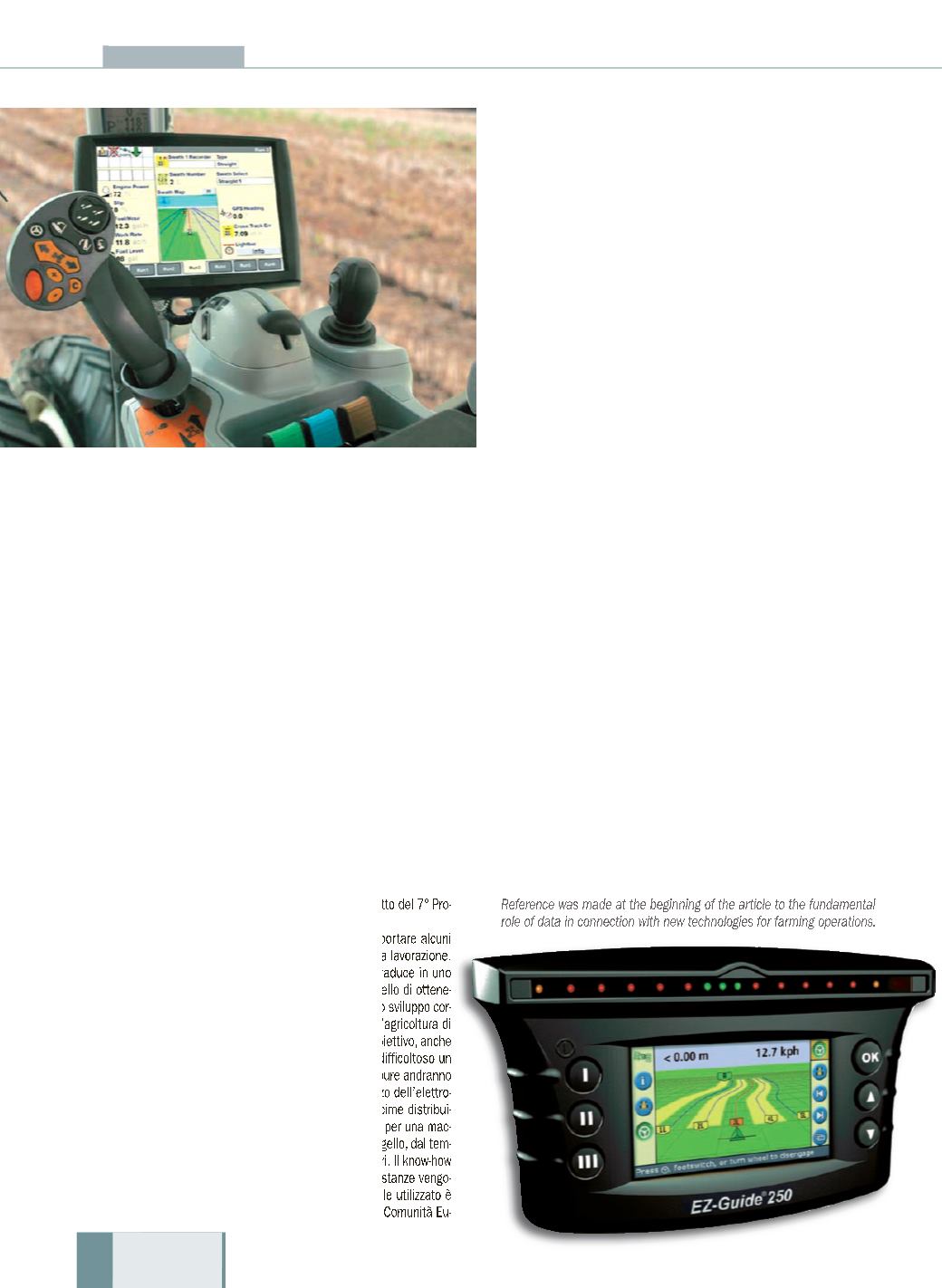
Reference was made at the beginning of the article to the fundamental
role of data in connection with new technologies for farming operations.
22
MW
n. 10_11/2013
S
PECIALE


