Urban greenery, tree planting technologies
Urban greenery in general and trees in particular, provide essential ecosystem services that improve the quality of life in urban centers and play an important role in countering the effects of climate change
Demographic analyses show that the world's population, including that of Italy, is increasingly moving to urban areas. Back in 2010, when Italy had just over 60 million inhabitants, 67.8% of its residents lived in cities; by 2026, the population had fallen to approximately 59 million, 72.4% of whom lived in urban centers. By 2030, the population is expected to be just under 59 million, with some 74.5% living in urban areas.
Italy is thus undergoing a transition towards an increasingly urban system, which requires a development model with ever-increasing services, not only social and health services, but also ecosystem services, provided by urban greenery in general and trees in particular. These services are particularly important for addressing ongoing climate change, due to which so-called extreme events are becoming commonplace. Precisely in connection with these services, urban greenery should be an integral part of public sector planning studies, as it plays a very important role in the ecological transition process. The goal should be that of creating an ecosystem in the city that brings benefits to both the environment and its citizens.
Moreover, there is now a general awareness that the presence of green spaces and trees improves the quality of life, thanks to shading, mitigation of temperature and heat islands, more effective water percolation, and the reduction of air pollution, smog, and fine particles, made possible also through carbon storage and sequestration. It is therefore necessary to properly respond to the issue of increasing the tree population in cities. At a national level, the green surface area per inhabitant is on average 31 m2, while the minimum requisite should not be less than 9 m2. These numbers do not allow for a qualitative assessment as they do not provide information on the location and type of greenery. Green spaces should be designed in accordance with the services they seek to provide, meaning that traditional urban planning standards are no longer sufficient and new assessment tools are needed. For this reason, when proceeding with new plantings agronomic and arboricultural constraints relating to different plant species should be taken into account in order to help reconcile biological and vegetation needs with urban planning ones. New analysis software provides valuable support in this regard, making it possible to assess the performance of the system under construction. It is therefore of great help in complex and delicate operations such as urban area tree planting.
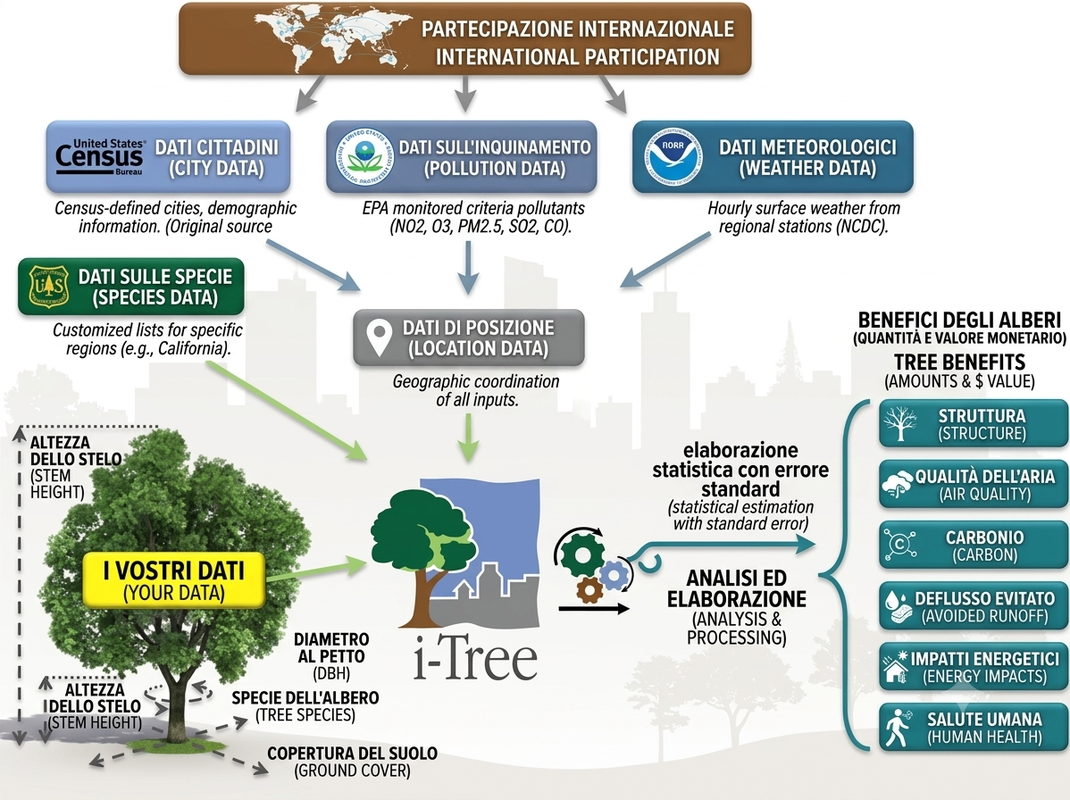
Combining new software with basic arboricultural and agronomic knowledge. In order to achieve the desired results, basic agronomic and arboricultural knowledge should be used synergistically with the data provided by analysis software and predictive models. One of the most advanced platforms is undoubtedly the one called i-Tree, an innovative software suite developed by the United States Forest Service (USDA Forest Service) that is used internationally to analyze greenery and predict and quantify the corresponding ecosystem services and biodiversity evolution. It is thus a very useful tool as it provides a large amount of information useful in the urban planning process, but it cannot ignore the basic concepts of agronomy (analysis of soil compaction, pH, soil nature, etc.) and arboriculture (knowledge of the characteristics of the chosen species). Software, for example, can predict how much CO2 the tree will absorb but cannot predict, much less ensure, that the tree will reach maturity. Thus it is necessary to create the biological-vegetational conditions necessary for the natural development of the chosen species at the time of planting. Here below we will provide some information regarding choice of species and planting. Next-generation IT platforms are also used to assess the loss of ecosystem services following the reduction of a green area due to a change in use, such as the transition from urban forest to building land. This creates a loss of value that generates an 'ecological debt' for future generations. The loss of soil - and thus the services it provides - is unfortunately an ongoing phenomenon, and it is important to be aware of it in order to limit its effects.
Choice of species. The choice of one or more species to plant has to take into account many factors, in particular suitability to soil, environmental, and climate conditions, including the effects of climate change. From this perspective, some native species, even if cultivated in the recent past, may no longer be suited to the conditions created by the consequences of global warming. To limit the spread of pathogens it is necessary to diversify the type of trees planted to prevent the arrival of a new pathogen whose defense system is not yet known from causing the loss of a significant portion of the tree population.
When choosing material for planting consideration should be given to its provenance and specific characteristics such as age, size, and shape, its resistance to pests and diseases, as well as its ability to withstand the high temperatures and water stress induced by the climate crisis. From this standpoint the assessment of the ecological function, i.e. the potential CO2 which can be captured and stored, as well as the capacity to abate PM10 and PM5, becomes increasingly important. Other factors that should not be overlooked include those related to the problems that plants can create, such as invasiveness, toxicity, allergens and the potential for emitting VOCs (volatile organic compounds). VOCs are molecules that evaporate easily into the air and perform various useful roles for plants, such as warning and defense against pests. At the same time, they can also cause discomfort to people (irritation of the respiratory tract, eyes, etc.). In any case, without prejudice to the requisites set out above, in order to make good decisions regarding what nursery material to acquire, it is of fundamental importance that it be properly certified.
Once the species to be planted has been chosen based on the agronomic and arboricultural analysis described above, integrating the analysis with tools such as i-Tree allows for a useful and accurate prospective assessment. This assessment should also cover the economic aspect, which includes not only installation costs but also maintenance costs.
Careful planting. Utmost attention is need when planting because in urban environments it is difficult to ensure that the soil offers the best conditions for the plant's needs. The hole must be the right size, that is, 1.5 times the diameter of the root ball. Less than optimal dimensions can be tolerated as long as a substrate is created in the hole that is capable of promoting the development of the root system. For this reason it is essential to prepare the substrate with organic amendments and by adding mycorrhizal consortia as well as biostimulators. Organic amendments act mechanically, optimizing soil structure to promote air and water circulation. Chemically, they promote the formation of humic-clay complexes capable of increasing nutrient and water retention, and biologically they improve the conditions for soil microbial life. Once the planting operations are completed, it is necessary to irrigate. In particularly clayey soils it is necessary to promote water drainage by placing a layer of gravel and sand at the bottom of the hole and inserting a drainage pipe to discharge the water outside the hole.
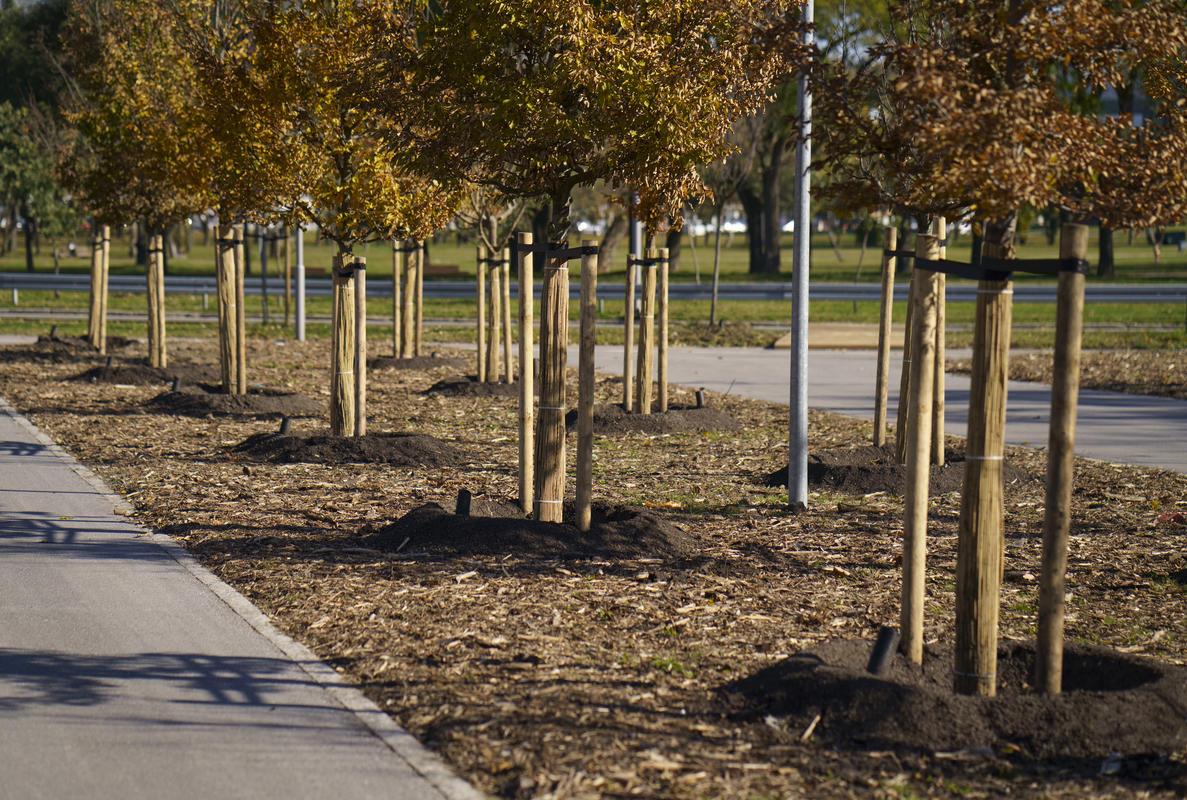
Once planted, the tree needs to be kept upright and protected from the wind using support or anchoring systems. The most common support system is comprised of one, two or three poles. For small plants, a single pole or two poles joined at the ends may be used. A very rigid solution is needed for the seedlings in both instances. The three-post system planted at the corners of an equilateral triangle and connected at the apex (if the posts are longer than 2 meters, the connection may also be at half height), allows larger plants to sway slightly, thus facilitating the development of the root system. The connecting collar between the plant and the support posts should allow the trunk diameter to develop (the higher the collar, the greater the wind resistance). Fairly decent sized trees situated in particularly windy areas can use wind ropes (3-4), which are applied to the tree through the collar and then secured to the ground. Anchoring is an underground support system that mimics the natural process of plants attaching themselves to the ground. The most common solution is that of tilting anchors. The anchors (3) are buried around the plant plug, spaced 120° apart, creating three attachment points for the cable (which will degrade over 3-4 years), which is passed over the plant plug. Cable tension is obtained by placing more dirt atop the anchors. While the best solution visually, it is also more demanding. Another type of protection against soil compaction, especially in highly trafficked public areas, is to place grates at the base of the tree. These come in various types and can also serve as a form of street decoration.
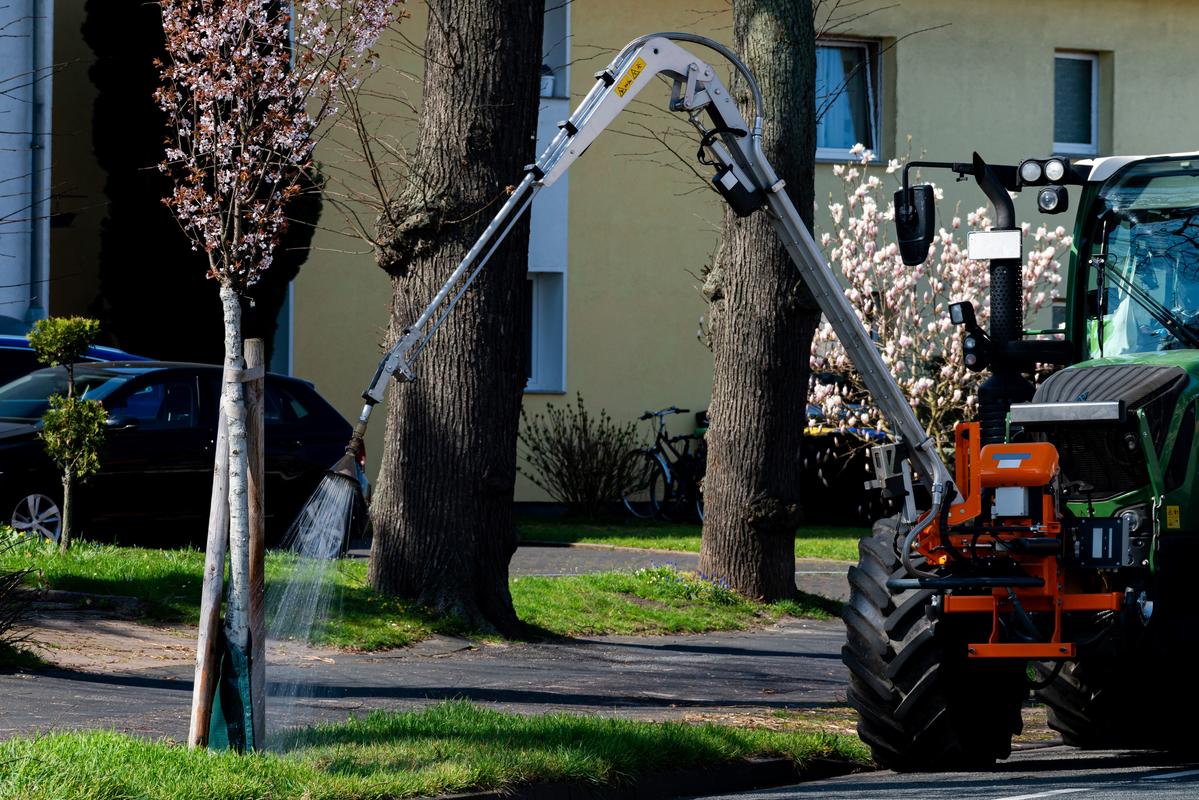
Machinery and equipment. Mechanical excavation of the hole can be done with an auger or with the bucket of a mini-excavator. The augers used usually have a diameter of 15-30 cm or greater, and reach depths of up to 1 meter. They are not suitable for clayey soils because they create an impermeable wall inside the hole which hinders root development. Excavators can be used to dig individual holes or trenches, such as in the case when planting an entire row. These rubber-tracked vehicles are equipped with an articulated, swiveling arm that carries the excavator bucket at its end. Mini-excavators have power ranging from 10 to 40 Hp with a digging force ranging from 10 to 40 kN.
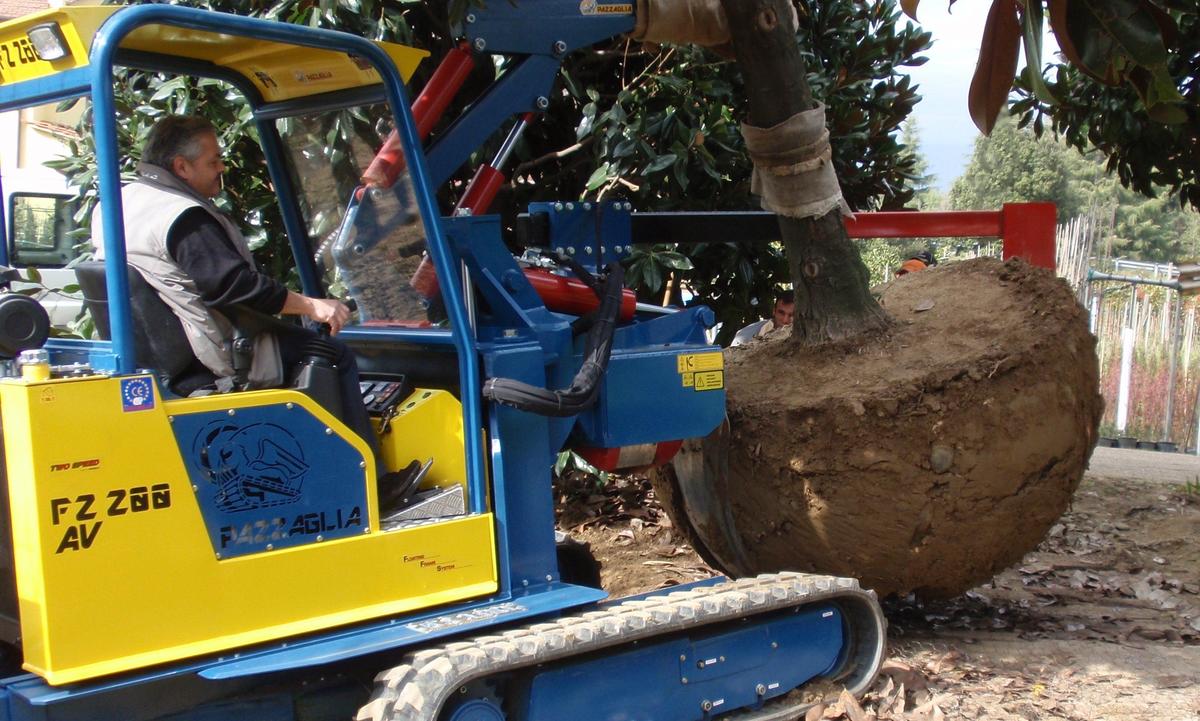
Tree spades are used to remove plants from the nursery. They remove the plants along with their plant plug (root ball). These self-propelled tracked vehicles perform the uprooting by using steel spades that are pushed into the ground in order to uproot the tree together with its root ball. The spades may be conical in shape (suitable for sandy soils with narrow plant plugs), truncated conical (for clayey soils with heavy plant plugs), or crescent-shaped (equipped with high-frequency vibrations, with spherical root balls). There are various models with different working capacities capable of uprooting trees of different growth patterns. Other fully hydraulic control models are coupled to a tractor or other self-propelled vehicles. Cultivator-transplanters are used to carry out the uprooting, transport and planting. Large-scale transplants, i.e. the removal and planting of large trees, require specific types of cultivator-transplanters.
Sustainable green architecture in the city. Green architecture is an architectural practice that respects the principles of sustainability: it implements the One Health principle, which is a global integrated strategy aimed at creating a link between the health of humans, animals, and plants, with the goal of optimizing common well-being without wasting natural resources. The best-known example is the vertical forest in Milan, a residential complex built in 2014, consisting of two towers, 110 and 76 meters high, which house a total of 800 trees, 4,500 shrubs, and 25,000 herbaceous plants. In short, it is a grouping of spaces immersed in the woods. This ecosystem is equivalent to a forest on a flat surface of about 5 hectares. The plant selection was made by agronomists over the course of two years. Maintenance was taken care of by flying gardeners. Irrigation is centralized and automated thanks to sensors, and is performed by recycling filtered gray water. This building solution has received significant recognition and has been replicated in other cities, both in Italy and abroad.