Farming at the speed of byte
With an ultimate goal of automation in our fields, there's a bigger need for faster data speeds. This means transforming ISOBUS precision Ag function into its next evolution for interconnected systems
Invented almost three decades ago, ISOBUS refers to the ISO 11783 standard "nervous system“ of agricultural equipment that seamlessly connects tractors to implements and aftermarket options such as displays and joysticks, and more. With ISOBUS, machines work together as a system better than each component can work on its own. The current ISOBUS is robust, delivering enough performance for today's applications, but ISOBUS has both physical and data limits.
"ISOBUS is still serving the industry very well and will continue to do so for years to come, but the industry has recognized that ISOBUS is holding back the development of far more demanding systems that aim for higher performance and accuracy of control," said Andrew Olliver, AEF Chairman.
While the AEF believes that the current ISOBUS can be stretched for 10 years, or possibly longer, the need for the next generation of ISOBUS is coming fast for the most advanced implements.
The need for speed. The next level of ISOBUS, known as “High Speed ISOBUS” (HSI), will deliver greater performance for the future, and that precision will help reduce the amounts of fertilizer and chemicals, improve agronomy, and allow companies to offer products that support sustainability.
“If you look to how fast everything goes in terms of digital transformation, not only sharing data from the machines to cloud platforms, but also sharing data between tractors and implements, there's a real need to do it faster,” said David Smart, retired Senior Staff Engineer and John Deere Fellow, and the current AEF HSI Team Leader.
Examples of future technologies requiring the speed provided by HSI will include higher performance command and control at the row level on a large planter or for the individual nozzles on a sprayer; higher performance of user interface to see the exact state of every row in real-time; remote process viewing with more advanced digital cameras replacing the analog of yesteryear; enabling higher levels of automation, and more.
“Multiple camera streams, for example, will allow the operator to keep an eye on what's happening either around the machine, or even on the implements,” said Smart. “So some level of situational awareness, whether that is to monitor the process itself on the implement, or just to see behind a very large implement.”
Creating a better world requires teamwork. AEF began researching High Speed ISOBUS in 2014, and as it moved into the development phase, additional expertise was needed.
In 2020, Smart, along with Greg Kittle, Manager of Product Safety and Compliance for the John Deere Construction and Forestry Division, foresaw a future standard that would serve both the agricultural industry as well as the construction industry. That future would meet the needs of higher speeds, faster communication, creating smarter equipment combinations.
The AEF was seen as the natural partner, given its long history of successfully developing guidelines and transitioning those guidelines into standards. The organization brought together a cross-industry collaboration of the world’s leading heavy equipment manufacturers to build ISO 23870, the new HSI standard.
In the AEF HSI project team, approximately 25 members, meet regularly to develop the agriculture needs and requirements.
“This is how we'll end up with a high-quality and usable standard that future proofs, at least to a large degree, what each industry wishes to do with it on their journey,” said Kittle. “OEMs could do this independently, but it would be incredibly costly, and we would be limited in the technology that we could apply to get those things done.”
“This also provides an economy of scale to suppliers that will deliver millions of chips and connectors for the HSI architecture,” said Ryan Milligan, Director of Business Development for Powell Agricultural Solutions, and Deputy Communications & Marketing, AEF. “That helps keep costs at an acceptable level.”
AEF’s role. Foundations like AEF come together specifically to tackle these sorts of projects. They develop certification processes, and procedures that their members can implement in the same way.
The AEF is writing guidelines and practices for their members in preparation for this new standard. They are answering questions like: How do we draft this specific feature? How does it fit with upcoming standards? What considerations do you need to take into account? What do others do?
The standard is one thing, but having a certain set of compliancy is the second level where the AEF will ensure that the different products are interoperable and work together.
HSI Discovery. AEF’s biannual Plugfest event provides an opportunity for precision ag software engineers to temporarily put aside competition to test compatibility and correct communication of their ISOBUS products. The events attract hundreds of attendees and participants, including AEF member companies AGCO, CNH, CLAAS, John Deere, Kubota, KUHN, and SAME DEUTZ-FAHR, among others.
The next Plugfest will be held September 8th – 12th in Marienfeld, Germany, where dozens of technical teams from across the agricultural industry “plug in” their competing equipment to help ensure all colors work together seamlessly, making equipment more effective, and the farmer's job easier to do.
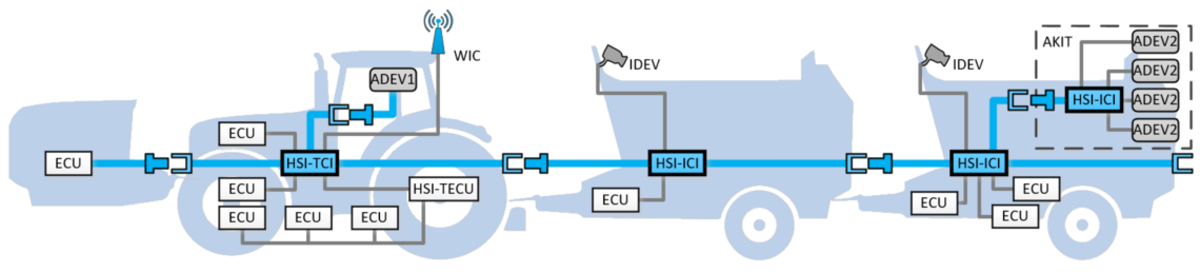
The event will also host an HSI “Discovery Station” where cameras, displays, implement ECUs, virtual terminals, network switches, and cable and connectors. Multiple manufacturers are involved as software engineers test whether their components are discoverable on the new HSI architecture.
“We’re involving as many companies, engineers and devices that are able to bring devices to the table to discover if our assumptions are good or bad, and to see if everybody came to the same conclusion interpreting the draft documents and relevant standards,” said Smart. “It’s a much less formal engineer-to-engineer test; to try concepts, make changes, and try again.”
“In the world of ethernet, there's literally tens of thousands of different protocols,” said Smart. “We are determining which ones are the right ones for us. We hopefully need just a few pieces to get a great start.”
Creating a whole new world together. “Looking beyond 2030, maybe even towards 2040, we see this increasing data demand. We see this digitalization coming up. We see a lot of robotics manufacturers that are coming up now,” said Milligan.
“To get all this equipment in the future interoperable in the field; that's what the farmer wants, and the grower wants, and the contractor wants, and the agronomist wants, even. It all has to work together,” he said.
But this digital transformation requires organizations to step up.
ISO standardization is a lengthy process, and according to the team, a development cycle could take many years.
“The urgency becomes a matter of corporate need, readiness, willingness, and ability to begin to deploy earlier than the actual final standardization based on the group’s work, based on the AEF guidelines, and based on our early development of an ISO standard,” said Smart. “Each individual company will need to make that call. Every one of these industries is looking to improve performance, efficiency, automation and to move forward on the path to autonomy.”
While the group is seeing a number of engineers volunteering, those individuals are told how many hours they can volunteer by their organizations, and that may not be enough to meet the aggressive timelines.
The new HSI will meet the future demand for more data and control between different brands so an implement controlling a tractor or vice versa, or even a combination in the field of multiple machines, will be the reality, but it’s going to be quite the undertaking for the global agricultural industry.
“The timeframe is a challenge; progress is based on the availability of volunteers, and company priorities usually take precedence over volunteerism,” said Smart.
“Companies have expressed that if we had the technology available today, it would be in production in their products today,” he said. “But that doesn’t always translate into the level of volunteerism that is needed.”
“Interoperability and equipment compatibility is a global challenge, and we want to make sure that we're using global standards, whether that’s in the Americas, Europe, Asia or Africa,” said Milligan.
“Farmers need tools that work,” he said. “It all comes down to creating solutions as an industry that answer one question: ‘how can we do agriculture better together.’”
To become an AEF member and/or a volunteer, please visit: www.aef-online.org. To register for Plugfest, please visit https://www.aef-online.org/events/fall-plugfest-2025.html#/about