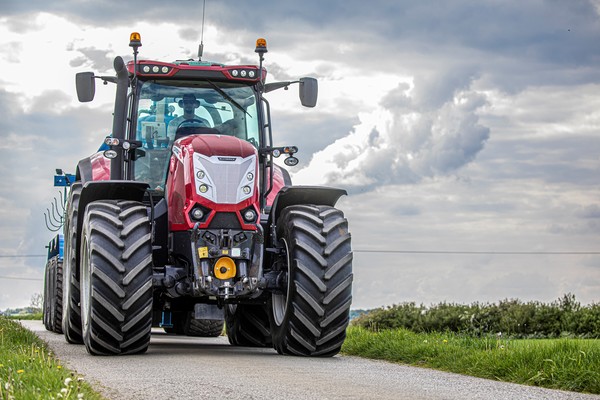
Fast farm tractors, undergo vehicle inspection
Tractors capable of speeds over 40 km/h under scrutiny. Inspections to begin by June 30. Mechanical tests include the braking system, lighting system, steering, windows, mirrors, axles, and tires
While the implementing decree that should have set the timeframe for vehicle inspections for self-propelled agricultural and operating machinery, including traditional farm tractors has been collecting dust in a drawer for 10 years now, due to a surreal succession of extensions, everything now seems ready to go. Fast farm tractors are legally defined as wheeled tractors with a speed exceeding 40 km/h.
It is difficult to estimate how many of these vehicles there are in Italy, since the the Ministry of Transport's database does permit filtering fast tractor models, but a conservative estimate by FederUnacoma's Technical Office quantifies the total number of units placed on the market in Italy from 2016 to today at around 10,000. A new phase is therefore opening up for this segment, given that on November 25, 2025, with Decree 494, the Ministry of Transport defined the operational guidelines for initiating the inspection of fast-wheeled farm tractors. This provision has also been expected for several years, considering that the relevant European Directive dates back to 2014 (2014/45/EU) and that it was implemented in Italy in 2017 (Ministerial Decree of May 19, 2017 no. 214).
When it happens. Immediately. Inspections of fast farm tractors will in fact be required starting February 1, 2026. Fast farm tractors registered between January 1, 2017, and December 31, 2019 must undergo an inspection by June 30, 2026, while those registered between January 1, 2020, and December 31, 2022, must do so by December 31, 2026. Starting from January 1, 2027, fast farm tractors registered after January 1, 2023 must also comply. As is the case for most of the automotive world, an inspection is due four years after the date of first registration and then, every two years. It must be performed at the public inspection centers of the Civil Motorization Department or at one of "870 authorized independent mechanical centers" (pursuant to Law 870/1986) specializing in the inspection of heavy vehicles (mass exceeding 3.5 t and buses).
Checks of brakes, lights and gas. One of the issues that have slowed down the implementation of the various inspections is the type of checks to be required. Directive 2014/45/EU seeks to clarify matters and lists the operations to be performed with the primary objective of ensuring public health and safety. For example, checks must ensure that the vehicle brakes properly, that the steering works within the proper displacement parameters, that the windows and mirrors are not damaged and/or have not been removed, that all the lighting system components are functioning, that the axles and other structural parts are intact and without cracks, and that the tires are not worn. But there is even more. Given the specific nature of farm tractors, Decree 494 of late 2025 places some additional restrictions on the braking system, the lighting system and gaseous emissions. In detail, the brake test must be carried out using a plate brake tester, restricting the use of roller brake testers and decelerometers to special cases. As for lighting, the instrument used to check the alignment of the headlights is the 'headlight tester', while as regards gaseous emissions in diesel engines it will be necessary to measure the opacity of the exhaust gases using an opacimeter and, in the few petrol engines, it will be necessary to measure the percentage of carbon monoxide (CO) using an exhaust gas analyzer. To get started, trained inspectors will be needed, which is why the Ministry of Transport, again with its own Decree (501/25), has provided a training module dedicated to farml tractors that complements the general training program that inspectors must periodically undergo. We are not yet at the point of a general overhaul of traditional farm tractors and other machinery, but this is the first step. In a few months time we will see whether this is a positive step towards a more extensive set of rules or just a measure with limited impact.