Club of Bologna: challenges and strategies for agricultural mechanization
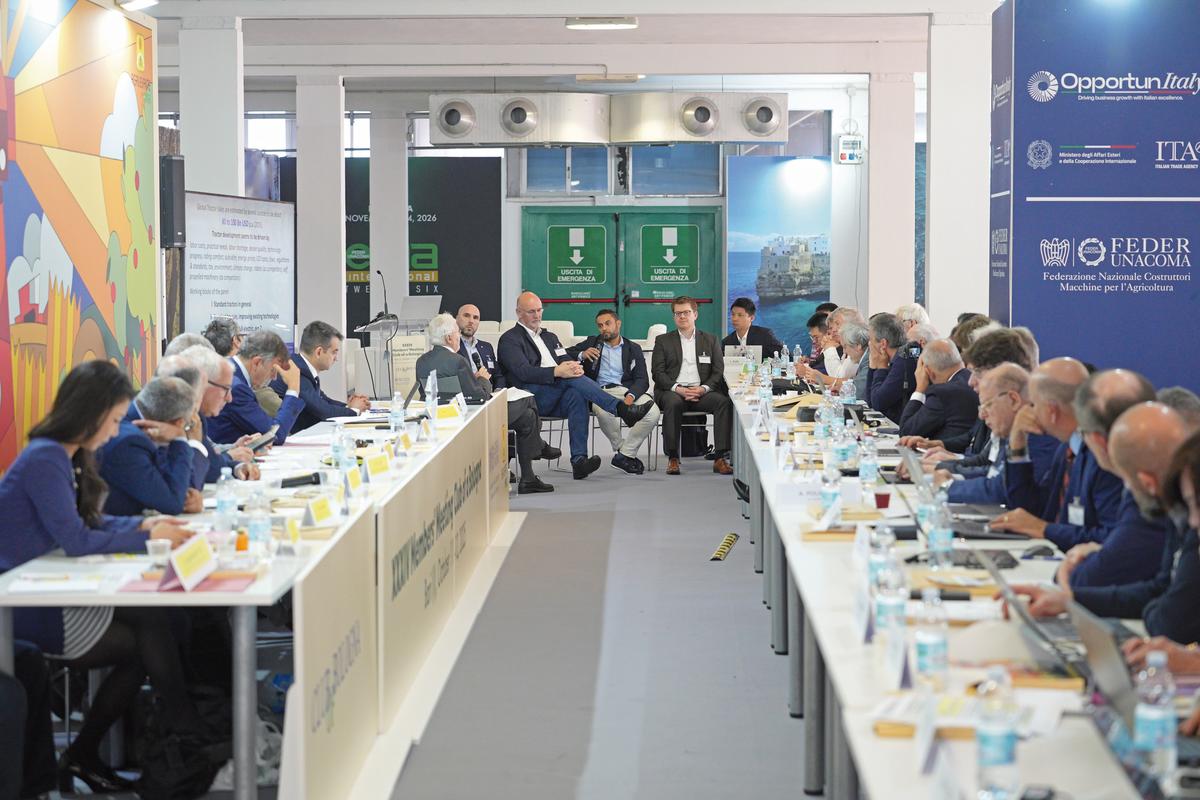
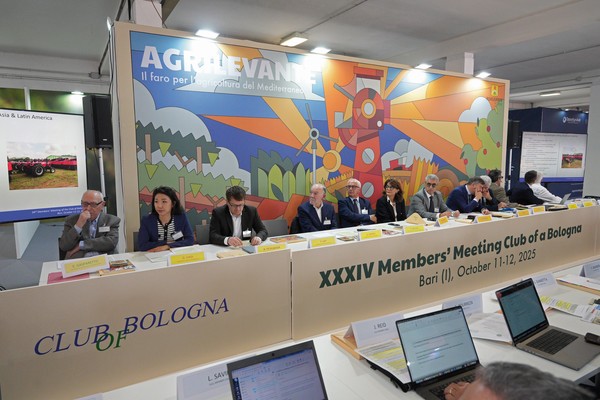
The Club of Bologna, the international gathering of agricultural mechanization experts sponsored by FederUnacoma, made its first visit to Bari, holding its 34th meeting in the Apulian city during Agrilevante 2025
The Club of Bologna's annual meeting took place this year in Bari on October 11th and 12th as part of Agrilevante, with the topic "Mechanization and Technologies for New Farmer Needs" as its guiding principle. On the morning of the first day, opening addresses were made by Club President Danilo Monarca and Federation President Mariateresa Maschio, who emphasized the great support the Club's work provides to the sector she represents. The Club has always analyzed the evolutionary scenarios of agriculture and agricultural mechanics, suggesting the types of machinery, skills and support that are necessary to accompany the growth of the different economies.
This was followed by the first session, dedicated to “How Technology and Farmers’ Needs Shape Next-Gen Tractors,” chaired by Giuseppe Gavioli (Atlantic Business Labs) with Andii Yatskul (LaSalle University) as rapporteur. This initial session included two reports: “Evolving Farmers' Needs as Drivers of Next-Generation Tractor Design in Africa, Asia, and Latin America,” with Karim Houmy and Joseph Kienzle of the FAO; and “Designing Dreams for a Bright Future,” with David Wilkie of CNH. The session's concluding remarks highlighted the need to reflect on how tractors can change agriculture, but also on how agriculture imposes strict constraints on the design of tractors and agricultural machinery more generally. Given that arable land is decreasing worldwide and that Africa, for example, has land that can be used for food production, agricultural tractors should be developed to meet the needs of local farmers, taking into account available land, field size, soil type, and climatic conditions. Many digital technologies, including those related to the introduction of artificial intelligence, can conflict with the slow turnover of machinery on many farms, largely due to low incomes. The work then continued with the round table “New Technologies for Tractors: Less Iron and More Intelligence” moderated by Karl Renius of the University of Munich, which saw the participation of Benno Pickelmaier of AGCO, Fulvio Zerbino of Kubota, Hans Jurgen Nissen of John Deere and Stefano Fiorati of CNH. Summarizing the findings, Renius noted that the standard tractor architecture will continue to be the benchmark for the next generation, with further automated tractor-implement coupling and driverless operations, the tractor cab will generally remain in place, and joystick steering could become more widespread if the issues related to emergency steering can be satisfactorily resolved. There is still considerable room for development in tractor hydraulics, with energy savings achievable through greater electronic control. ISOBUS is now widely accepted, although system load and signal speed sometimes pose limitations. Robotization of operations will see further development, although concerns remain regarding its use in soil cultivation. Finally, electric tractors have a secure future, especially for nominal power ratings in the 75–100 kW range.
The second afternoon session focused on the topic of "Specialized Mechanization: Machinery for Olive Growing and Oil Extraction," with chairman Alessandro Leone of the University of Bari and rapporteur Lu Xun of Henan University, winner of the 2024 Pellizzi Prize. Four reports were presented: "Global Olive Cultivation: Between Tradition and Innovation to Preserve Oil Quantity and Quality in a Changing World" by Eddo Rugini of the National Academy of Olives and Olive Oil; "Advanced Field and Mechanical Milling Technologies to Enhance the Olive Oil Supply Chain and Sustainability: Towards AI" by Alessandro Leone; "Technologies and Mechanization to Enhance Value Chain in Developing Countries" with Biagio di Di Terlizzi of CIHEAM in Bari; "The Challenges of EVOO Production in New Areas: The Australian and Californian Experience" by Pablo Canamasas, consultant for Cobram Estate Olives (Argentina). The following elements emerged from the conclusions: the vast majority of olive oil production comes from traditional tree plantations and provides a lot of employment for the local population, while the use of modern cultivation methods is carried out on smaller surface areas. While many innovative tools exist to improve olive production there remains a need for technologies that adapt to the traditional harvesting methods developed over the centuries. Climate change, which leads to an increase in average annual temperatures, negatively affects olive oil production and its quality. For the successful production of olive oil, it should be possible to introduce all the technologies offered by Industry 4.0.
The third and final session of the Meeting, dedicated to "Application of AI in Agricultural Machinery and Components," was held on the morning of October 12th. It was chaired by Paolo Gay of the University of Turin and rapporteur Zixuan He of Aarhus University. Again here four reports were presented: "AI in Agricultural Engineering: Reality, Limits, and Outlook" by Georg Happich of the University of Applied Sciences of Kempten; "AI in Agriculture: Rushing Between Challenges and Opportunities" by Alessio Bolognesi representing FederUnacoma; "Embedded AI for Application in Real-Time" with Marko Bertogna of the University of Modena and Reggio Emilia; and "The Use of AI for Productivity and Safety in Agricultural Machinery" with Daniele Parazza of Kiwitron. The session summary states: The value of AI is based on training data that is owned by the farmer, and the value of this data must be defined by science and implemented in practical examples. AI requires real-time data in a standardized form for practical application, and researchers must seek to define the necessary standards and evaluate them with end users. This issue, which requires rules and trust as well as a clear legal framework, could be an important element for the development of machines, but it is not the only solution. Its integration into autonomous agricultural machinery is promising but requires rapid changes in business models. The closing session was presided over by President Monarca, who set the date for the 35th meeting of the Club, already scheduled for November 13th and 14th, 2026 as part of EIMA International (November 10th-14th).