Southeast Asia in the new global trade landscape
From Malaysia and the Philippines, via Singapore and Indonesia, to Thailand and Vietnam, the six key ASEAN countries are important manufacturing hubs and essential nodes in global supply chain. Business opportunities for Italian companies
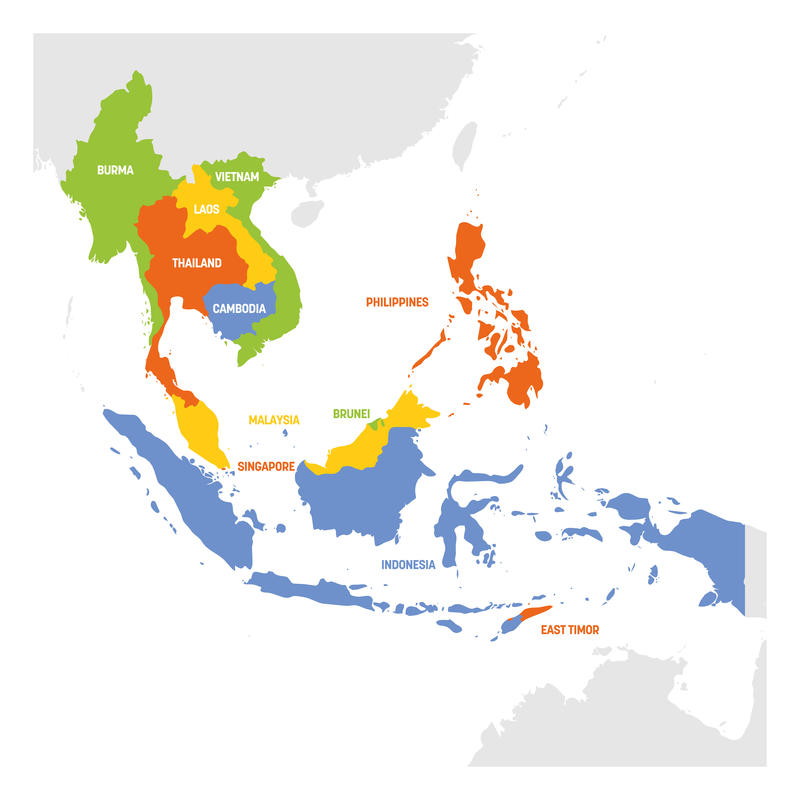
The market area that Machinery World focuses on comprises the countries of the Association of Southeast Asian Nations (ASEAN). Of the eleven national markets that are part of it - Brunei, Cambodia, East Timor, Laos, Myanmar, Malaysia, the Philippines, Singapore, Indonesia, Thailand, and Vietnam - particular attention is paid to the latter six, which are the most interesting in terms of size and economic structure. On the other hand, the Italian Export Action Plan, launched last April by the MAECI, identifies the ASEAN area as a target and Thailand, Vietnam, and Indonesia as countries to focus on.
The Southeast Asian region has traditionally served as a manufacturing hub and an essential junction in the global supply chains of many American and European multinationals. Recent geopolitical developments - from the tariff war to unilateral economic sanctions - are viewed with great concern by countries in the region, but also as an opportunity to redesign the area's role in global trade. Initial reactions have varied, ranging from accelerating negotiations for free trade agreements with other countries (thus diversifying trading partners) to implementing retaliatory measures. In general, it can be observed - somewhat as has happened in India - that Southeast Asian nations are seeking to develop a multipolar trade policy aimed at broadening the range of trading partners.
This approach, which also offers significant business opportunities for Italian companies, is explicitly advocated not only by India but also by Vietnam with its "bamboo diplomacy" and by Indonesia with its “bebas-aktif” (independent and active) policy.
In this scenario, ASEAN countries are pursuing - more than they have done so far and despite differing views on tariffs - a trade policy aimed at strengthening intra-regional ties.
This is confirmed by the statement issued at the latest edition of the ASEAN Business and Investment Summit in Kuala Lumpur (October 25-26, 2025), entitled Unifying Markets for Shared Prosperity.
This trend is also of great interest to our companies, for which – as we will see later – a regional trade approach (rather than one focused on a single partner in the region) can be more efficient and productive. Some recent events are useful for understanding the evolution described above.
Following the new US tariff policies, ASEAN countries have given new impetus to the negotiations on the China-ASEAN Free Trade Area 3.0 agreement ( ), which were successfully concluded last October.
The agreement also aims to intercept the "China Plus One" strategy adopted by multinationals. Under this strategy, multinational companies that manufacture in China aim to also have a presence in another Asian country, often in Southeast Asia.
Remaining on the subject of international cooperation, May 2025 saw a special event: the summit between ASEAN, China, and the Gulf Cooperation Council (GCC, which brings together Saudi Arabia, the United Arab Emirates, Qatar, Kuwait, Bahrain, and Oman), marking the beginning of an economic partnership between the three regions.
In January, Indonesia formally joined the BRICS group, with the aim – as confirmed by authoritative analysis centers – not so much of a political rapprochement with China or Russia, but rather of consolidating economic relations with the various blocs.
One last aspect worth highlighting is the global impact of the different significant restrictions on international trade that occurred over the past year.
A study by Allianz Trade conducted last November estimates that the impact of these restrictions (tariffs, non-tariff barriers, and sanctions) affected goods worth a total of $2.7 trillion, about 20% of total imports. The report estimates that global trade growth will slow to 2% in 2025 and slow further in 2026 (+0.6%).
According to analysts' forecasts, 2027 should see a recovery in trade value (+1.8%), though growth will still be slower than in previous years.
The variables underlying this trend are linked not only to the trade war, but also to heightened geopolitical tensions and the worsening climate crisis.
Examples include the Houthi attacks that have disrupted trade routes through the Gulf of Aden and the Red Sea, and the lowering of water levels in the Panama Canal, resulting in traffic congestion.
For businesses, this has raised the issue of resetting physical supply chains and transport, leading to increased costs and, in some cases, longer transport times.
However, it is worth noting that the Allianz report, which compiles an annual ranking of next-generation trade hubs, placed four Asian countries at the top of this special ranking in 2025.
The United Arab Emirates remains in the lead, followed by Vietnam – which overtakes Malaysia (third) – and Saudi Arabia.