The Italian Trade Agency ICE, a hundred years of exports
The Institute for Foreign Trade turns 100. A work celebrating the milestone was presented last July in Rome. The volume is a summary of the activities carried out by the Agency over the last hundred years heralding the success of products Made in Italy in markets throughout the world
In 2025, the value of Italian export goods hit EUR 643.2 billion, a 3.3% increase compared to 2024. This upswing was supported by the increase in sales of non-durable consumer goods, intermediate goods, and capital goods, offset by the decline in exports of energy and durable consumer goods. The value of imported goods - EUR 592.5 billion - also increased (+3.2%), mainly due to the sharp increase in purchases of non-durable consumer goods. These dynamics have led to an improvement in Italy's trade balance, which is in the black at EUR 50.7 billion (up from EUR 48.3 billion in 2024).
This is just some of the data contained in the 40th ICE Report (2025-2026) and in the 28th edition of the Statistical Yearbook entitled "Foreign Trade and International Business Activities", the result of the collaboration between the ICE Agency for promotion abroad and the internationalization of Italian businesses and the Italian National Institute of Statistics (ISTAT), presented last July on the occasion of the celebration of the Agency's centenary.
Created in 1926 as the National Export Institute, the institution has evolved over the decades, moving from carrying out mere commercial promotion activities to being a service for companies operating outside Italy and a key partner for trade associations and institutions. The results have been significant: in 1926 exports of goods and services accounted for approximately 12% of Italy's gross domestic product. In 2025, the ratio reached a record value of 32.2% of GDP.
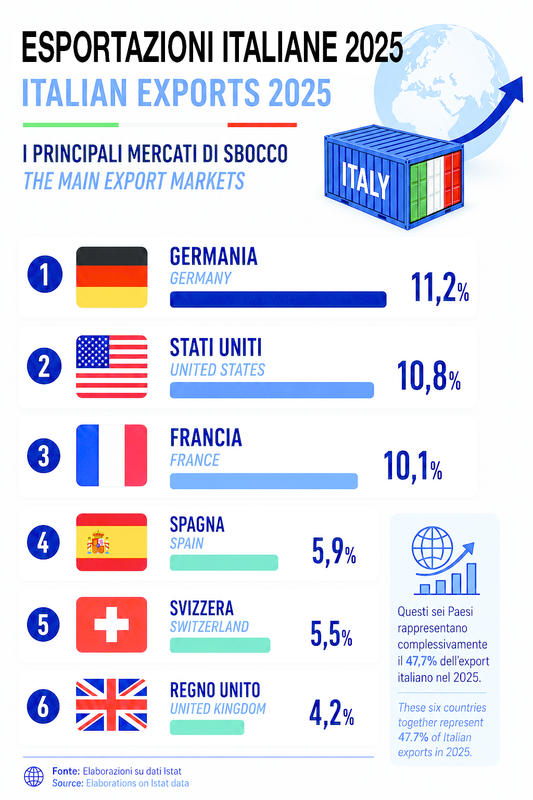
Made in Italy products account for 3% of global trade. The growth recorded in the value of Italian exports is largely due to the increase in average unit values (+2.6%), while export volumes grew by only 0.6%. For imports, however, the growth in value is mainly due to the increase in purchased volumes (+2.1%), with average unit values increasing by 1.1%. Italy's market share of global merchandise exports (measured in dollars) increased slightly, rising to 2.77% from 2.75% in 2024. The increase was more pronounced in some geographical areas, particularly the Middle East (going from 2.69% to 2.82%), North America (up from 1.99% to 2.11%) and the European Union (rising from 4.88% to 4.99%), while decreases were recorded in non-EU European countries (dropping from 5.23% to 4.85%), North Africa (down from 5.85% to 5.73%) and in other African countries (falling from 1.22% to 1.12%). In 2025, Germany was the main export market for Italy, accounting for 11.2% of national exports. The United States and France rank second and third among partner countries, at 10.8% and 10.1%, respectively, followed by Spain (5.9%), Switzerland (5.5%), and the United Kingdom (4.2%). Major countries recording the greatest increases over 2024—i.e., 0.2% or more—were Switzerland, the United States, Spain, Ireland, the United Arab Emirates, and France. while Turkey, China, and the United Kingdom saw a decline in Made in Italy products.
Regional contributions. The Yearbook also provides a snapshot of the different In contributions of Italian regions to the increase in exports. The most significant increases were seen in Tuscany (+21.3%), Friuli-Venezia Giulia (+17.8%), Calabria (+10.8%), and Liguria (+10.2%), while the greatest declines were reported in Basilicata (-17.8%), Sardinia (-11.4%), and Sicily (-10.8%). The increase in exports was exceptionally strong for Central Italy (+13.2%), more moderate for Southern Italy (+3.2%), North-Western Italy (+2.3%) and North-Eastern Italy (+2.0%), and a sharp decline was reported for the islands of Italy (-11.0%). The territorial origin of sales on foreign markets remains strongly concentrated in the Central-Northern regions, which account for 88.3% of national exports, while the South contributes 10%. In 2025, Lombardy remained the leading exporter, with a 26% share of national exports, followed by Emilia-Romagna (13.1%), Veneto (12.4%), Tuscany (11.9%), and Piedmont (9.6%). In 2025, a total of 126,491 economic operators sold goods abroad. Of these, nearly 37,000 belong to the machinery and equipment sector, a sector that remains strategic for the national economy.
A prestigious gathering took place for the Agency's centenary. In addition to ICE President Matteo Zoppas and ISTAT President Francesco Maria Chelli, attendees included the Vice President of the Council of Ministers and Minister of Foreign Affairs and International Cooperation, Antonio Tajani, the Minister of Enterprise and Made in Italy, Adolfo Urso, the Minister of Agriculture, Food Sovereignty and Forestry, Francesco Lollobrigida, and the Minister of Tourism, Gianmarco Mazzi, for the presentation of the ICE Agency's commemorative volume, a true compendium of the Institute's history and the key milestones in the growth of the Italian system in international markets.