Walking tractors and motor hoes: pathways to electrification
Electrification is progressively extending to compact self-propelled agricultural machinery, including walking tractors and motor hoes. Despite the presently limited commercial availability of battery-powered models, these machines could benefit from this new mode of power delivery
The iconic symbols of modern agricultural mechanization are often identified with tractors and imposing, powerful, high-performance harvesting machinery. In reality, a much more compact and maneuverable range of vehicles, such as rotary tillers and, above all, motor cultivators, play an essential role in everyday agricultural work on small farms and hobby farms, especially where the terrain is rough or the slopes are steep.
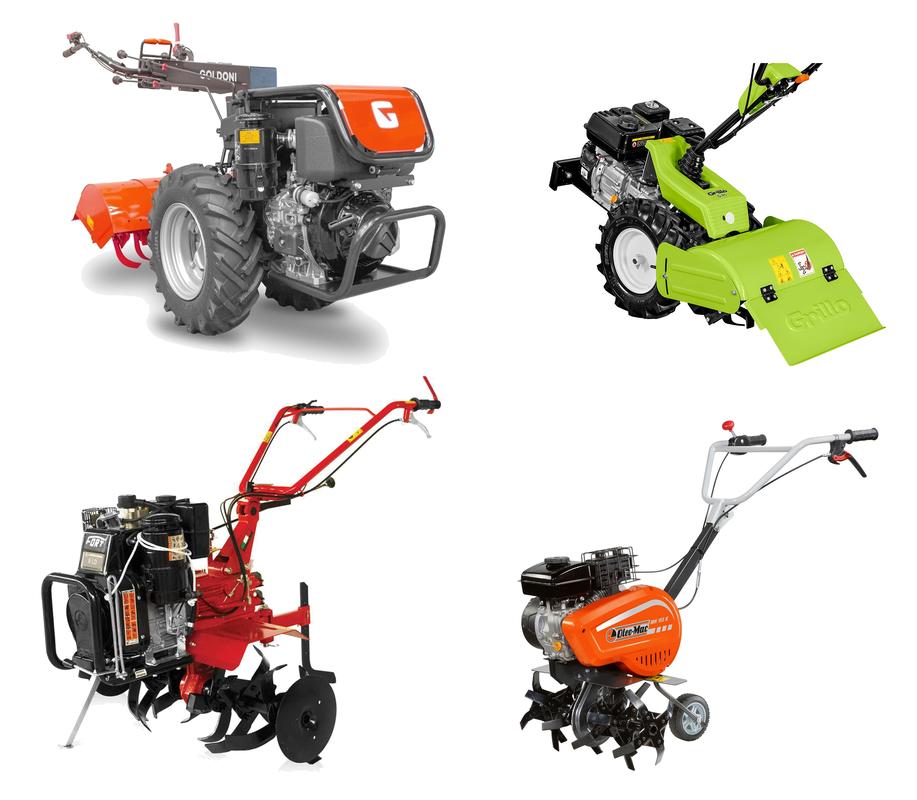
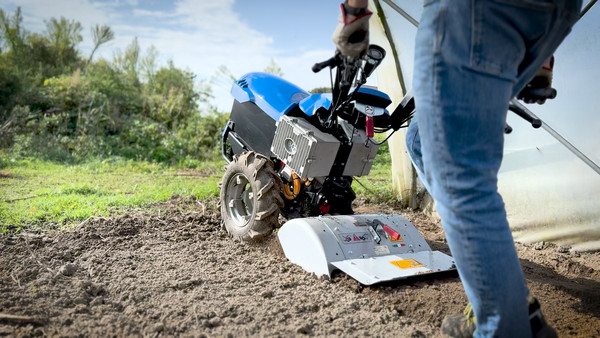
The basis of small-scale mechanization. The rotary tiller is a self-propelled two-wheeled machine, operated by two handles or handlebars held by an operator walking behind it.
It is equipped with an internal combustion engine (traditionally powered by gasoline or diesel, in the latter case in the more powerful models), which transmits motion to the propulsion components for forward movement, and at the same time to a power take-off that makes it possible to operate various implements, such as rotary hoes, plows, small trailers, pumps, mowers, blades, or snow blowers, etc. It is usually a small vehicle, weighing between 70 and 150 kg, which nevertheless ensures good stability and traction even on steep slopes. Its typical uses range from professional horticulture and floriculture to the maintenance of public green spaces and work in small vineyards and orchards.
The rotary tiller is a valid alternative essentially for primary and secondary soil cultivation only. It is always operated by a driver, but it does not have wheels or a power take-off; its weight generally varies between 30 and 70 kg. The engine, which in this case is also conventionally a very low-power gasoline internal combustion engine, directly drives the working parts (the hoes), which are fixed to a rotor of limited width.
The electric transition. Driven by the need for 'zero-emission' solutions, the availability of more efficient and reliable electric motors and, above all, the increase in the so-called 'energy density' of batteries (i.e., greater charging capacity in increasingly smaller volumes and weights) and their electronic management, the electrification of agricultural machinery has undergone a progressive spread in recent years, and even more so in the present period. As a result (in the not-too-distant future...), this is expected to lead to the abandonment of fossil fuels, but also of those from renewable sources, as an energy source for powering machines using traditional internal combustion engines. In particular, "light" agricultural mechanization is benefiting greatly from this transition, especially due to the limited power requirements, which allow for the use of battery packs of reasonable size and weight. Furthermore, the availability of high and constant torque over a wide operating range, which typically characterizes electric motors, favors their profitable application on motor cultivators and rotary tillers, especially when used for tilling the soil. In addition, unlike internal combustion engines, electric motors maintain the same efficiency regardless of load, with immediate responses to the s in the latter. The enormous improvements in operator comfort and health should not be underestimated, with drastically reduced noise and vibration levels and the total absence of polluting gas emissions, all to the benefit of environmental sustainability and, above all, profitable use in protected environments, such as greenhouses and tunnels.
The lithium-ion batteries currently available and installed on motor cultivators and rotary tillers guarantee reasonable autonomy, up to 3-4 hours of continuous work, with dimensions and weights that are perfectly compatible with the optimal operation of the various models. The setup is modular, allowing for quick replacement. It is therefore possible to work with a first battery pack while a second one is being recharged, without downtime, drawing energy from a common single-phase outlet or, better still, through company photovoltaic systems, thanks also to high-performance battery chargers equipped with special thermal management circuits. On the other hand, it should be borne in mind that, unlike in the automotive sector, on motor cultivators and rotary tillers (as well as on tractors), within certain limits, the weight on the drive wheels improves traction, an important feature for certain tasks performed with these machines.
The market situation. Unlike tractors, most of which are low-powered, where there is a decidedly growing supply, the market for battery-powered electric rotary tillers and motor hoes is not particularly rich at the moment. While rotary hoes are often typically hobbyist models or little more, the availability of rotary tillers is very limited.
Without a doubt, this is a strange dynamic, given that battery packs (strictly lithium-ion) with sufficient capacity to ensure adequate autonomy for long periods of work have reached sizes and weights that are perfectly compatible with these machines. Moreover, in most cases, these are low-voltage batteries, 36 or 48 V, i.e., values that do not pose a risk of electrocution to the operator.
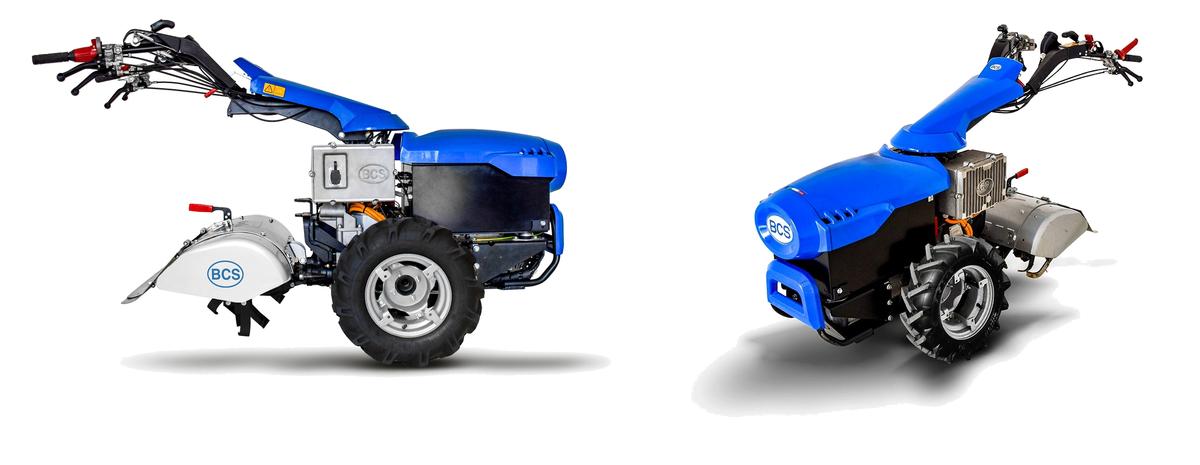
In this not particularly lively landscape, BCS of Abbiategrasso (MI) stands out. At the latest edition of EIMA International, it presented a fully electric motor cultivator model called the e-780, which was awarded the Technical Innovation award. The machine has an original configuration, with two electric motors, the first 1.5 kW dedicated to traction and the other 3 kW for driving the equipment coupled via the power take-off, for a total installed power of 4.5 kW. Compared to the use of a single engine that meets all requirements, this design choice is advantageous, as it allows one need to be met without penalizing the other, with maximum torque delivery at low revs and a wide range of rotation speeds for the two electric motors.
The BCS e-780 has a range of between approximately 1.5 and 4 hours, depending on the workload; the battery pack recharges in just under 2 hours. Similar to its "twin" equipped with an internal combustion engine, this BCS motor cultivator also has a continuously variable transmission, for forward speeds between 0 and 5 km/h.
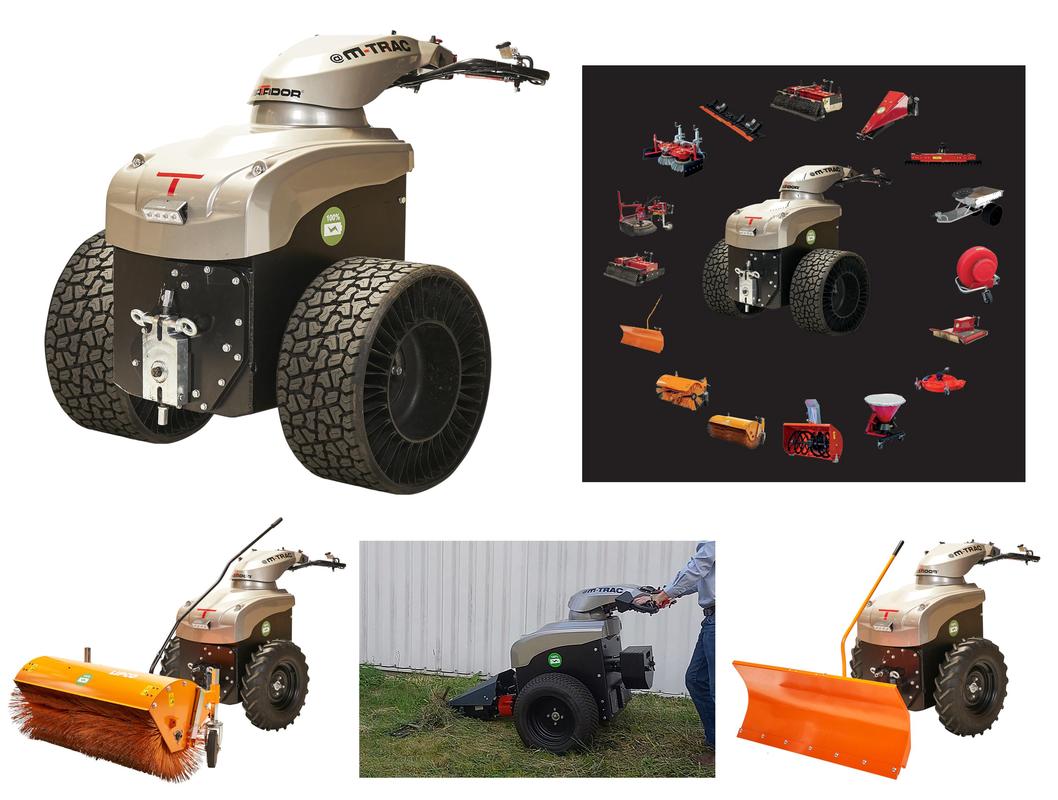
Built in the Netherlands but marketed by the British company Kersten, the Matador 2.0 is now available on the market. It is an electric motor cultivator powered by 48 V lithium-ion batteries with a charge capacity of between 60 and 200 Ah, delivering power of between 5 and 22 kW, depending on the configuration. It is a fairly large machine, given that the engine alone weighs approximately 240 kg. The maximum speed is 6 km/h, while the power take-off for driving equipment has a variable speed between 0 and 1,000 rpm, controlled electronically. Depending on the capacity of the battery pack, the charging time varies between 1 and 10 hours. Numerous attachments can be combined: sweepers, blades or snow blowers, mowers, fertilizer spreaders, etc. In addition to a wide range of tires, from ribbed traction tires to sculpted lawn tires, both narrow and wide sections, it is interesting to note the possibility of fitting puncture-proof rubber wheels, consisting of a sculpted tread connected by a series of "spokes" (also made of rubber) to an inner ring that is fitted onto the rim.
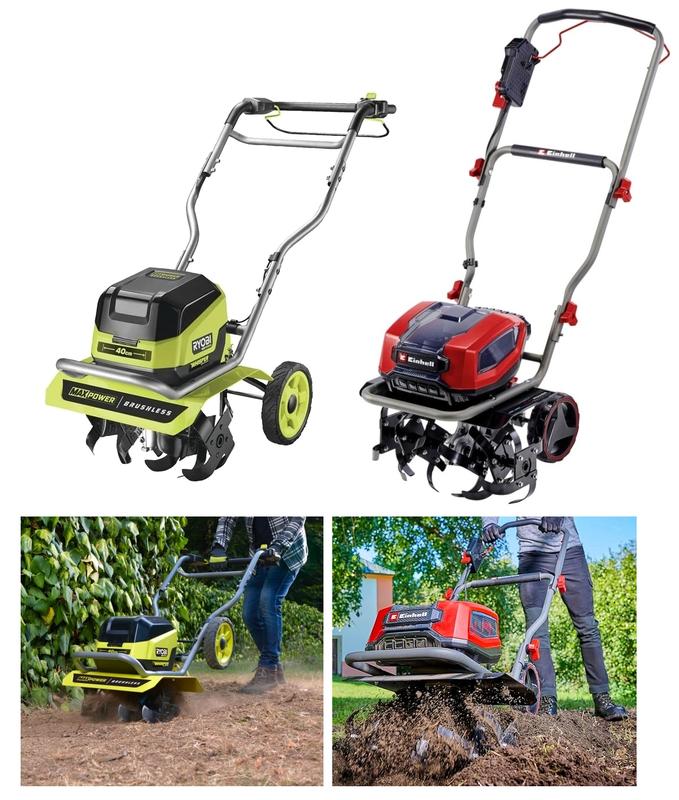
Conversely, the choice of electric tillers is much wider, although most models are purely hobbyist, i.e., equipped with low-power motors and standardized battery packs (often 36 V) that can also be used on other electrified tools. As a result, their working capacity, both in terms of width and depth, is rather limited. There are far fewer (semi)professional models: Ryobi, for example, offers the RY36CVXA-0 model, with a working width of up to 40 cm and a maximum (declared) depth of 20 cm. Batteries with a capacity of up to 12 Ah can be used, with a range that the manufacturer claims is sufficient to work 300 m². The German company Heinhell also offers several models of electric tillers, also powered by 36 V lithium-ion battery packs. The GP-CR 36/45 model is equipped with 24 blades arranged in 6 rows, has a working width of 45 cm and can work - according to the manufacturer - to a depth of up to 20 cm.
Electric motors vs. internal combustion engines for small agricultural machinery: better efficiency and performance
From a construction point of view, electric motors are much simpler than internal combustion engines: for the same power output, they are less bulky, lighter, and therefore require less maintenance, which is essentially limited to checking the integrity of the wiring and periodically cleaning the cooling system. In this regard, modern solutions feature a dedicated liquid circuit for heat dissipation, which allows for proper thermal management of the engine even on hot days and/or in dusty environments, conditions that frequently occur in agriculture. Protection up to IP68 level ensures perfect sealing against dust and prolonged immersion in water or mud. In terms of performance, the electric motor outperforms the internal combustion engine in several respects.
Energy efficiency: electric motors can reach up to 95%, while in real-world conditions, internal combustion engines average around 30%.
Torque and power delivery: electric motors deliver high torque across a wide range of speeds, improving, among other things, the speed of response to load variations, especially with regard to power consumption peaks.
Polluting gas emissions: despite recent remarkable progress, internal combustion engines (especially diesel engines) still produce various polluting gases, such as particulate matter, NOx, carbon monoxide, unburned hydrocarbons, and above all CO2. Electric motors, on the other hand, do not generate direct emissions during operation.
Maintenance: thanks to their simpler construction, the absence of combustion processes (which cause stress on materials) and fewer moving mechanical parts (with the advantages of less complex lubrication), electric motors require simpler maintenance and less frequent service.
The torque and power of electric motors
In internal combustion engines, maximum power is typically delivered at high revs, while maximum torque is developed at a much lower speed. In fact, the difference in terms of revs between maximum power and maximum torque is called "elasticity." The wider this range, the better the engine will be able to overcome the load peaks that the machine encounters during operation without stalling.
The electric motor, on the other hand, behaves very differently, because it is able to develop maximum torque right from the start of rotation, maintaining it for a significant interval as the speed increases. Since power is the product of driving torque and rotational speed, it will also increase until it reaches a maximum value, beyond which it can no longer increase; consequently, a further increase in the number of revolutions will result in a progressive decrease in torque. It is therefore clear that the electric motor performs best at low speeds, unlike the internal combustion engine.
Furthermore, to overcome the so-called "starting torque," i.e., the peak load that allows the vehicle to start moving, the electric motor is definitely more suitable because it can do so at low speeds, unlike the internal combustion engine. For agricultural machinery such as motor cultivators and rotary tillers, if equipped with an electric motor, this behavior is very advantageous because it allows the motor to overcome the increases in load required, for example, to till a more compact section of land while maintaining the motor at very low speeds, which benefits the durability of its components.