Kubota ultraviolet for crop protection
Technology developed in partnership with the French company UV Boosting strengthens plants' natural defenses through controlled ultraviolet light. Sustainable and cost-effective, the two-panel UV-C equipment only requires 12 Hp at the PTO
Two years after announcing its partnership with the French company UV Boosting (June 2024), Kubota confirms its commitment to technology that strengthens plants' natural defenses using UV-C light. For the Japanese multinational, this is a truly strategic choice: stimulating plant responses through controlled ultraviolet light improves crop quality while also helping to reduce crop losses and thus potentially increase yields, all in line with the principles of agricultural sustainability. Germán Martínez Sainz-Trápaga, president of Kubota Spain, details the reference scenario and the group's moves: “At the Kubota Innovation Center in the Netherlands, we are seeking smart farming solutions to meet new needs: sustainable practices, lower emissions, and minimizing the costs of traditional treatments. UV Boosting is one of the solutions we are investing in because it is sustainable, clean and capable of helping farmers' production costs. This technology integrates perfectly with the corporate philosophy expressed by the slogan 'For Earth, For Life'”.
Specifically, pulses of UV-C radiation are used on high-value crops: fruit trees, vines, vegetables, golf courses, lawns, where fungal diseases are the main threat. This special light emission helps the plant strengthen naturally. For Martinez, it's the equivalent of a vaccination in humans: the body reacts and develops immunity. These UV-C pulses increase the level of salicylic acid in the plant, making it more vigorous and resistant. Thus, in the event of fungal attack, drought stress or extreme heat, the plant becomes more resilient. It's a preventative treatment, free of chemicals, side effects, and unwanted consequences. At the same time, it is highly sustainable as it does not cause pollution. The effects appear very positive, especially when combined with a reduction in fungicide treatments, which leads to direct savings on production costs. Furthermore, it is a low-cost technology, making it accessible both for purchase and application.
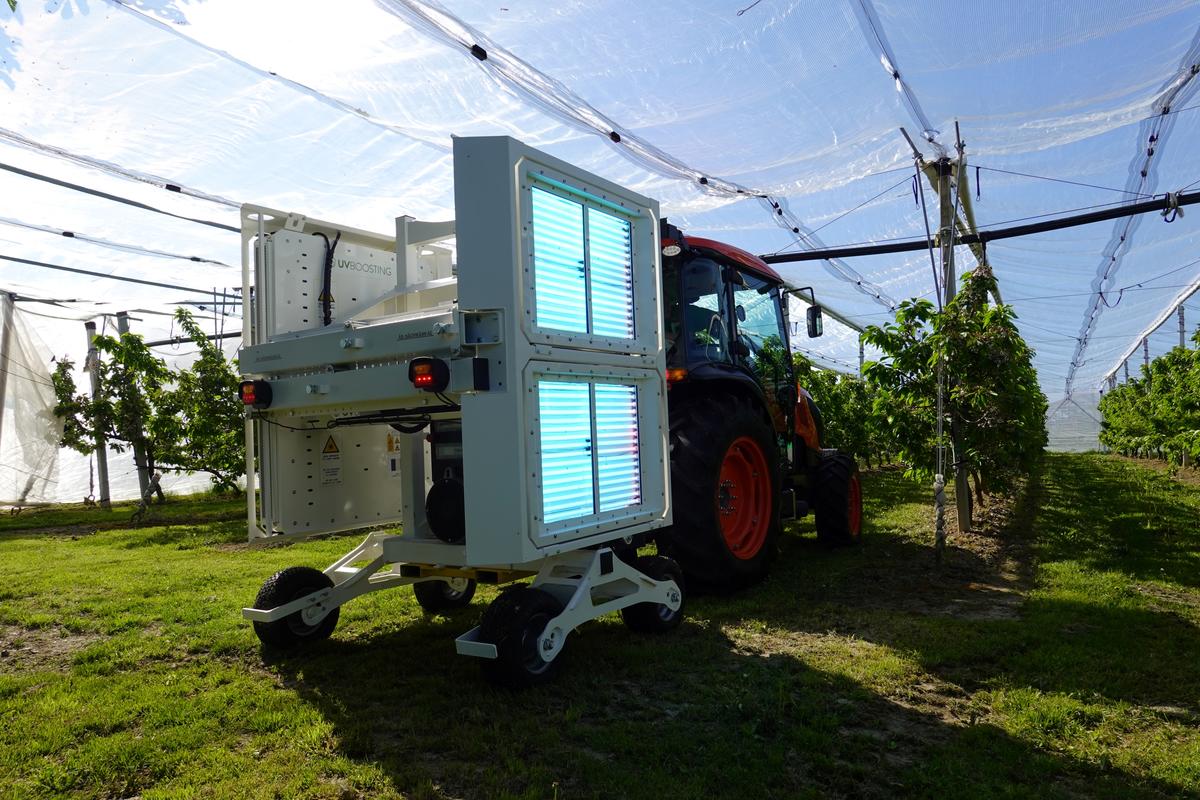
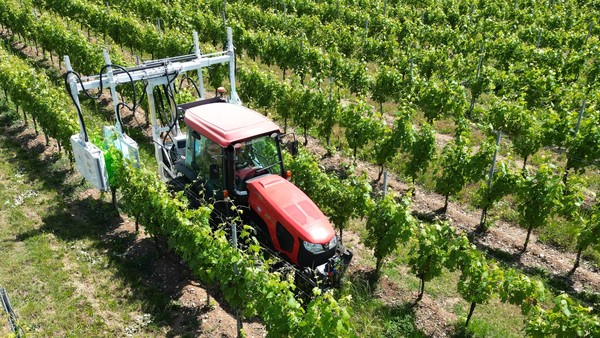
From a strictly operational point of view, the equipment connects to the rear hitch of the tractor and works at a constant speed. It can be used in almost any weather conditions and at any time with low fuel consumption and minimal power requirements: 6 Hp at the PTO for each emission panel. Diego Martin, a smart farming solution specialist, provides the technical details of the Kubota proposal: “From vineyards to orchards, from olive groves to lawns, as well as other applications currently under development, we have specific models for different types of crops, but in 2026 we are focusing primarily on grapevines, fruit trees, and olive groves”.
This mounted equipment (category 1/2) has a support wheel to increase stability during field work and maintain the optimal distance between the crop and the panels (from 15 to 25 cm at a working speed of 4 km/h). Three to four stimulations are performed in the vineyards. We offer a model with two 3.5 kW panels that requires a total of 12 Hp at the PTO and weighs 850 kg. The compact structure allows you to work in rows 1 to 3 meters wide, even on slopes or in fields with narrow headlands. Additionally, a four-panel model is available that allows for the simultaneous stimulation of two rows. In orchards and olive groves, six stimulations must be carried out, using a machine with four 3.5 kW panels each (two per side), which requires a total of 24 Hp, weighs 1,100 kg and is designed for rows of 2 to 5 meters.
It is worth mentioning the low power requirement, which allows working with the PTO in Eco mode, further reducing the engine speed and thus fuel consumption. All models can be mechanically adjusted at the factory or by the local Kubota dealer to suit the size of the crop. Furthermore, operators can make adjustments to best suit the crop conditions at any time from the cabin using electro-hydraulic control. Kubota has demonstrated positive results across several crops - pear, apple, super-intensive and intensive olive groves, pistachio, almond, and stone fruit - that can be summed up in a few key points: improved plant nutrition, prevention of fungal disease spread, protection from frost damage, increased drought resistance, and improved plant yield. In short, it generates greater productivity and a higher yield per hectare.