The trade prospects of the EU-MERCOSUR agreement
Pending the European Court of Justice's legal opinion requested by the European Parliament, the Trade agreement between the European Union and Mercosur, opening up a market of 700 million consumers, provisionally entered into force on May 1st
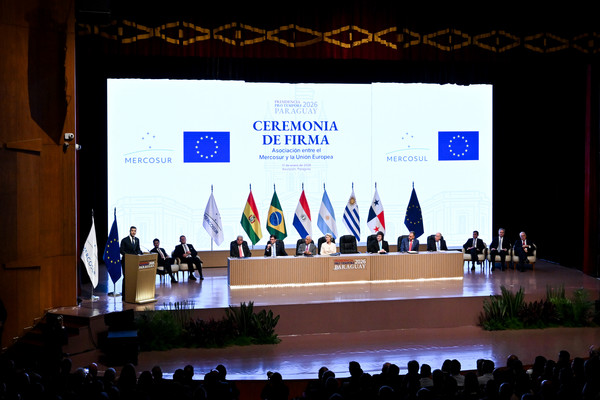
In the new geopolitical scenario that, as is now well known, is structurally changing the global trading system, the Latin American (LatAm) market, which since the 1990s – when the Mercosur agreement was first discussed – was seen as a competitive opportunity, has now become a strategic priority for Italian and European companies. It is no coincidence that the official negotiations begun in 1999 have suddenly picked up speed: on December 6, 2024 the political agreement was signed in Montevideo, in September 2025 the EU Commission proposed that the Council sign the Partnership Agreement and the one on trade, and on January 9th of this year the Council gave the green light to the signing of the agreements, which took place in Asuncion (Paraguay) eight days later. The trend of the votes in the Council clearly showed the countries with the most critical positions towards some parts of the Agreement.
France, Poland, Austria, Ireland and Hungary voted against, while Belgium abstained. The final green light came thanks to the Italian government, which changed its position, and expressed its support for the Trade agreement. However, the Partnership Agreement has not yet fully entered into force, as the EU Parliament has made its ratification conditional on the opinion of the European Court of Justice, which could take up to two years. Pending a ruling from the EU Court, the Mercosur Partnership has been provisionally applied since May 1st, creating a free trade area encompassing 700 million consumers, with Latin American members consisting of Argentina, Brazil, Paraguay, and Uruguay. The agreement promotes Europe's global trade and partnerships and essentially opens the doors, through interregional connections, to the whole of Latin America (LatAm).
The agreement between South American countries and the European Union is part of a context characterized by a repositioning of other global players. The current US Administration has expressed its position unequivocally in the National Security Strategy document: “The United States' national security strategy places dominance of the western hemisphere as a strategic objective for the Trump administration”.
This includes Latin America, which is part of that hemisphere. As for China, it is still unclear to what extent its growing economic influence in the South American region can be contained by US policies. Also worth considering is the political realignment, with some states in the region—Argentina, Ecuador, and El Salvador—aligning themselves with supporters of the US administration's policies, while Brazil and Mexico are more hawkish toward it. Colombia, too, is currently holding presidential elections.
The first round saw the victory of pro-Trump candidate Abelardo de la Espriella, narrowly defeating progressive Iván Ceped. The second round of the Colombian elections, scheduled for June 21, will also have significant geopolitical implications, as will the presidential elections to be held in Brazil next October. Companies approaching Mercosur markets with a view to regional expansion must also consider these aspects, given the costs and time required to get established in the area. This requires an approach that goes beyond a single country, at least in the medium term, and instead takes on a regional dimension. Indeed, if geopolitics guides trade and investment flows in a complex and volatile context, companies, for their part, must learn to manage and operate within this framework.
A final consideration is due to the factor traditionally cited as a competitive advantage of Italian companies: the significant presence of communities of Italian origin, the so-called Italo-descendants. It is a very strong component in some countries: in Brazil it is the largest in the world (around 32 million people), but the presence of Italian descendants is also very strong in (around half the population) in Uruguay where 40% of the inhabitants are of Italian origin.