Variable rate defoliation in vineyards: the key role of the feeler
The feeler regulates the mechanical leaf remover’s proximity to the canopy according to its density and texture, optimizing leaf removal and preventing efficiently damage to the bunches
Defoliation is now a traditional practice in Italian viticulture, involving the removal or inactivation of part of the vine leaves. This technique has always been used for cultivating table grapes, but until a few years ago, it was not widely applied to wine grapes due to the high costs, since it was performed exclusively by hand. Recently, the benefits of thinning the canopy to prevent diseases (especially in humid climates), increase sugar content, and improve bunch ripening have led to growing interest in defoliation.
Moreover, in New Zealand and US vineyards, post-fruit-set defoliation was initially adopted to reduce canopy density, thereby facilitating the penetration of phytosanitary mixtures, but almost immediately numerous studies confirmed additional positive effects due to changes in the microclimate and improved availability of solar radiation. in addition to increasing sugar content, positive effects were also recorded on acidity and malic acid content, pH, and potassium. Furthermore, especially in conditions of high initial vegetative vigor, higher concentrations of anthocyanins and phenolic compounds were measured in the skin of the berries with defoliation. In any case, the effectiveness of this practice depends on several factors, such as the timing of the intervention, the training system, the vegetative state, and environmental conditions.
The definitive success of defoliation, however, was determined by the appearance on the market of defoliating machines that, using different techniques, can carry out controlled, selective removal of part of the canopy, even for different purposes at various stages of the growing season.
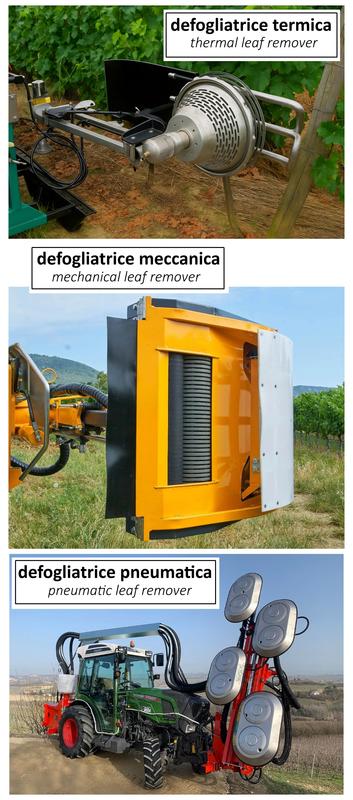
Thermal defoliators were the first to appear on the market. An LPG or propane burner heats air to 70-100°C; the heat generated is directed onto the leaves, causing a thermal shock that leads to protein coagulation and interruption of lymphatic circulation, resulting in the leaves wilting within a few hours and falling off after about two weeks. The main advantage of this solution is its gentle action on the bunch, because the heat acts selectively on the leaf blades and has no effect on the berries (thanks to their high liquid content), but above all because no mechanical stress is produced, thus preventing any damage.
However, thermal defoliators are highly complex to use and incur significant operating costs due to fuel consumption and low operating capacity. In fact, this equipment operates at low speeds of about 2-3 km/h. These limitations, together with the risk of damage to the product in the event of incorrect adjustments, have reduced their use to a few experimental areas or vineyards that are particularly difficult to treat with mechanical systems.
Mechanical defoliators are now the most widely used, thanks to their good balance between effectiveness, operational capacity, and cost. They remove leaves using cutting or tearing mechanisms (rotating blades, mowing bars, milking rollers), assisted by a powerful suction air flow that intercepts and captures the leaves and conveys them to the removal devices.
In models with rotating blades, leaf cutting is facilitated by a rear fan driven by a hydraulic motor, which sucks the leaves in and channels them through a protective grid, preventing the entry of shoots. The versions with milking rollers, now considered more advanced, use two counter-rotating rollers that grab the leaf and tear it from the stem. These machines guarantee excellent quality of work, with good uniformity and a minimal risk of damage to the bunches. Their main limitation is their sensitivity to the structure of the canopy: in very vigorous vineyards or those with irregular vegetation, the action can be uneven and require multiple passes. In addition, the cutting mechanisms require periodic maintenance and, above all, continuous and accurate adjustment of the distance from the bunch area.
Pneumatic leaf removers differ from the previous ones in that they do not operate by suction: their operating principle is based on powerful jets of compressed air, which tear the leaves by striking the leaf blades directly. The damaged parts dry out and fall naturally after a few days. The system is highly effective in reaching the inner areas of the canopy and in working in difficult conditions, such as in pergola or horizontal cover vineyards, where mechanical defoliators encounter difficulties.
However, the high noise level, the considerable cantilevered mass, and the need for careful adjustment of the air pressure make these machines challenging to use. In fact, if the flow is too intense, it can damage young tissues or setting fruit; if too weak, it has an insufficient effect.
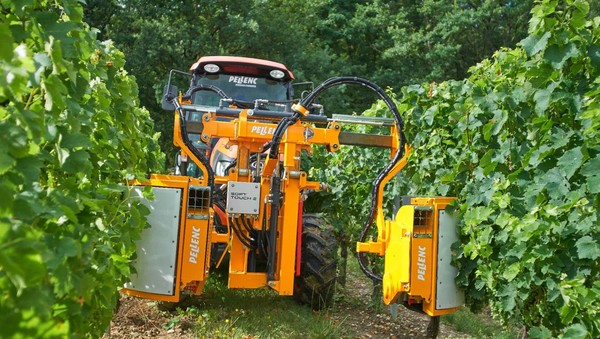
Variable rate defoliation. The most recent evolution in leaf removers is represented by automatic adjustment models, which improve the efficiency and precision of the operation, reducing damage to the bunches and adapting the intensity of leaf removal to the canopy conditions. This is made possible by a mechanical sensor, which is kept constantly pressed gently against the vegetation, continuously detecting the contact pressure. This parameter is used to control electro-hydraulic actuators, which automatically adjust the approach or retreat of the head. In practice, when the vegetation is sparser, the head approaches the row, while if the sensor comes into contact with the bunches, the pressure generated is higher, causing the head to retreat, thus avoiding damage to the fruit. In this way, the machine can perform effective defoliation even in irregular rows and/or with uneven development, to the benefit of the vegetative-productive balance. In the most advanced models, control is electronic, and the operating parameters of the defoliator can also be adjusted according to the speed of the tractor or even on the basis of previously defined canopy vigor prescription maps (e.g., using NDVI or NDRE indices), improving the quality of the work. In addition, the operator can initially set the intensity and sensitivity of the operation, customizing it for early or late defoliation. In particular, it is possible to adjust the rotation speed of the milking rollers and fan, as well as the optimal distance of the head from the canopy (the so-called "zero point") and its translation speed (transverse to the forward movement), as well as the inclination with respect to the horizontal plane.
Automatic adjustment models typically have higher yields than traditional ones, usually working at speeds between 2.5 and 4.5 km/h, with excellent operating capacities (between 0.6 and 1.2 ha/h). Despite their undoubtedly higher cost and the need for careful maintenance of the sensors, these models are now one of the most promising solutions in the field of precision viticulture.
The sensor. Also known as a "sensitive eyelid" or "palpator," it is a fundamental control device in automatic adjustment systems applied to equipment for managing the vegetative wall. Its function is to monitor the density of the canopy (including the presence of bunches), generating a reference signal that allows the intervention to be adapted to morphological variations in the row. Structurally, it is a curved hinged panel connected to an elastic or articulated system that allows it to compress in the vertical plane and then return to its resting position. The extent of the panel's deviation, determined by the pressure of contact with the canopy, is transmitted to a mechanical, hydraulic, or electronic detection system. The signal generated is then processed by a control unit that regulates the approach of the defoliator head in near real time.
In the latest models, mechanical sensors are replaced, or more often supplemented, by optical, infrared, or ultrasonic proximity sensors, which operate without physical contact, detecting the distance from the vegetation wall by measuring the return time of a light or acoustic signal. These solutions ensure greater precision, faster response, and less wear on components, making them particularly useful in operating contexts characterized by particularly irregular vegetation.
In the presence of denser or protruding vegetation, the more pronounced deviation of the sensor causes the operating apparatus to move away immediately; conversely, when the canopy thins out, the system commands it to move closer. The operator can intervene by adjusting the sensitivity of the sensor or the response threshold, adapting the behavior of the system to the specific conditions of the vineyard.
The use of the sensor has numerous operational advantages: it allows for a more consistent quality of work, reduces manual adjustment, and improves the safety and delicacy of the action on the plant. Automatic adjustment of the approach also compensates for unevenness in the vegetative wall, optimizing the effectiveness of the treatment and reducing the risk of accidental impact or damage. The main disadvantages include greater construction complexity and higher cost compared to traditional manual adjustment systems. Sensors, especially mechanical ones, are subject to wear, tear and require careful periodic maintenance to ensure reliable operation. The accumulation of dust, plant residues, or moisture can compromise their sensitivity and responsiveness. Furthermore, even electronic systems require regular calibration and adequate protection against vibrations, shocks, and adverse environmental conditions. The effectiveness of the sensor is proven by its extended application to pneumatic defoliator models, where the removal of leaves does not involve tearing or cutting, but rather laceration of the leaf blade, which leads to its gradual inactivation.
In this case too, the effectiveness of the powerful pulsed air flow, which exerts the mechanical action of breaking the leaf, is managed by moving the head closer or further away, regulated by a palpator.