Apps for monitoring agricultural tyre performance
Tyre inflation pressure should not be regarded as a fixed value: variations affect tractive performance, soil compaction, fuel consumption and tyre wear. Dedicated Apps help select the most suitable pressure and, in more advanced systems, monitor and adjust it while working
An agricultural machinery too, tire inflation pressure was long considered almost a “workshop” parameter: it was checked occasionally, often before the busiest season, and then work was always done at the same pressure, whether for plowing, transport, sowing, or harvesting. For some time now, that approach has been getting harder to sustain, since tractors, trailers, and self-propelled machines are heavier, travel farther, and keep switching between field work and road work. At the same time, there is growing attention to protecting soil structure, reducing fuel use, and minimizing tire wear. Against this backdrop, inflation pressure inevitably becomes a real operating adjustment, chosen according to the machine’s characteristics and typical farming operations. The right value depends on the tire’s construction technology and size, the number of wheels on the axle, the static and dynamic load, speed, ballast, the implement (mounted or towed), and the type of use. For each tire, the Apps available today start from the minimum values permitted for safely carrying the maximum expected load at the stated speed, in line with the manufacturer’s tables, and turn those complex technical tables into a guided, repeatable, and documentable procedure.
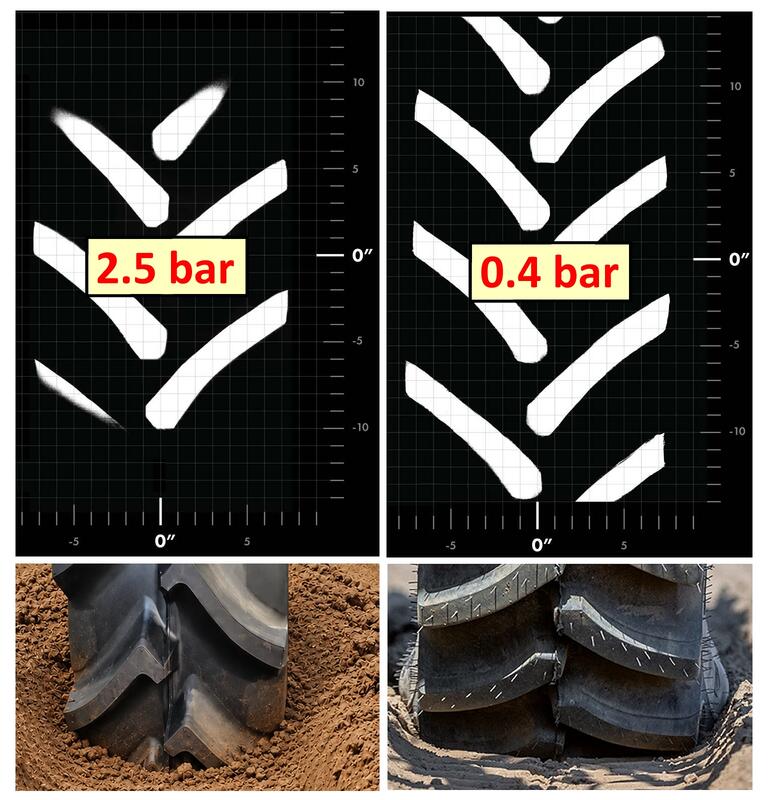
A footprint that changes how the machine works. Internal pressure supports the load and, together with the carcass, determines how much the tire deforms. Lowering it within the permitted limits widens the footprint on the ground; more lugs in contact with the soil help generate drawbar pull, while the weight on the wheel is spread over a larger surface, which reduces sinkage, limits slip, and ultimately improves traction efficiency. The size of the benefit, however, also depends on several other factors, such as soil texture and moisture, the added weight on the axles (through ballasting) and how it is distributed, the type of implement attached, and the tread pattern.
For traditional agricultural tires, the usual practice is to take 1.6 bar (160 kPa) as the standard inflation pressure; recently, however, there has been a marked trend toward lowering it to about 1 bar, especially for the newer tires marked IF (Increased Flexion) and VF (Very High Flexion). These widen the operating margin considerably, but they do not remove the obligation to respect the load, speed, and pressure specifications. It follows that to get the best performance, the pressure has to be lowered to 0.6-0.4 bar, but never below that minimum limit. Conversely, values above the standard reduce the footprint and stiffen the carcass, causing deeper ruts and more slip in the drive wheels, so more power is wasted. It should also be remembered that deep compaction (the kind produced below the normally worked layer) depends not only on inflation pressure but above all on other highly influential factors, such as axle load, the number of passes, and soil moisture conditions.
It must also be kept in mind, however, that a pressure below what load and speed allow can cause the tire to overheat, damage the carcass, and encourage slipping on the rim, all of which can compromise its stability and durability. The correct technical criterion is therefore to use the lowest pressure permitted for that actual working condition.
This is where dedicated Apps prove their usefulness: indeed, field and road call for sharply different settings. In the field, in fact, the aim is to reduce ground pressure so as to keep a wide footprint, while on the road stability, low rolling resistance, and effective thermal control of the carcass take priority.
Leaving the “road” pressure in the field reduces traction and damages the soil; keeping the “field” pressure during road transfers can compromise safety and accelerate wear.
Therefore, it is necessary to change the pressure every time the machine moves from field to road and back: in this case, CTIS systems (Central Tire Inflation System, centralized systems for changing inflation pressure, see box) prove invaluable, as they make these changes possible even while the vehicle is moving.
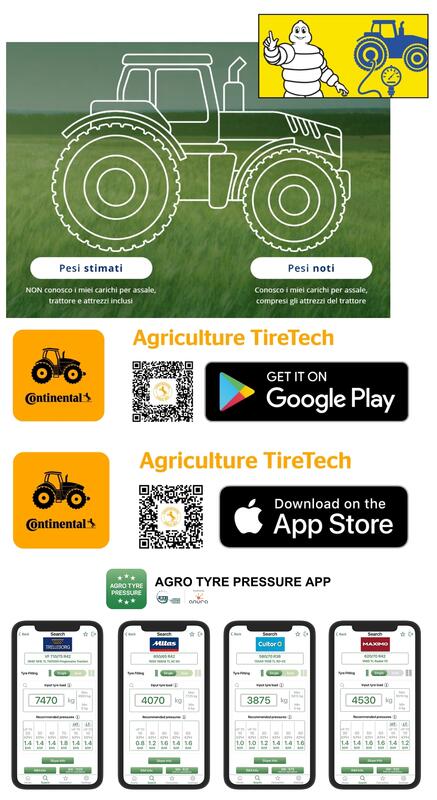
Dedicated apps complement this by making the choice easier: once the tire size, axle loads, speed, and type of work have been entered, the appropriate values are worked out. The most complete solutions also allow recurring configurations to be saved, but at this stage entering correct data becomes important. In other words, the real axle load has to be actually measured, or estimated with a model that takes into account equipment, tank fill levels, and load transfers, rather than relying on mere “nameplate” data.
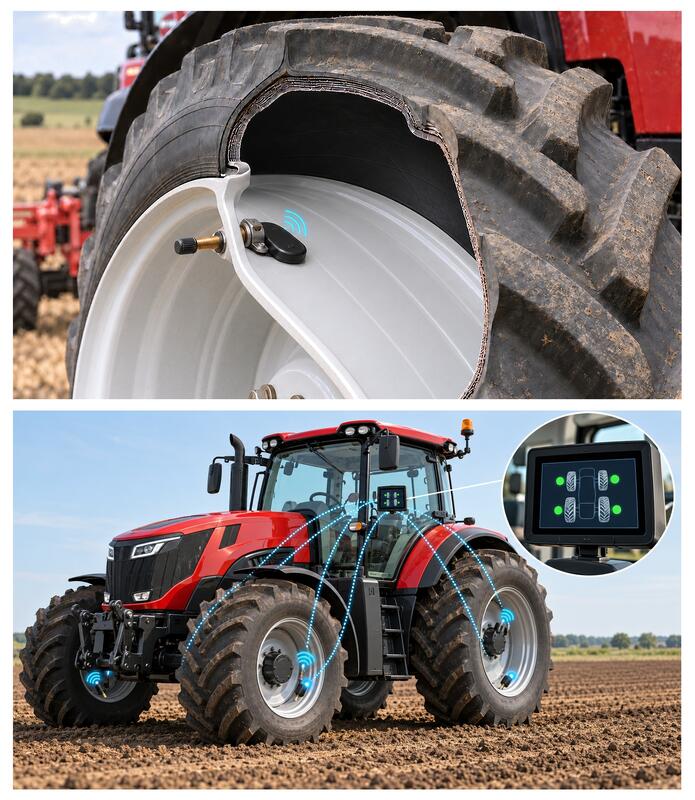
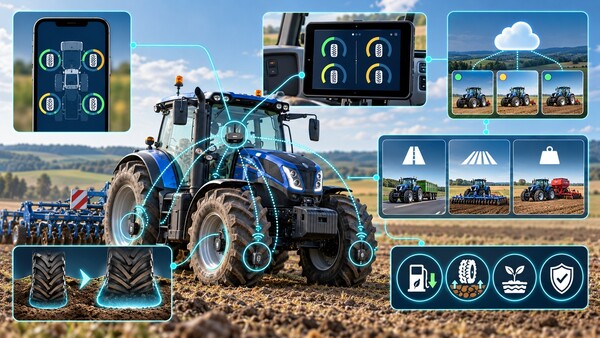
From spot checks to TPMS. The most advanced applications do not just run a “static” calculation but also interface with the now widely used TPMS (Tire Pressure Monitoring System, tire pressure monitoring systems). These report the actual pressure of each tire on the vehicle, thus providing dynamic control through sensors that are normally fitted to the valve or inside the wheel and often also detect temperature. A gateway receives the wireless signal and sends it to the onboard display (or to a smartphone, tablet, or even a remote portal).
In fleet management, the data can also be viewed at company headquarters or by an authorized dealer, turning pressure checks into preventive maintenance. So TPMS and CTIS are not synonyms: the former measures and communicates, while the latter physically acts on each tire’s pressure.
On the most advanced tractors, the ISOBUS monitor in the cab is therefore the terminal that handles the entire function.
The role of Apps. They can be classified into 4 levels of increasing completeness and performance. The simplest level consists of single-brand pressure/load calculators; their strength is direct access to the manufacturer’s tables and, in some cases, to databases of tractors, implements, or trailers.
Michelin AgroPressure (https://agropressure.michelin.net/home) is available as web and mobile versions and guides the user in estimating or entering the loads on each axle, then returns the recommended pressure for the given configuration. Continental Agriculture TireTech (https://www.continental-pneumatici.it/continental-for-business/services-and-solutions/agriculture-tiretech-app) combines the calculation described above with a front-wheel lead calculator for 4-wheel-drive tractors with front and rear wheels of different sizes. A further, more practical option is the multi-brand one: the Agro Tyre Pressure App (https://play.google.com/store/apps/details?id=biz.anura.agrotyres, available for both Android and iOS), developed in collaboration among several manufacturers, brings together pressure, load, and speed tables for different brands, so that, with a mixed fleet, there is no need to switch from one catalog to another. This is undoubtedly an operational simplification, but it still requires checking that the selected brand, series, load index, and operating condition exactly match the mounted tires.
Integration with TPMS is a leap in quality, as it pairs calculated values with measured ones and can alert when they deviate from the targets.
The TLC Plus recently developed by Yokohama-Trelleborg-Tires as an evolution of its Load Calculator, connects valve-mounted pressure sensors and a gateway to the mobile device, with the option of remote consultation. This solution illustrates the transition from “recommendation” to continuous verification, although it requires checking the availability, support, and compatibility of individual kits in the national market.
The highest level of automation is that of active inflation pressure management systems.
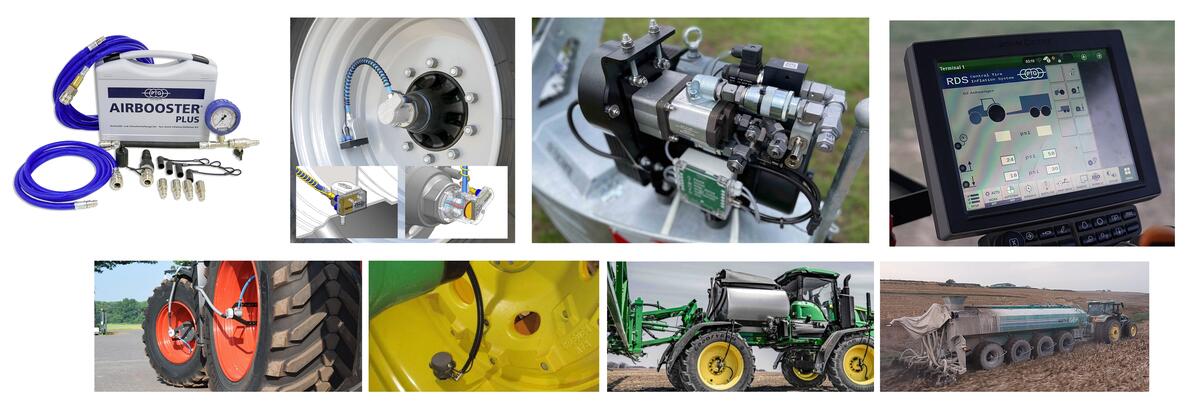
This software runs on a proprietary or ISOBUS terminal: the operator selects a profile (often saved beforehand), and the system changes the pressures while the tractor-implement combination moves. PTG of Neuss (Germany) (https://ptg.info/?lang=en) has long specialized in developing centralized pressure control systems for agricultural tires, at various levels of completeness and automation.
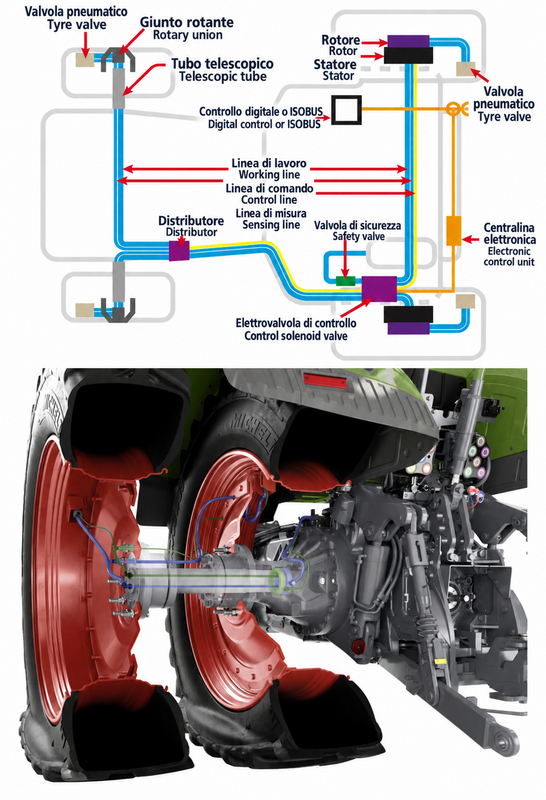
Its range starts with the Airbooster Plus, a portable kit for raising and lowering tire pressure with the machine stationary, and goes up to several CTIS models that adjust pressure on the move. For agricultural tractors, one-line and two-line solutions are available: RDS/radial systems use a rotary union inside the wheel, while AIRBOX/drive systems run lines from the fender to an external union. In two-line systems, the wheel valve isolates the tire from the circuit when adjustment is not active, keeping the piping free of pressure.
Control can be pneumatic, digital, or, usefully, integrated into the ISOBUS terminal; with the latter, it is possible to recall profiles and manage both axles of the tractor at the same time.
Several solutions are also available for trailers and self-propelled machines (combine harvesters, forage harvesters, self-propelled sprayers and slurry spreaders, etc.), allowing modular configurations to be set up according to the characteristics of all the axles, the required air flow rate, and the conditions of use (field or road).
The CTIS (Central Tire Inflation System)
The first prototypes date back more than 35 years, and today CTIS is firmly established in practice. It is a system that allows the tire pressure of tractors, self-propelled machines, and trailers to be varied from the driver’s seat, even with the vehicles moving. Unlike TPMS, which measures and communicates pressure and temperature, CTIS actively changes each tire’s pressure.
Air from a tank kept under pressure by a compressor is filtered and then reaches a pressure regulator and, after that, the solenoid valves. The connection to the wheels is made through fittings and rotary unions on the hubs; the latter are the most critical components of the entire system. Shut-off valves and sensors keep the circuits separate and verify that the set value is reached.
The control unit opens the inflation or deflation valves and checks the pressure. In the cab, a dedicated monitor (or the ISOBUS terminal) makes it possible to call up stored profiles, such as “field,” “road,” or “loaded trailer.” In fact, the most complete systems also manage the towed implement, monitor speed, and report leaks or other anomalies.
The advantage is that it makes the switch between two opposite conditions both possible and effective: in the field, a low pressure is needed (within the technically permitted limits for that particular tire) to enlarge the contact area, so as to maximize the tractor’s pulling capacity and limit compaction; on the road, higher values are needed for greater load capacity and optimized stability of the tractor-implement combination, but above all to limit wear and motion resistance.
Profiles have no standard values: they must be defined by considering the real load on the axles, speed, and the size and construction technology of the tire, in compliance with the manufacturer’s specifications. CTIS therefore does not replace the right choice of tires and ballast, but makes it possible to apply the right pressure continuously for the job at hand.