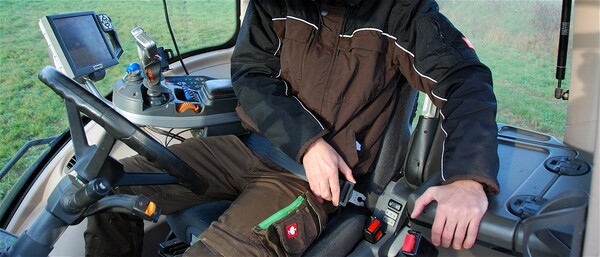
"Smart" seat belts
The agricultural sector continues to record numerous accidents at work, the vast majority resulting from tractor overturning. The ROPS is the primary protective device, but it must always be used in conjunction with a properly fastened seat belt
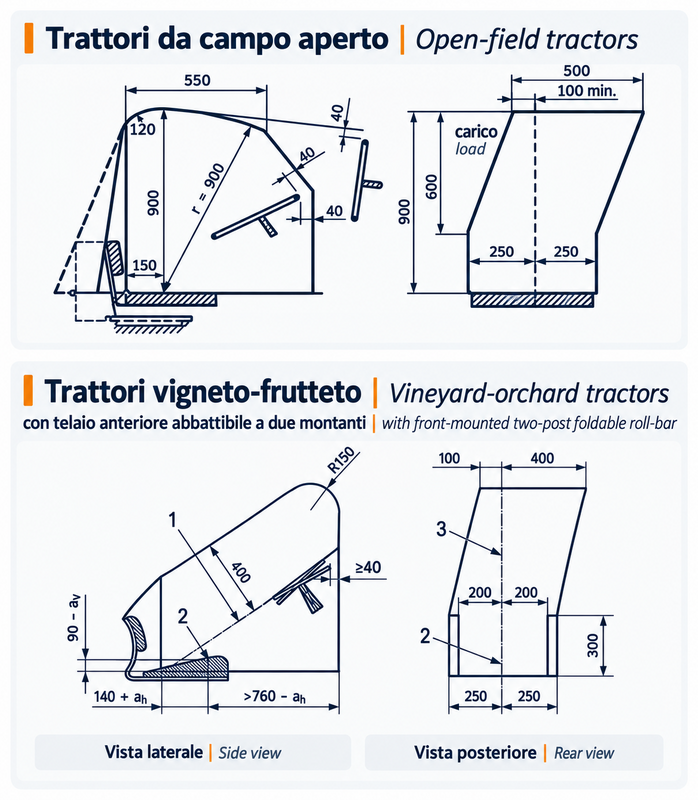
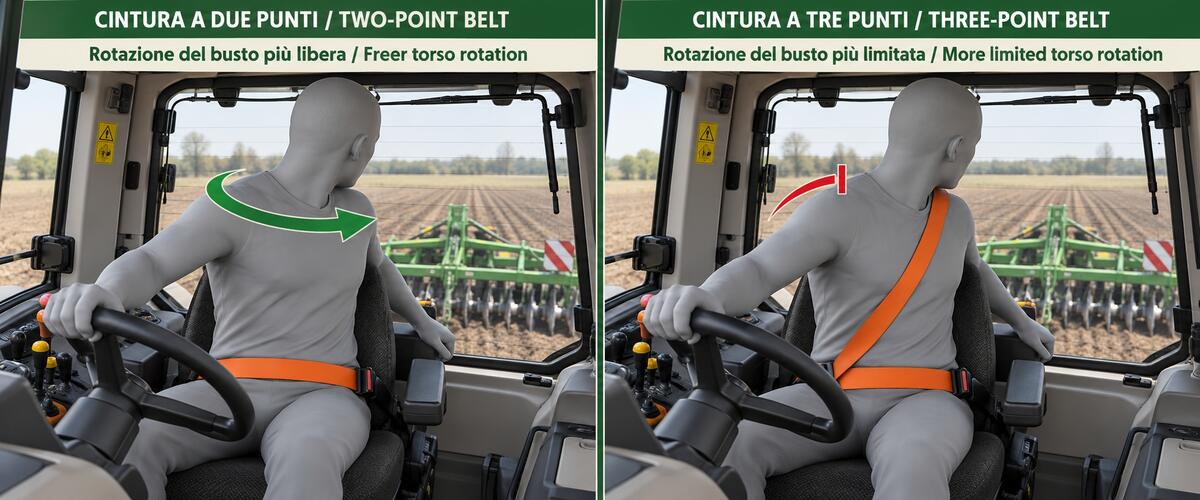
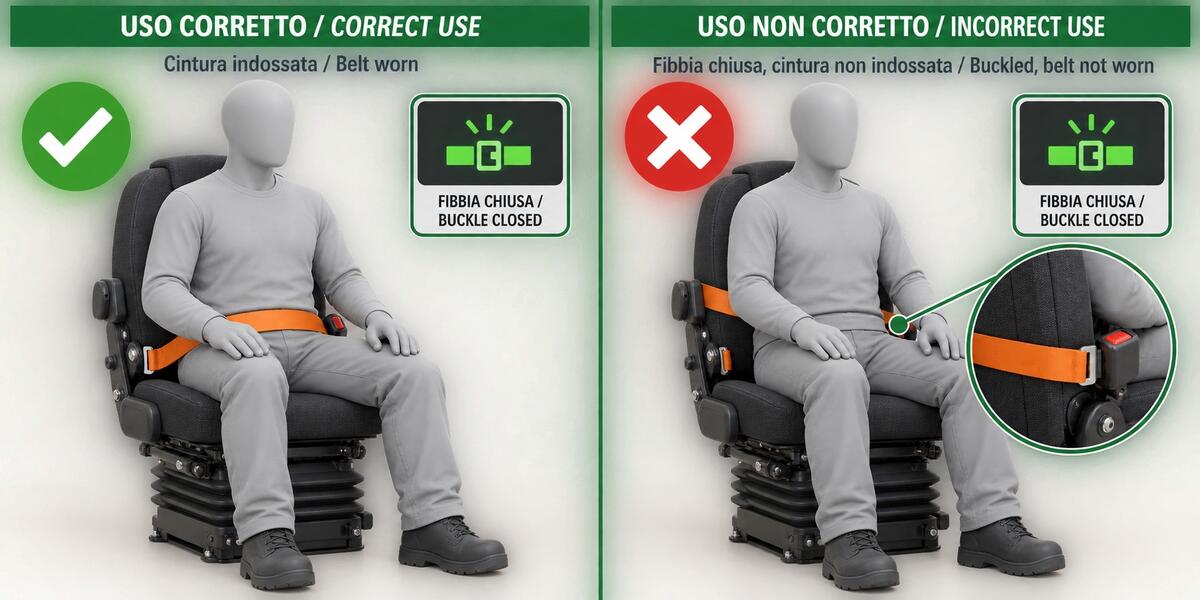
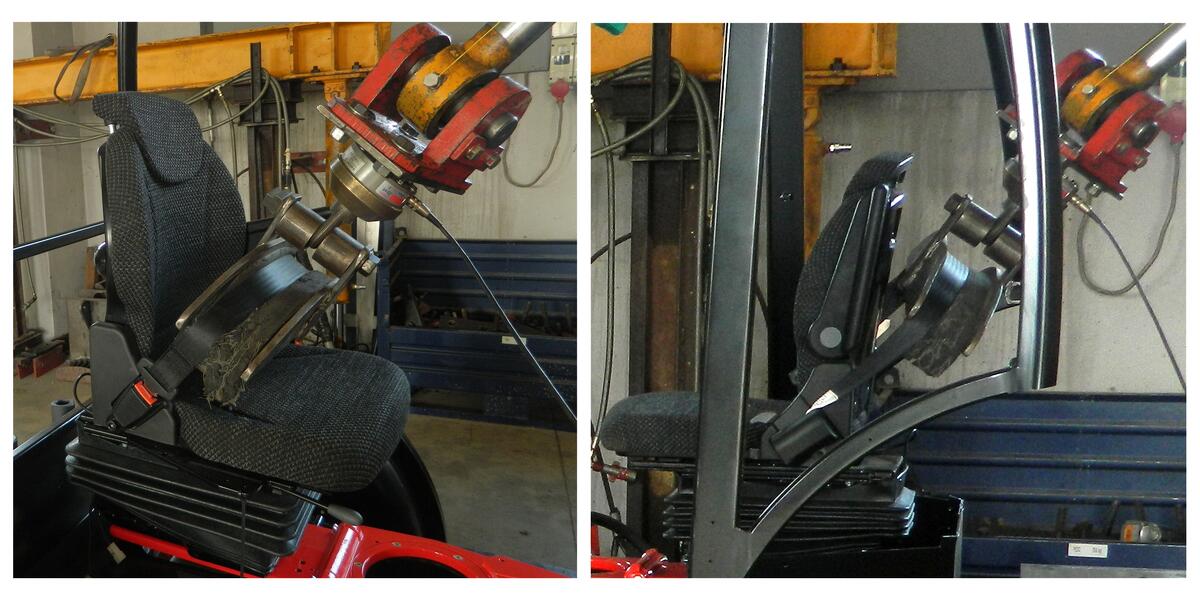
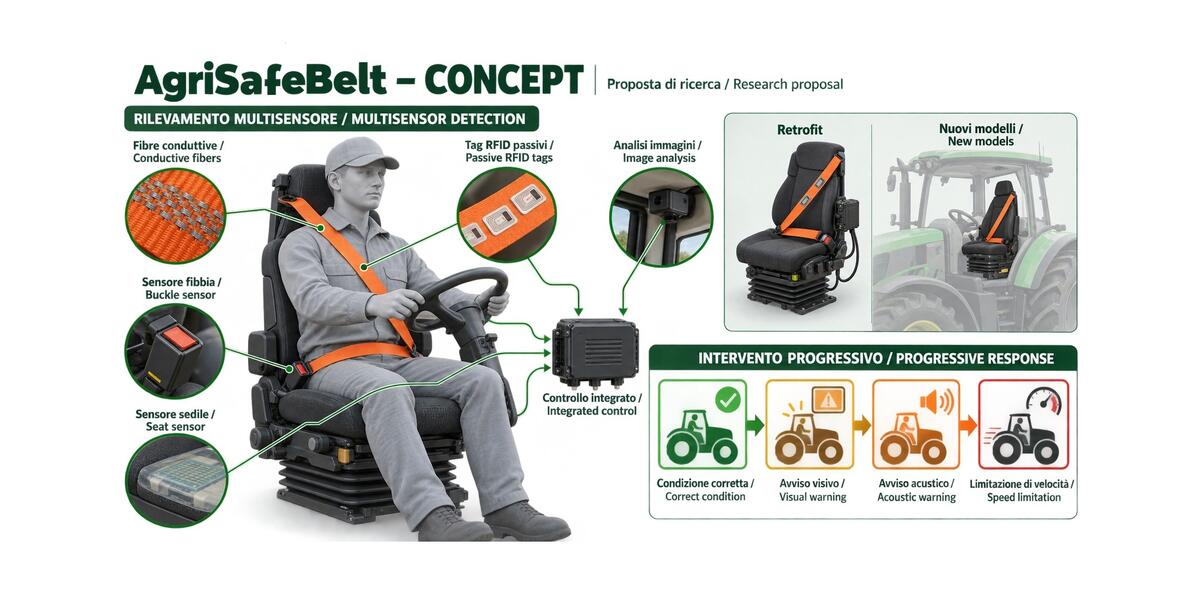
Tractors are often used on terrain that has uneven and irregular surfaces, may be sloping and have variable grip conditions. Soft, uneven, or unstable ground, combined with a relatively high center of gravity and the stresses generated by equipment, can compromise the stability of the work site and make overturning one of the most serious and recurring accidents. Since the risk of overturning cannot be completely eliminated, driver protection relies primarily on devices designed to limit the consequences. Among these, ROPS (Roll-Over Protective Structure/Systems) play a fundamental role, i.e. structures providing protection in the event of a rollover: the main types include two- or four-post frames, or closed cabins whose framework acts as a ROPS. These structures are designed to resist the mechanical stresses caused by tipping, protecting the space occupied by the operator (clearance zone), provided that he remains attached to the driver's seat. Thus the ROPS does not prevent the tractor from losing stability, but rather maintains a geometrically determined safety volume around the seat-steering wheel complex, within which the driver can be protected from the risk of crushing. The effectiveness of the ROPS therefore depends on the operator remaining within this volume during all phases of the rollover. This function is currently entrusted exclusively to the seat belt, which completes the protection system by preventing ejection from the driver's seat and limiting movement towards the rigid parts of the vehicle. The proper and effective use of the seat belt is still one of the most critical aspects of the current system. The development of configurations with more than two anchor points, perhaps also including devices capable of recognizing usage methods, together with progressively more complex intervention logics undoubtedly opens up new and interesting perspectives for the safety of drivers of tractors and self-propelled vehicles. The seat belt, the weak link in the system. The rollover protection system basically includes ROPS and a seat belt, which perform complementary functions: the former protects the safety zone, while the latter keeps the driver within the defined volume. However, unlike most protective structures, the seat belt requires voluntary action to properly perform the function for which it is installed, that is, it must be properly worn, adjusted and maintained. The mere presence of the device on board does not automatically ensure its effectiveness. In agricultural work, the systematic use of the seat belt can be hindered by the need to frequently get into and out of the driver's seat to connect and adjust equipment, or to check the quality of the work performed, but above all by the need to frequently turn around in order to check the operation of rear-mounted equipment, as typically occurs when plowing. Vibrations, bulky clothing, dust and mud can also reduce ease of use. Added to this is a very insidious psychological factor, namely the belief that at low speeds the risk of overturning is low. In reality, overturning can occur even when the tractor is almost stationary, for example due to a sudden subsidence of the ground or landslide, coming upon a steep slope or a sudden imbalance caused by the coupled equipment. Although it seemingly offers better protection, even a closed cab cannot compensate for the effectiveness of a properly worn seat belt: in fact, an unrestrained driver can hit the rigid parts of the passenger compartment, or break the glass of a door and be thrown out. In any case, failure to use it should not be considered exclusively a behavioral problem, but also a design one. The position of the anchors, accessibility of the buckle, ease of adjustment, freedom of movement and reliability of the alarms have a direct impact on the propensity to use of the device. An ergonomic seat belt, compatible with real operational needs, is more likely to be worn effectively, allowing the ROPS–seat–seat belt system to provide the protection for which it has been designed. Two anchor points and freedom of movement. Unlike the automotive sector, where the seat belt must hold the person firmly against the back of the seat to avoid a frontal impact with the front window (as well as an excessively violent impact against the airbag, in the event that the latter were to explode), the main function of the lap belt is to keep the operator's pelvis firmly against the seat in the event of a rollover, preventing him from being thrown outside the safety zone. In the agricultural sector (and, more generally, often also in other work sectors) the two-point seat belts currently installed on self-propelled agricultural machinery sufficiently meet this requirement, while still ensuring reasonable freedom of movement of the operator's torso. While this feature may be an advantage to the effective use of the lap seat belt, it can also become a critical issue, as this solution does not prevent great turning of the operator's torso during a rollover, thus potentially preventing the head, shoulders, or chest from impacting against rigid elements of the passenger compartment. It is precisely this critical issue that has given rise to interest in developing multi-point anchoring solutions for agricultural vehicles capable of limiting the movement of the upper part of the body. Furthermore, the potential application of seat belts with multiple attachment points also presents technical and operational problems, such as the inadequacy of their use in relation to normal seat suspension oscillation, the large movements of the torso and upper limbs required to activate the controls necessary to manage the tractor and coupled equipment, but also a certain design difficulty in identifying a suitable third anchor point (the upper one), considering the typically central location of the driving position within the passenger compartment. Thinking about the application of these solutions in a retrofit context is even more complex: the fleet of vehicles currently in operation, often having been in service for a very long time, includes seats, platforms and construction architectures that are very different from each other, often difficult or completely incompatible with a potential upgrade of this magnitude. Installing a seat belt with more than two anchor points cannot thus be considered a universally valid solution, much less one that can be addressed by resorting to improvised anchors. It must be supported by tested and valid configurations, precise instructions and verification of the strength of the assembly. Buckled up does not always mean worn properly. The most common control systems only detect when the buckle is actually inserted into the designated slot, otherwise activating audible and/or visual alarms, and in some cases preventing the vehicle from starting. However, this system does not verify that the seat belt actually wraps around the driver correctly. A truly effective control measure thus should involve combining the buckle closure signal with other parameters, such as the actual presence of the operator on the seat and the actual elongation of the belt, perhaps with the measurement of the tension force compatible with its regular use. Comparing multiple pieces of information would make it possible to distinguish between proper and improper usage, while at the same time limiting false alarms. It is important to stress that in this case the aim is certainly not to monitor the driver's behavior, but rather to verify that the restraint system is actually operational. A changing regulatory framework. In tractors equipped with ROPS, the seat belt is not simply a seat accessory. For approval purposes, both the complete device and the anchor points are evaluated. Delegated Regulation (EU) No. 1322/2014 in fact sets out separate requirements for anchorages and seat belts, recalling the ISO 3776 standard, which in its various articulations defines the position of the attachments, their resistance and the characteristics of the complete belt. The belt fabric must also meet specific performance requirements, together with the buckle, adjustment systems and other components. More specifically, for work vehicles (including agricultural tractors) the resistance of the anchors has to be assessed. This test does not only concern the points to which the seat belt is directly connected, but involves the entire seat system: during the test, in fact, the tensile forces that are exerted are transmitted from the attachments to the structure and suspension of the seat, up to its fastenings to the vehicle. Increasing the attachment points from two to three (or more) may therefore require rethinking the testing methods, since adding one or more anchor points inevitably changes the path and distribution of the loads. AgriSafeBelt, an “intelligent” restraint designed for agricultural workers. Funded by the INAIL BRiC 2025 project and being developed by university research units and CREA, the “AgriSafeBelt” project aims to develop models of intelligent seat belts, with three (or more) anchoring points for tractors and self-propelled agricultural machinery. The goal is to determine whether the belt is actually being worn by checking not only that the buckle is properly closed, but also the fastening sequence, the length of the belt extension, and whether the belt is maintained properly during work. To this end, various technologies will be evaluated, including sensors in the seat and backrest, conductive fibers embedded in the belt, passive battery-free RFID tags, and image-analysis-enabled cameras. Comparison of all the information collected should allow for the effective and continuous recognition of improper use, while reducing false alarms. The project also aims to study new anchor configurations, with the aim of limiting sudden movements of the torso in the event of a rollover, without however hindering movements necessary during normal work. The application of a progressive intervention logic will also be evaluated. This logic, after adequately warning the driver of a non-compliance, can limit the vehicle's speed and/or certain operating functions without causing dangerous sudden stops. The solutions will be designed to be integrated into both new production models and hopefully to update vehicles already in use. Expected outcomes will include prototypes, test methods, guidance for manufacturers, and information materials for users, which will also serve as a basis for future regulatory developments.
Two-point seat belts
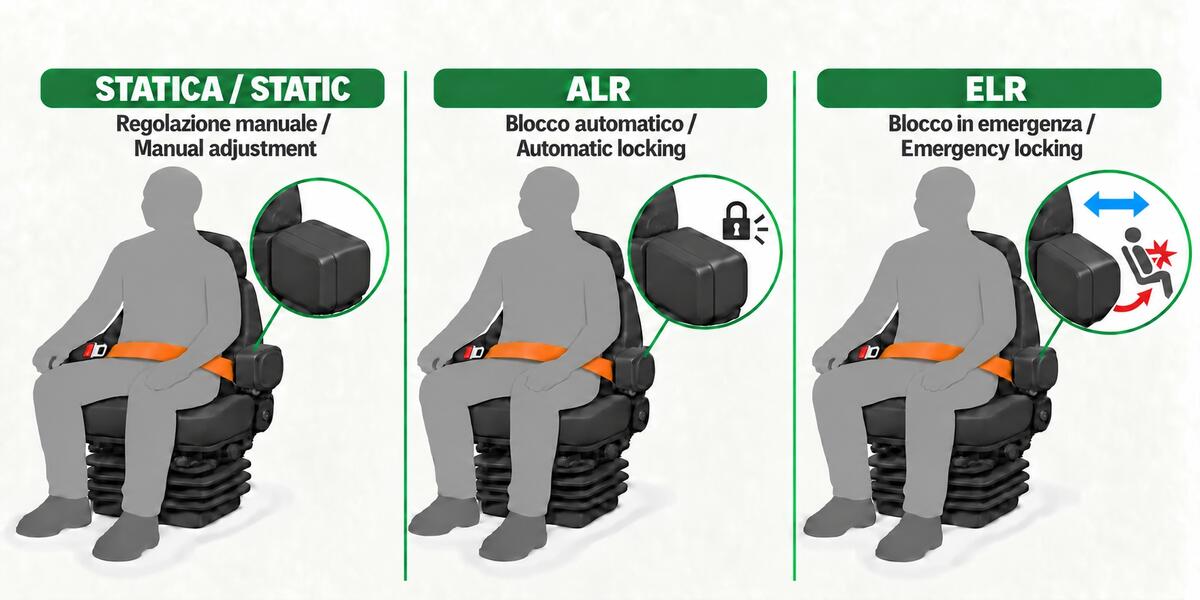
Also called “lap” seat belts, these are very similar to those usually installed on aircraft. They differ mainly in the belt adjustment system: - static belts: they do not have a retractor and must be adjusted manually to adapt to the operator's build. They are simple and inexpensive, but require re-adjustment when changing drivers of the vehicle; - ALR retractor seat belts (Automatic Locking Retractor): the belt is pulled out to the required length and then automatically locked, keeping the belt close to the body. On rough terrain, however, it can tend to become tight and uncomfortable; - ELR retractor seat belts (Emergency Locking Retractor): These allow the driver to move normally and only lock if the belt is pulled out quickly, the vehicle decelerates suddenly, or tilts beyond a certain threshold. These therefore offer greater freedom of movement, but require that the retractor be installed properly. Versions with devices that prevent the progressive tightening of the strap, high-visibility colors or electrical contacts in the buckle are also available.