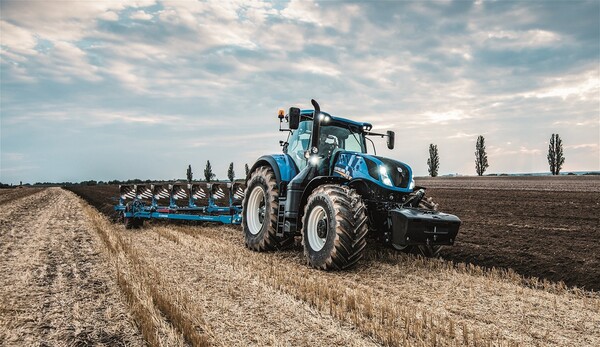
When plowing, power alone isn't enough
Pulling capacity, net power, and stability are the three fundamental parameters for correctly sizing the tractor-plow combination, making the most of the tractor's performance without unnecessary oversizing
Versatility is the agricultural tractor’s defining feature, since, paired with implements, it must handle very different tasks as well as possible: from soil preparation to seeding, from crop treatments to haymaking, and on to material handling and transport. Not to be forgotten is its multifunctionality, which makes it useful in many other sectors, such as forestry, horticulture, floriculture, and nursery operations, as well as road and green-space maintenance, quarry and construction sites, and more. This valuable feature stems from the tractor’s ability to deliver engine power in different ways, depending on the needs of the implement attached at any given time.
Traction, power, and lifting capacity. The tractor can transfer engine power to the implement in different ways. The main (and traditional) way is mechanical: the tractor generates the power to move forward, towing equipment and trailers. The power delivered to the power take-off (PTO) is also mechanical (but rotary), and drives the working parts of many implements, such as rotary harrows, mulchers, and round balers. A further form of power is hydraulic: a pump, still driven by the internal combustion engine, produces a flow of pressurized mineral oil to operate hydraulic cylinders and motors. The lift, which moves mounted implements on the 3-point hitch, is part of the same system.
In plowing (as in many other tillage operations), the main power requirement (i.e., force multiplied by speed) is for draft: during work, the tractor must provide enough pulling capacity to overcome the plow’s resistance as it breaks up the soil. The hydraulic lift, to which the plow is usually attached, plays a very important role in managing the implement: it raises the plow off the ground during turns and transport, but above all it helps adjust the working depth as soil consistency varies. In fact, using data from dedicated sensors, the draft control function makes the lift adjust the implement’s position in the soil to limit load fluctuations on the tractor.
To size the tractor-plow combination correctly, you must therefore consider not only sufficient pulling capacity at the working depth and cruising speed, but also proper load distribution, to keep the combination stable during the auxiliary phases (turning and transport) of the work routine.
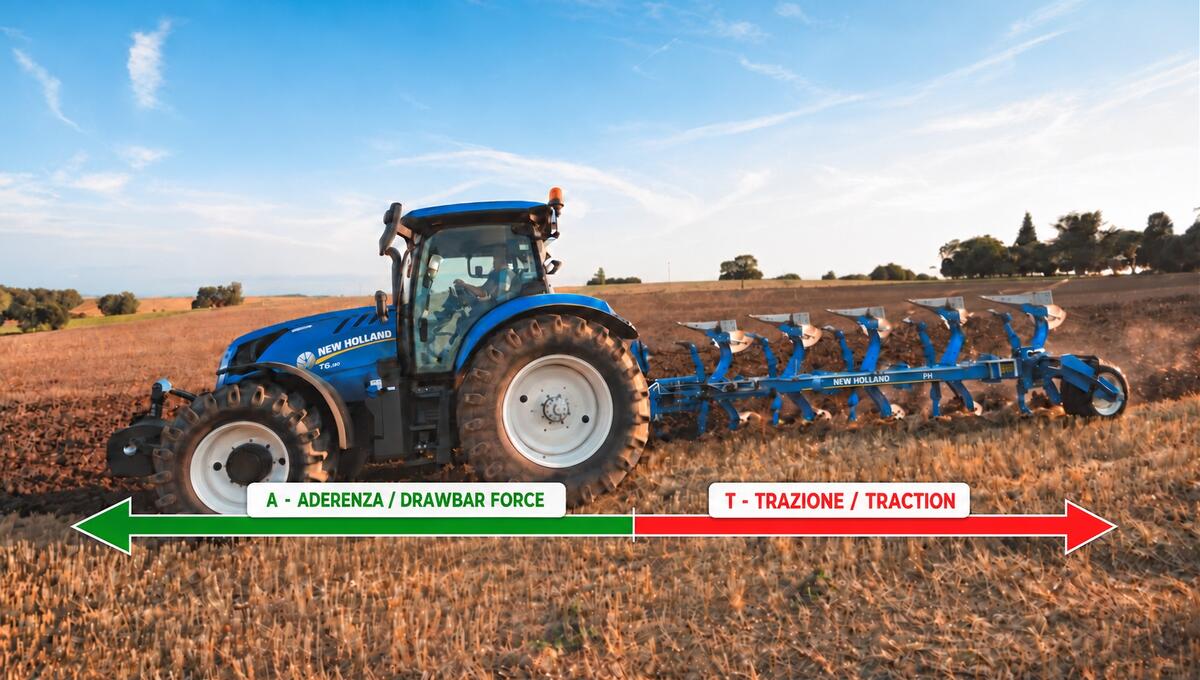
Choosing the right tractor for plowing. The choice of the most suitable tractor must take into account the characteristics of the operation: working width (number of plow bodies), soil characteristics and conditions, cruising speed, etc. These factors determine the draft (T) required by the implement and, consequently, the performance the tractor must deliver. For plowing and, more generally, deep tillage (characterized by high draft requirements), the first check concerns the tractor’s pulling capacity (defined as “traction,” A); next comes the net power (Pu) check, the share of engine power left for the implement after deducting internal losses. Finally, you need to check the stability of the tractor-plow combination, especially important when the plow is off the ground, typically during headland turns and transport.
Traction and draft. Besides the soil’s specific resistance, the draft T required by the plow depends on the cross-section of soil worked, that is, depth multiplied by total working width. Soil texture, moisture content, and degree of compaction can significantly alter the required draft: working just a few centimeters deeper can bring the working parts into more compacted layers (such as the so-called “plow pan,” created by previous operations), resulting in a substantial increase in draft. The tractor’s traction (A), on the other hand, depends on its contact weight, the load distribution across the axles, the tires’ technical and performance characteristics, and the condition of the ground surface. Initially, you should compare the required draft with the available traction, considering the tractor in its standard configuration. If the available traction proves insufficient, you can significantly improve it by adding ballast and/or enhancing the tires’ grip on the ground (see box).
Assessing the required power. Given the nearly constant draft required by the plow, the power the tractor must deliver increases in proportion to the forward speed. The net power available for tillage is not all the power the engine can deliver, because you must subtract the portion absorbed by internal losses, in this case, self-propulsion, the operation of the transmission components and the hydraulic system, and wheel slip.
The tractor must therefore have sufficient net power (Pu) to maintain the desired speed even with normal variations in soil resistance to tillage. Allow some operating margin, without excessive oversizing. A higher forward speed increases productivity and makes better use of the available net power, but it must remain compatible with tillage quality, which here essentially means completely inverting the tilled layer to bury crop residues properly. On the difficult soils of the Mediterranean region (including Italy), plowing speed should not exceed about 10 km/h.
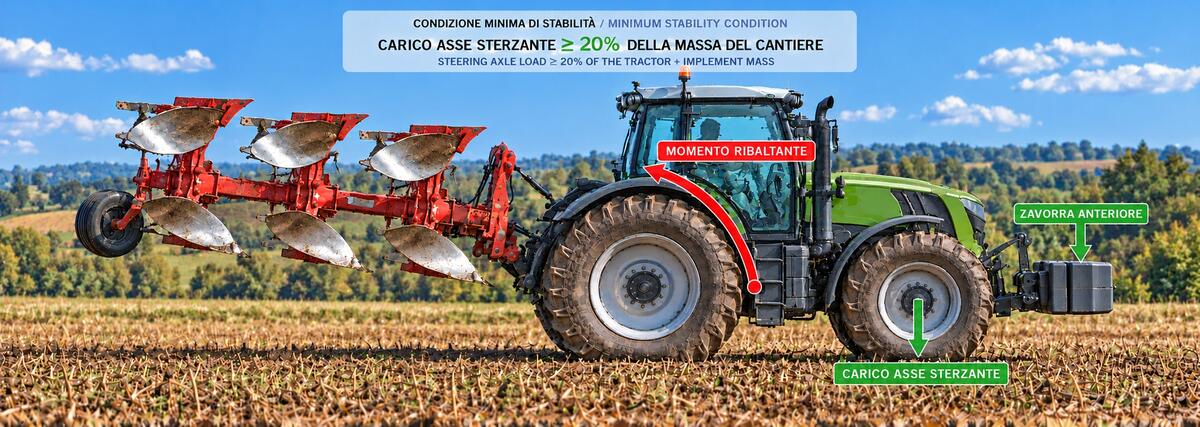
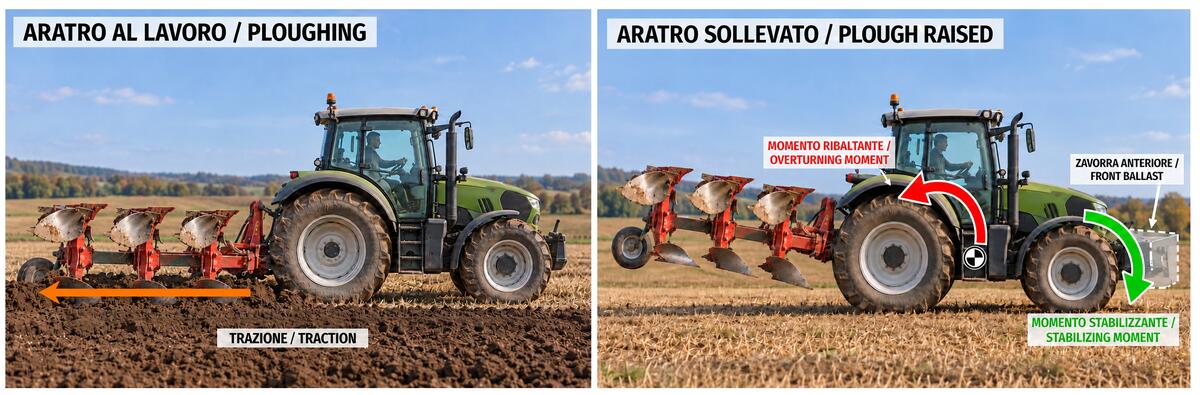
Stability of the combination. Attaching a mounted implement to the lift’s 3-point hitch creates a tipping moment along the longitudinal axis and always transfers load from the tractor’s front axle to its rear axle; both factors can reduce steering efficiency, because the front wheels grip the ground less effectively. For travel on public roads open to vehicular traffic, the Italian Highway Code requires that at least 20% of the mass of the tractor-implement combination remain on the steering wheels under all operating conditions. When plowing, therefore, the check must consider the actual mass of the implement and the distance of its center of gravity from the tractor’s vertical axis of rotation in the event of front-end lift (i.e., the transverse axis passing through the center of the rear axle). The fact that the lift can raise the plow does not, by itself, guarantee a stable and safe coupling. If the residual load on the front axle is insufficient, you need properly sized front ballast capable of creating a sufficient stabilizing moment.
A practical example. Consider an 80 kW, 4-wheel-drive utility tractor weighing about 4,500 kg in its standard configuration, coupled to a 3-body mounted plow. It plows at a depth of 20 cm and an initial speed of 6 km/h on medium-textured soil tending toward heavy, with the soil at optimum moisture for tillage. The plow weighs about 1,800 kg. The first check concerns traction. The draft required by the plow depends on the cross-sectional area of the soil being tilled and the soil’s specific resistance. For this soil, we can assume, as an example, a tillage resistance of 900 N/(m•cm).
Applying a 20% increase factor to account for uneven soil texture and local variations (in moisture and/or compaction, for example) gives a required draft of about 18.3 kN. Since all 4 wheels contribute to pulling capacity, the weight on them helps determine traction. Taking the tractor’s total weight as contact weight, and allowing for soil conditions and rolling resistance, the tractor in its standard configuration can develop 19 kN of traction. The comparison is therefore favorable (i.e., traction exceeds draft); the job is feasible, using almost all of the tractor’s pulling capacity.
The second check concerns available power. As we have seen, internal losses absorb part of the engine power, so not all of it reaches the implement. We can assume the following shares: 10% for self-propulsion (on bare ground or with little crop residue); 12% for the transmission (simple power-shift); 4% for the hydraulic system (with the pump always engaged and normally not under load); 15% for wheel slip (during plowing, the PTO is stationary and therefore does not draw any power).
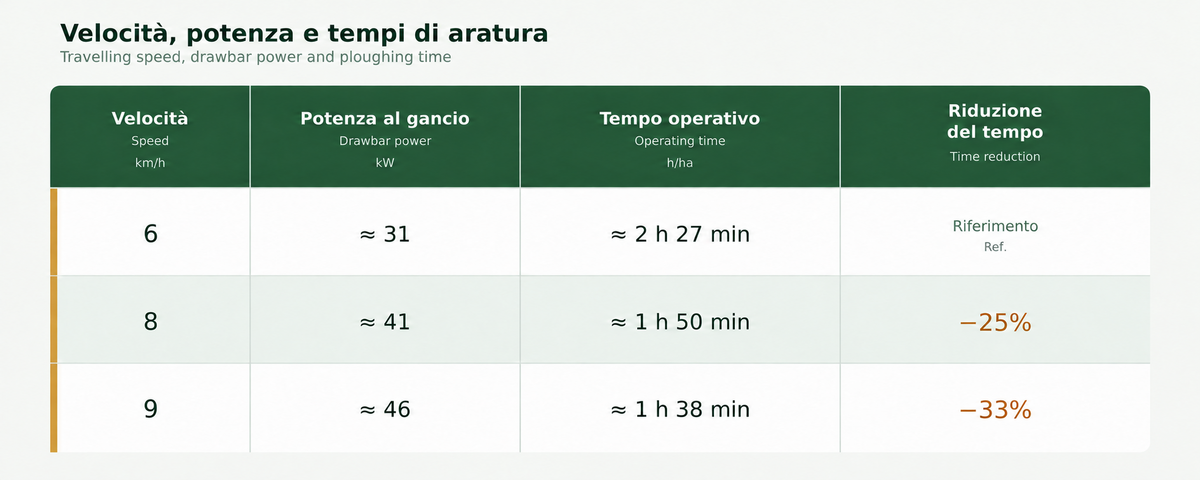
The net power available for tillage is therefore 59% of the rated power, or approximately 47 kW. At an initial speed of 6 km/h (or 1.7 m/s), the required drawbar power is approximately 31 kW. Against the 47 kW available, this leaves a 16 kW reserve that could be put to good use by plowing faster, while taking care to maintain work quality. If soil conditions and plowing quality permit, you can use the available unused net power to increase the forward speed. Assuming, as a first approximation, that the plow’s draft stays constant, increasing the speed from 6 to 8 km/h reduces the time required to plow one hectare of land by approximately 37 minutes (a 25% reduction). At 9 km/h, the time savings increase to about 49 minutes (a 33% reduction).
Keep in mind that, as mentioned, to preserve plowing quality the operating limit on Mediterranean soils is around 10 km/h.
The third check concerns stability. With the plow raised, the implement’s mass and the rearward position of its center of gravity create a tipping moment, which at the same time transfers load from the front axle to the rear axle. In this example, the total mass of the combination is approximately 6,300 kg.
The load on the steering wheels must not fall below 1,260 kg; at exactly that limit, the rear axle would carry about 5,040 kg.
You must therefore also check the combination’s suitability by comparing these values with the maximum allowable mass, the tire load ratings, and the lift capacity at the actual distance of the plow’s center of gravity.
To rebalance the combination, size any front ballast according to the stabilizing moment it can generate. As a rule, it should not exceed 20% of the weight of the tractor alone.
Increasing the tractor’s pulling capacity
If plowing proves difficult, before switching to a more powerful, and therefore heavier, tractor, you can effectively improve the tractor’s setup with solutions that require increasing effort (and cost).
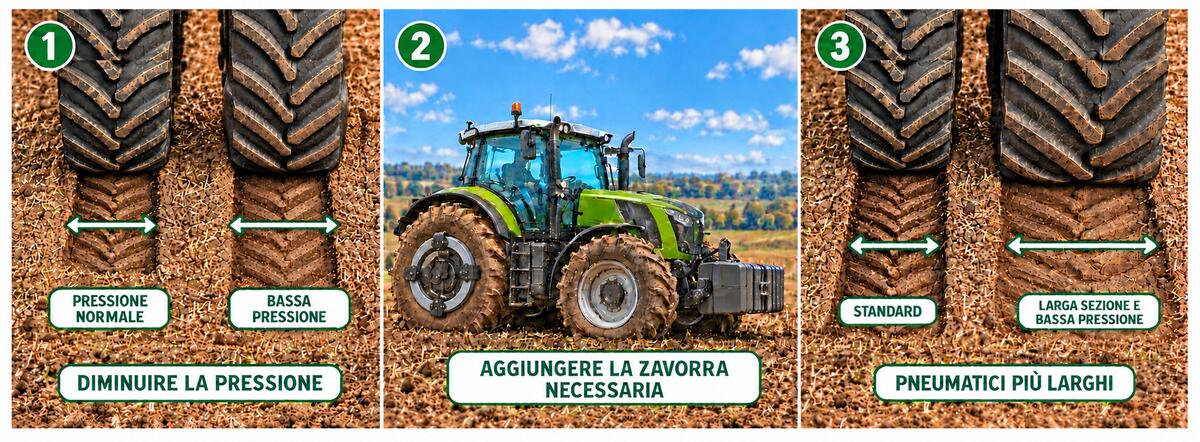
Reduce tire pressure. For field work only, you can lower the tire pressure to the minimum compatible with the axle load, working speed, and the manufacturer’s specifications. Lower pressure enlarges the contact patch, improving tire-soil interaction and the grip of the lugs on the ground.
Add ballast. If lowering the pressure is not enough, you can increase the contact weight by adding appropriately sized and distributed ballast. Add only the weight you actually need, to prevent a harmful increase in rolling resistance (which raises diesel consumption) and, above all, soil compaction. Ballast is therefore not advisable on wet soil or when working seedbeds, where the tractor’s wheels could sink too deep.
Use wide-section tires. This is undoubtedly a bigger step, as it means replacing not only the tires but also the rims. The latest versions of these tires are also designed to work effectively below standard pressures. The wider contact patch improves pulling capacity and spreads the load over a larger area.
Many contractors equip their tractors with wide, low-pressure tires from the outset; this setup lets them work efficiently on different soils and in different operating conditions, making good use of the available power while limiting both wheel slip and ground pressure.