Machinery for tackling soil erosion and landslides
Cultivated slopes, terraces and forests cover extensive areas that are often difficult to access. Preventive measures and routine maintenance are therefore essential to protect the landscape, with machinery playing a key role
We should not regard hydrogeological instability as an exceptional phenomenon to address only after a landslide or flood. It is the result, often a gradual one, of the interaction between heavy rainfall, the geological and morphological characteristics of the terrain, the abandonment of rural land management works, the deterioration of the drainage network, and improper management of vegetation cover. Dry-stone walls, earth-bank terraces, ditches, channels, forest roads, and small drainage crossings are closely interconnected elements of a single system: if any one of them loses its effectiveness, water can concentrate, erode the soil, and trigger instability.
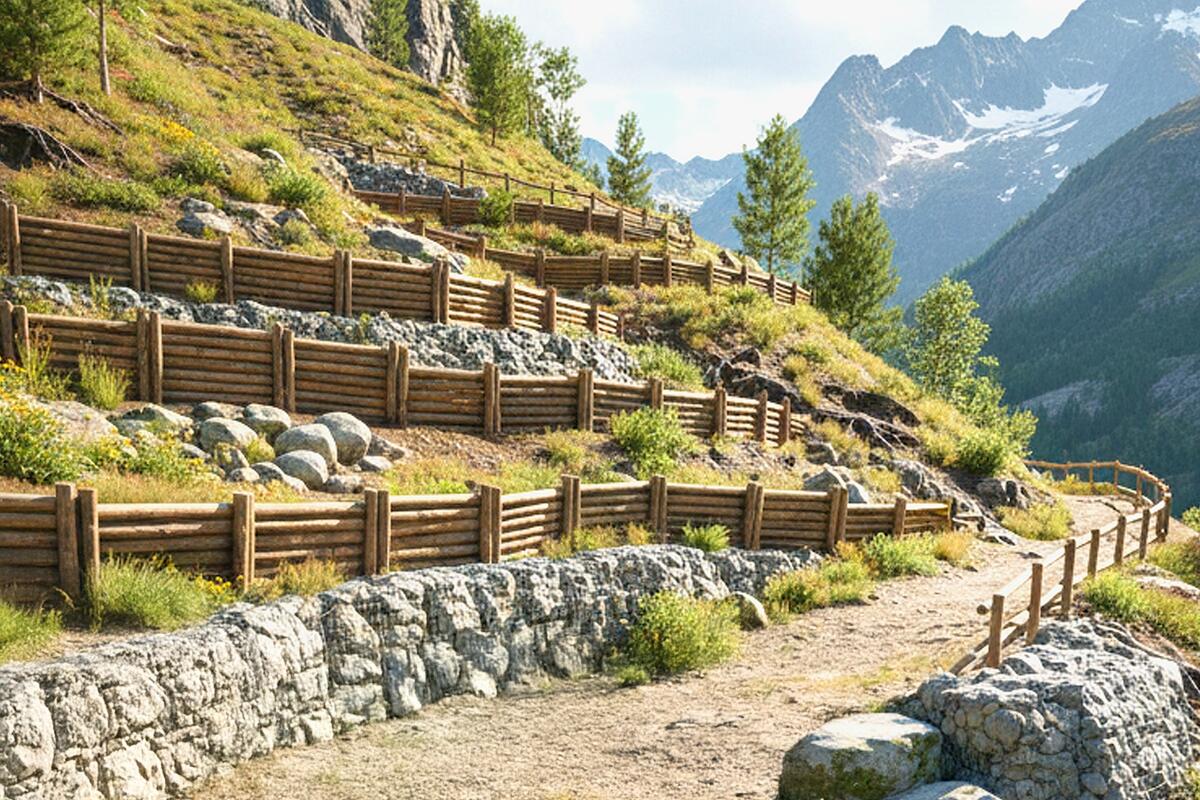
Soil bioengineering is the foundation for the coordinated use of soil, water, and vegetation, supplemented by natural materials. We should not see timber crib walls, brush layering, vegetated gabions, erosion control mats, and bank restoration exclusively as “green” measures carried out for purely aesthetic or landscape purposes: their design must take into account the slope, the nature of the soil, the reasonably expected water volumes, and the rooting capacity of the sown or transplanted plant species.
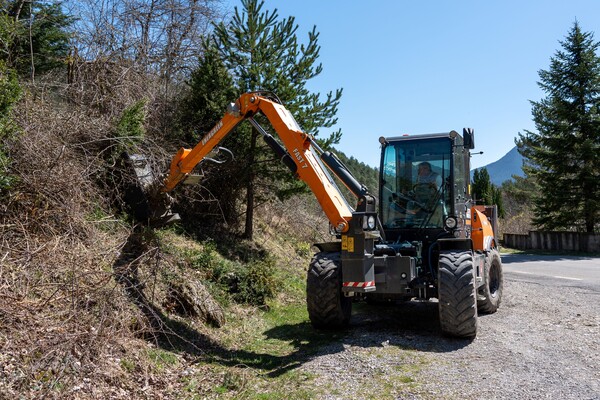
The implementation phase must also necessarily take into account the actual feasibility of moving earth and materials without further compromising the soil, root systems, and pre-existing structures. To this end, compact excavators, specialized tractors, and forestry winches are undoubtedly useful: they do not replace the work of geologists, agronomists and foresters, and qualified technicians, but they make implementation feasible even on fragmented, narrow, and sloping plots. The choice of the most appropriate machine depends on its weight, stability, overall dimensions, ground pressure of the running gear, visibility, and equipment, all factors that directly affect the efficiency and safety of the worksite.
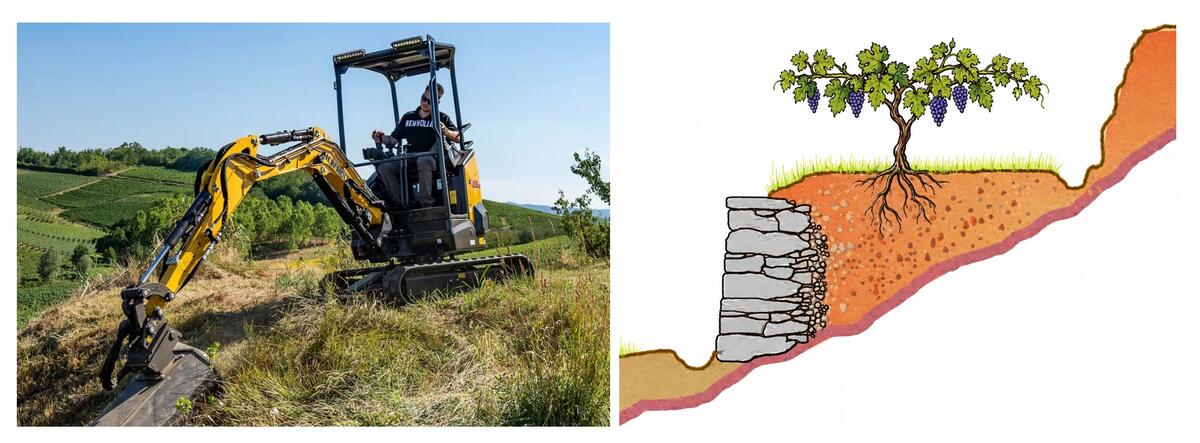
Terraces: preserving geometry and managing water. Agricultural terraces serve important functions related to production, landscape, and water management. The retaining wall supports the soil, but its durability depends largely on what happens upslope and downslope: water interception, the presence of drainage systems, the correct profile of the cultivated area, and the maintenance of the terrace edges. When an embankment deteriorates, the solution cannot be reduced to simply adding soil. First and foremost, operators need to remove the unstable material, rebuild the gradients, restore diffuse runoff, and put back the retaining or revegetation elements originally present.
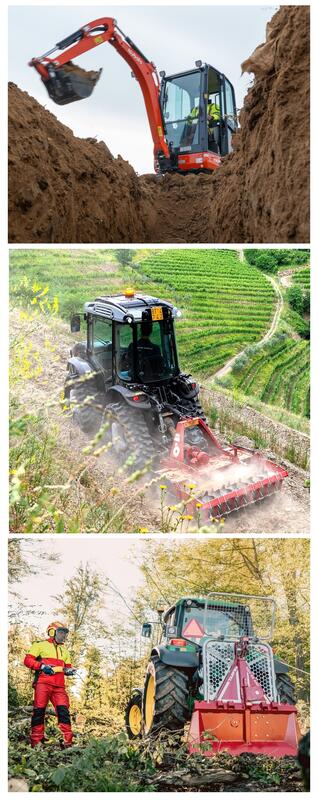
Thanks to its ability to operate in confined spaces, the compact excavator is a machine that proves particularly effective for these types of jobs. Models with reduced tail swing, featuring a variable-width undercarriage or retractable tracks, can access narrow terraced areas and work close to walls, rows of plants, or structures. If necessary, the machine can be equipped with a front blade to stabilize it and, when needed, allow for minor finishing work, while the swing boom facilitates excavation and grading along the edge without having to constantly reposition the machine. Narrow excavation buckets, ditch-cleaning buckets, tilting buckets, and sorting grapples allow for alternating between earthmoving, placing stone, leveling the surface, and handling any residual material.
However, the machine’s compact size requires special attention to ensure stability during all phases of work. The center of gravity shifts with the extension of the boom, the load in the bucket, and the swing of the upper structure: access platforms, bearing capacity checks, safe maneuvering areas, and, if necessary, specific anchors are required. It is important to limit repeated passes and excavations that could undermine the toe of the wall. In soil bioengineering projects, the excavator demonstrates its full versatility, capable of shaping a slope to gradients suitable for revegetation, digging drainage trenches, cutting benches, placing boulders or timber for a specific crib wall, and distributing topsoil.
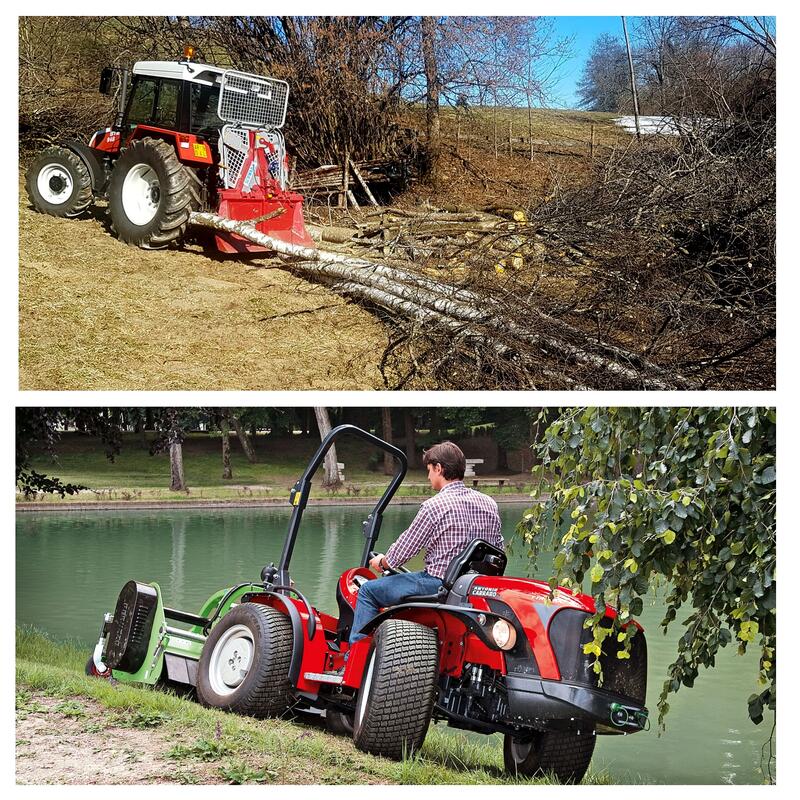
Specialized tractors: traction, versatility, and soil conservation. Where passage widths are narrow, vegetation is dense, and slopes are steep, the specialized tractor is often the logistical backbone of the worksite. Models designed for vineyards, orchards, and mountain work, with an articulated frame and isodiametric wheels or 4-wheel steering, combine compact dimensions with a short wheelbase for excellent maneuverability. Versions with a reversible driving position are ideal for working with mulchers, winches, stump grinders, chippers, brush-cutter arms, and field ditch maintenance equipment, as the operator can maintain a direct view of the implement, which improves precision and promotes better working posture.
For these vehicles, the primary requirement is not maximum power, but rather available traction: wide-section radial tires with low inflation pressure, properly sized ballast correctly positioned on the vehicle, and, where site conditions permit, tracks or half-tracks (strictly rubber) help reduce slippage and soil compaction. Four-wheel drive and the locking of both differentials help resolve challenging operating situations, but they must not become an invitation to work beyond stability limits. In these situations, a correctly set up ROPS plays a fundamental role in preventing fatal rollovers, closely combined with the effective and diligent use of the seat belt and supplemented by specific training for working on slopes.
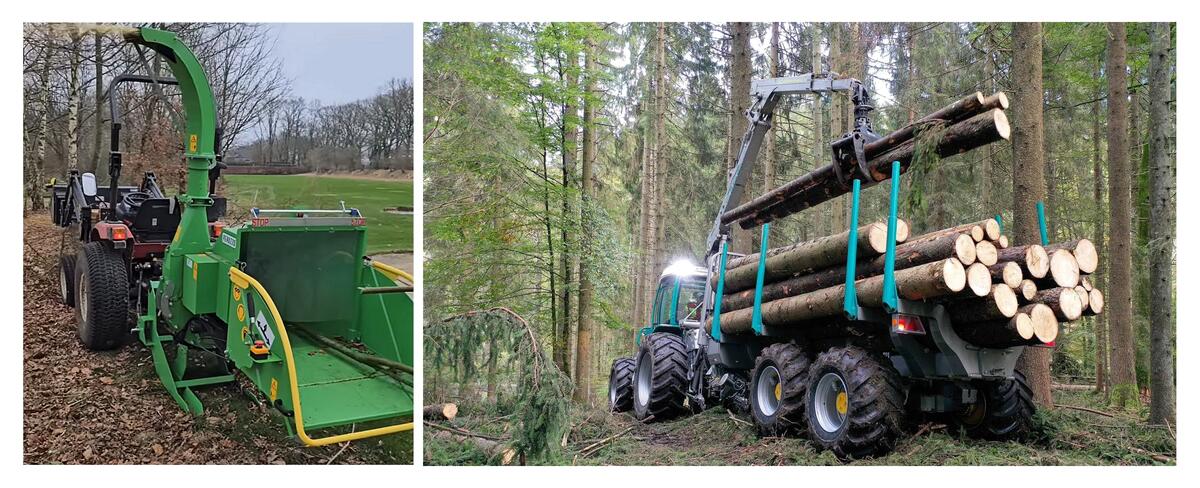
Thanks to a particularly wide range of available attachments and its numerous features, the agricultural tractor is useful for countless operations: it can transport poles, light stone, fascines, plants, and tools; operate a pump for hydroseeding or wetting revegetation materials; power a wood chipper; mulch regrowth and maintain inter-rows, etc. In forested areas, when paired with a forestry trailer and a crane, it can harvest and haul out small- and medium-diameter timber, provided there is adequate road access. However, the tractor’s high versatility requires a methodical approach: implements with excessive overhang, overloaded trailers, and work phases that raise the center of gravity (such as when handling loads with crane booms) are critical factors that must be carefully evaluated.
Forests and riparian zones: selective maintenance, not simplification. Forest management must be distinguished from generic “forest clean-up.” A stable and well-maintained vegetation cover protects the soil from the direct impact of rain, promotes infiltration, and consolidates the surface layers with strong, well-developed root systems; conversely, blocked channels, woody material accumulated in riverbeds, or deteriorated water regulation works can exacerbate the effects of flooding.
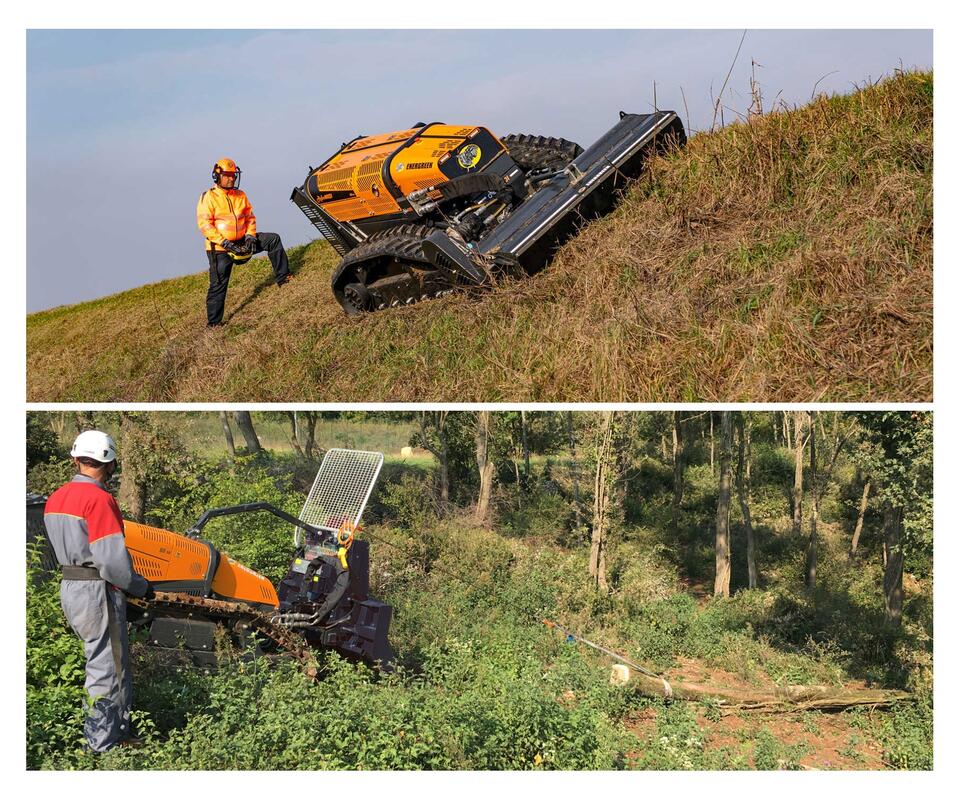
On very steep slopes, a forestry winch reduces the need to drive the tractor all the way to the base of the tree. The cable allows material to be hauled from a safer position, minimizing the need to create new trails and reducing traffic on the most vulnerable areas of the ground. In the context of soil bioengineering, the winch can assist in removing windthrown or unstable trees, handling timber for crib walls and check dams, and retrieving materials along slopes. On more complex slopes, operators also use hoists and radio-controlled tool carriers, which keep them in a safe position when working on cross-slopes.
Compactness, control, and safety. The machines designed for these worksites are not derived from the traditional open-field agricultural sector, but rather from the construction, specialized agricultural, and forestry sectors. The common goal is undoubtedly to ensure greater operational capacity without increasing the machine’s footprint, combining digging or traction power with features that help the operator work with greater precision, ideally at a safe distance from hazardous areas.
For compact excavators, the evolution primarily concerns mobility in confined spaces. Variable-track undercarriages, retractable tracks, zero or reduced tail swing, and swing booms are now common solutions in the lighter weight classes. New cabs and operator stations improve visibility, ergonomics, and controls, while auxiliary hydraulic systems and quick-couplers speed up the switch between an excavation bucket, a tilting bucket, a hammer, a grapple, and a mulcher. There is a significant increase in focus on electric powertrains or reduced diesel consumption, a feature highly valued in areas sensitive to noise and/or air pollution. The most interesting innovation for water regulation works, however, is the widespread adoption of excavation assistance features: tilt sensors, laser guidance, and 2D or 3D systems can help ensure that the elevations and slopes of ditches, benches, and bedding surfaces are maintained, reducing the need for rework and unnecessary movements.
In specialized tractors, innovation is advancing along three lines: stability, visibility, and versatility. While a low center of gravity, narrow track widths, an articulated chassis, or isodiametric wheels remain the cornerstones of their design, evolution is focused on more advanced transmissions and the widespread adoption of electro-hydraulic controls, more comfortable cabs, and an ever-expanding range of hydraulic spool valves. The reversible driving position continues to be a valuable feature for working with rear-mounted implements in tight spaces. The range of fully electric or hybrid models is also expanding, as are connectivity and diagnostic solutions. For soil bioengineering worksites, the ability to properly configure the machine is paramount: tires, ballast, underbody guards, the PTO, and attachments must be selected as a complete package, not added later and separately.
For forestry winches, given that the current leap in quality is the professional radio-controlled version, models featuring proportional controls, brakes, and advanced rope management systems are particularly popular, along with solutions to reduce friction during unwinding and maintain smoother traction across the different rope layers on the drum.
However, there is no ideal machine for tackling hydrogeological instability: the right choice must take into account the nature of the slope and the task at hand. A very compact mini-excavator may be ideal for rebuilding a field ditch, but unsuitable for moving large boulders; a low-profile, reversible tractor can handle the maintenance of a terrace, but should not be used to access unstable areas; a winch can prevent damaging vehicle traffic, but requires reliable anchor points and trained operators. When integrated into a coherent project and supported by ongoing maintenance, these machines transform from simple worksite equipment into practical tools for prevention.
Hydroseeding machines
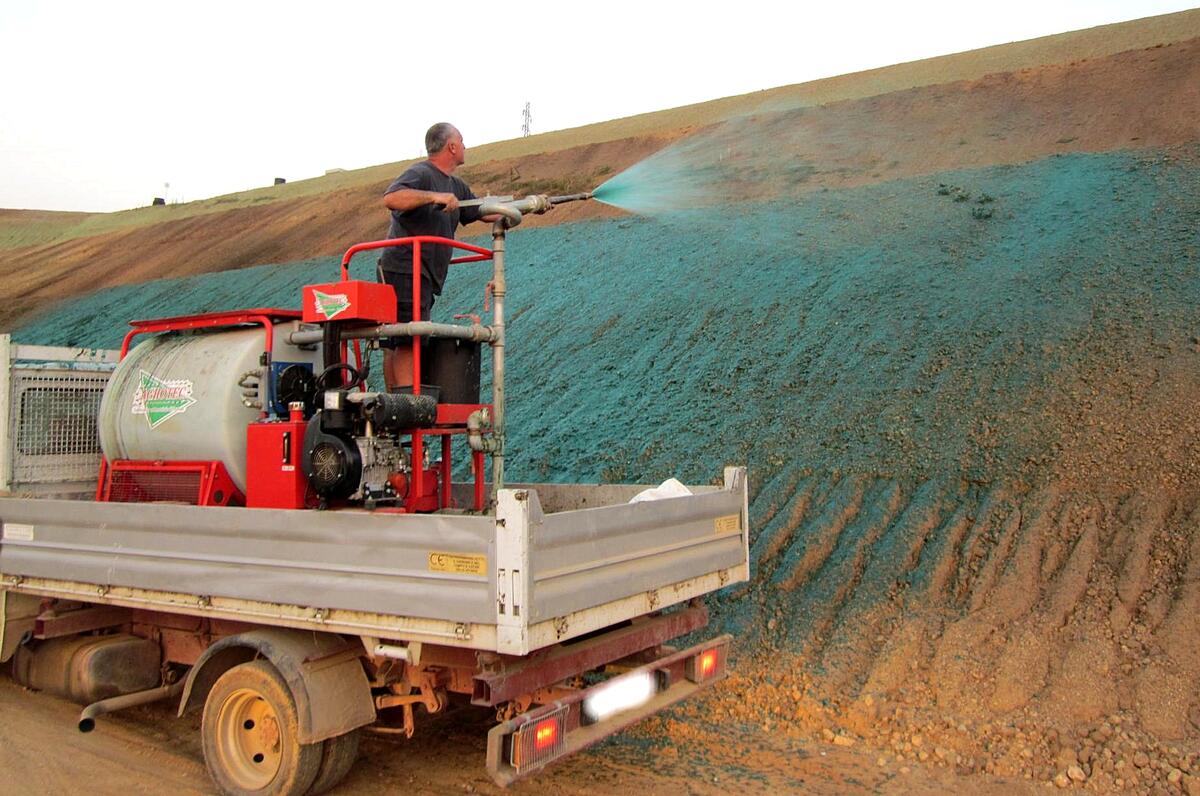
Hydroseeding is an effective technique for revegetating degraded surfaces such as road and railroad embankments, levees, landfills, and quarry faces, helping to limit erosion caused by rain impact and the resulting runoff, which is particularly damaging during the vegetation establishment phase. A single pass distributes water, seeds, fertilizers, soil conditioners, and mulch fibers, plus tackifiers when necessary.
Mounted on a trailer or truck, or carried by a tractor, the machine that performs the operation described is the hydroseeder, consisting of a mixture tank, an agitation unit, and a recirculating pump system.
The tank, made of painted steel or fiberglass, can have a capacity ranging from a few hundred to 10,000-15,000 liters; it is equipped with a loading hatch with a safety filter, a level indicator, a bottom drain, and access for internal cleaning. Agitation is mechanical, using paddles, or hydraulic, via a recirculation flow, to keep seeds and organic components properly suspended, preventing the formation of fibrous clumps that can clog the pump, valves, and nozzles. A high-flow centrifugal pump supplies the spray lance, which can be manually aimed or, on higher-capacity machines, mounted on a swiveling turret. Shut-off, bypass, and control valves let the operator adjust the spray flow without interrupting recirculation within the tank. The spray range (up to 40-50 m for the largest units) depends on the available head, the density of the suspension, pressure losses in the piping, and the nozzle cross-section.
Operators must load the mixture in a precise sequence: first water and soluble products, then fertilizers and soil conditioners, followed by seeds, fibers, and binders. Dosages depend on the slope, soil texture and fertility, climate, and the plant species to be sown. Cellulose, wood, or straw fibers reduce evaporation and rain splash; natural or synthetic binders increase the cohesion of the distributed layer, which is particularly useful on steeper slopes. In environmental restoration projects, mixtures of hardy and perennial species compatible with local soil and climate conditions are preferred. For projects requiring immediate results, fast-emerging species such as Italian ryegrass and cereals are preferred; permanent mixtures favor hardy, strong-rooting grasses such as fescue, bluegrass, and orchardgrass. On poor soils, legumes are included, while native species are preferred in land reclamation projects. Specific formulations are required for arid, saline, or unstable areas.